The short version
Rodent control in Baton Rouge, Louisiana, comes down to closing every opening larger than half an inch, the LSU AgCenter standard for rats, plus quarter inch gaps for mice, and then trapping what is already inside. With an average winter low near 43F, roof rats and Norway rats keep breeding through the whole year, so a bait-only plan rarely ends the problem.
- LSU AgCenter tells Louisiana homeowners to seal every opening wider than half an inch.
- Mice still fit through quarter inch gaps, so door sweeps and pipe sleeves matter.
- Winter nights averaging 43F never pause breeding, so pressure runs all twelve months.
- Roof rats favor attics; Norway rats burrow along slabs and in wet, low ground.
- Anyone placing bait for you should hold a Louisiana LDAF pest control license.
Read this if you own or rent in Baton Rouge and have heard movement in the attic, found droppings in a pantry, or watched a rat run the fence line at dusk. It also fits landlords with rentals near LSU fielding tenant complaints, and owners of small commercial or industrial buildings who need a company licensed for vertebrate work rather than a general bug service.
What to look for
Three species matter most around Baton Rouge, and the LSU AgCenter groups them together in its household pest guide: the Norway rat, the roof rat and the house mouse. They divide a house between them. Roof rats climb, so they arrive by tree limbs, power lines and fence tops and settle into attic insulation. Norway rats dig, tunneling beside slabs, under sheds and along drainage ditches before pushing in at ground level. House mice take whatever gap is left, nesting in cabinets, wall voids and even inside appliances, where they chew wiring. Local conditions keep all three busy. At 56 feet of elevation with 61 inches of annual rain, the ground stays wet for much of the year, and heavy downpours can flood burrows and send Norway rats toward drier shelter such as a crawlspace or garage. Humidity averaging 76 percent softens fascia and soffit boards, which makes chewing an entry easier for roof rats. Mild winters mean the fall surge simply adds to animals that never stopped breeding.
- 1Thumping or scurrying overhead in the first hours after dark, when roof rats leave the attic to feed.
- 2Capsule-shaped rat droppings near the water heater, or rice-grain mouse droppings in a utility drawer.
- 3Greasy brown rub marks along rafters, pipe runs or the top of the foundation where rats travel the same path nightly.
- 4Fresh holes beside the slab, under the AC pad or at the base of a shed, with loose soil pushed out.
- 5Shredded insulation, paper or fabric balled into a nest behind the refrigerator or under the dishwasher.
- 6An appliance that suddenly quits because the cord or the wiring behind it has been gnawed.
- 7A dog or cat fixated on one wall, vent or cabinet and refusing to walk away.
Why it’s worth acting soon
- UC IPM puts Norway rats at four to six litters a year, so an August sighting can be a colony by spring.
- Gnawed wiring in attics and appliances is a fire and repair risk that grows every week rodents stay.
- Urine and droppings soak into insulation, which then has to be bagged and replaced rather than wiped.
- Rat urine in standing rainwater is how leptospirosis spreads, and wet yards give it plenty of chances.
- Established rats learn their routes and avoid new objects, so trapping gets slower the longer you wait.
Seal all openings larger than 0.5 inchLouisiana rat-proofing standardLSU AgCenter Every 5 to 10 feetMouse trap or bait spacing in heavy infestationsLSU AgCenter At least 3 ouncesMinimum bait per tamperproof stationLSU AgCenter Treatment options and typical costs
Exclusion and rodent proofing
Quoted after inspection
The provider walks the roofline, soffits, foundation and utility penetrations and closes every opening wider than half an inch with hardware cloth, sheet metal or concrete, which is the LSU AgCenter benchmark for rats. Gaps down to a quarter inch get attention where mice are the concern. This is the step that stops new animals from moving in.
- Time
- One to three days for most houses
- Best for
- Any home with repeat activity or attic rats
Interior snap trapping
Quoted after inspection
Snap traps set along walls and runways remove the rodents already inside once the openings are closed. LSU AgCenter suggests a trap or bait placement every 5 to 10 feet in heavily infested areas, since mice stay close to the nest. Glue boards are listed as an option where bait is not acceptable, though many households prefer snap traps.
- Time
- Several weekly checks
- Best for
- Mice in kitchens and rats already in the attic
Exterior tamperproof bait stations
Quoted after inspection
Locked stations along the foundation and fence line intercept Norway rats before they reach the house. The LSU guide calls for every rodenticide to go in a tamperproof station holding at least 3 ounces of bait per placement. Ask exactly where each station will sit and how often it will be serviced, especially with pets or children in the yard.
- Time
- Ongoing, usually monthly service
- Best for
- Properties with burrows or neighboring rat pressure
Sanitation and attic cleanup
Quoted after inspection
Removing droppings, nests and soiled insulation after the rodents are gone, using the CDC method of airing the space for 30 minutes, soaking everything in a 1 to 9 bleach solution for 5 minutes, then wiping up. Insulation removal and replacement is a separate, larger job that most companies price on its own.
- Time
- One day to several days
- Best for
- Attics with heavy droppings or flattened runways
Prices are typical published ranges. Ask what’s included before you compare quotes.
 Clutter gives mice cover. Keeping stored fabric in lidded bins and off the floor takes away the nesting spots they like best.
Which rodent is living in my Baton Rouge house?
Where you find the evidence usually tells you the species. In Baton Rouge, roof rats claim the attic, Norway rats claim the ground floor and the soil around it, and house mice take the kitchen and the wall voids in between. Roof rats are slim and agile enough to run a power line. They come in from the top: a gable vent, a gap where roof meets wall, a soffit corner that constant humidity has turned soft. UC IPM notes they raise three to five litters a year of up to eight young each. Norway rats are heavier and they dig. Look for holes beside the slab, under the AC pad and along drainage ditches, especially after a downpour fills their tunnels with water. House mice are the smallest and the most likely to show up inside living space. The LSU AgCenter points out that they nest inside appliances, chew wiring, and can carry the same diseases as rats. Knowing which one you have tells a provider where to start.
A month-by-month rodent calendar for Baton Rouge.
Rodent activity in Baton Rouge never shuts off, but it shifts through the year in a pattern you can plan around. January through March: cool, wet nights near the 43F average low keep rats close to shelter. This is a smart window to seal the house, because the animals inside are concentrated and easier to trap. April through June: breeding has not stopped all winter, so young rats are out exploring. Expect new burrows near slabs and fresh noise overhead. July through September: highs average 92F, so rodents feed at night and go looking for water. Leaky AC drip lines, pet bowls and pool equipment become gathering points. Any heavy rain that floods burrows can push Norway rats toward garages and crawlspaces. October through December: the fall surge. Cooler nights send mice and rats indoors in larger numbers, layered on top of the ones that never left. If you had activity last year, book an inspection before this season starts.
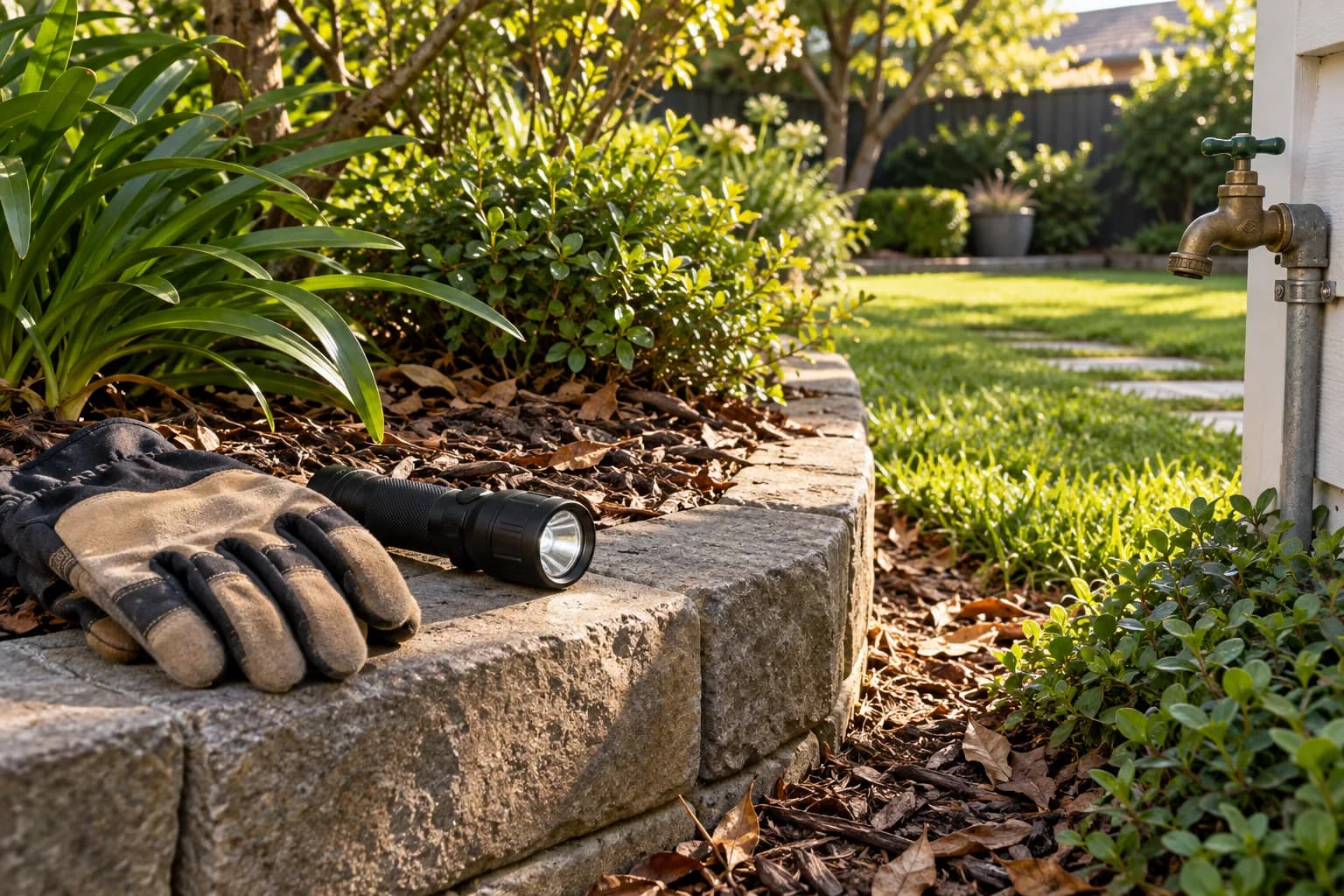 Dense shrubs against the house and a dripping hose bib give rodents cover and water. Trimming back and fixing drips makes the yard less inviting.
What should a first rodent inspection include?
A useful first visit is mostly looking, not baiting. Expect the provider to walk the exterior, climb into the attic, check under the house or along the slab, and then hand you a written list of openings with photos. The LSU AgCenter guide gives you benchmarks to hold that visit against. Any opening larger than half an inch should be sealed for rats. In heavily infested areas, traps or bait placements for mice go every 5 to 10 feet, because mice do not wander far from the nest. Rodenticide belongs in tamperproof stations with at least 3 ounces per placement. If someone scatters loose bait in a Baton Rouge attic, or skips the roofline entirely, ask why. A rat that dies inside a wall void during a 92F summer becomes an odor problem for weeks. A solid inspection ends with the entry points documented, a sealing plan in writing, and a schedule for coming back to check traps.
How do I know a Louisiana rodent company is properly licensed?
Louisiana licenses structural pest control through the Department of Agriculture and Forestry, and rodent work sits in one of two categories. LP1 is general pest control. LP2 is commercial vertebrate control, a category worth asking about if you run a warehouse, restaurant or industrial site in a petrochemical economy. A few LDAF details show how the system works. Every place of business pays an annual permit fee of $150 with two or fewer employees or $200 with three or more, and those permits expire June 30. Licensees recertify every 3 years. Technicians have to be registered within 30 days of starting and complete at least 4 hours of recertification training annually. You do not need to memorize any of it. Ask for the license number and category, ask whether the person coming to your Baton Rouge home is a registered technician, and if the appointment falls in late June, confirm the company's permit has been renewed.
Cleaning up after rats in a humid attic.
Cleanup is where many people put themselves at risk. The CDC is blunt about it: do not sweep or vacuum droppings, because both lift contaminated dust into the air you breathe. Start by opening the attic or room and letting it air out for 30 minutes. Mix 1.5 cups of household bleach into a gallon of water, roughly one part to nine, and spray droppings, urine stains and nest material until soaked. Wait 5 minutes, wipe everything up with paper towels, and bag it. Keep rubber or plastic gloves on the whole time. Baton Rouge humidity, averaging 76 percent, raises the stakes. Damp insulation holds urine and odor longer and can start growing mold once it is soiled. If a large section is stained or packed down into runways, removal and replacement usually makes more sense than spot cleaning. Ask whether the provider does that work or refers it out, and get it priced as its own line.
What affects the price
- How many openings the roofline has, and whether humid weather has softened fascia that must be replaced before it can be sealed.
- Whether rats are in the attic, under the house, or both, since each zone is sealed and trapped separately.
- Homes raised on piers expose more underside to inspect and screen than a slab house does.
- How much insulation is soiled and needs removal before the attic can be sanitized.
- The number of follow-up trap checks and station visits written into the agreement.
- Commercial or industrial sites, which call for a provider licensed in commercial vertebrate control.
📊
What's your biggest concern about rodents?
When to call for help
Bring in a professional once you are seeing signs of rats rather than a lone mouse, when droppings turn up in two or more rooms, or when attic noise continues for more than a week. Those patterns point to an established nest and an entry point you have not found yet. In Baton Rouge, attic rats deserve a full roofline inspection because roof rats come in high, and closing those gaps means ladders, sheet metal and sometimes soffit repair. Call sooner if someone in the home has a weakened immune system, or if the problem is in a restaurant kitchen, warehouse or plant where a commercial license applies.
What you can do yourself
Paying once for proper sealing usually beats buying traps all year. A licensed provider brings the ladders, the metal and a trapping schedule, and should follow the LSU AgCenter practice of keeping any rodenticide in tamperproof stations. Roof rats mean working the ridge, gable vents and soffits, often replacing wood the humidity has softened, and Norway rats under a slab need burrow work plus exterior stations. Rats are a different job. If catches stop after a week or so, you probably solved it. Set snap traps baited with peanut butter along the wall behind the stove and refrigerator, add a sweep to any door with daylight under it, and pack steel wool into pipe holes under the sink before caulking over it. Doing it yourself is fair game for a mouse or two in a kitchen you caught early.
Rodents in Baton Rouge
Baton Rouge has about 220,000 residents and wears several hats at once: state capital, college town around LSU, and petrochemical hub. Each of those shapes the rodent picture a little. Dense urban blocks put homes, restaurants and dumpsters close together, which shortens the trip a rat makes for food. If you rent near LSU, report droppings and gaps to the landlord in writing as soon as you find them. Louisiana has a separate license category for commercial vertebrate control, so the owner of a plant, warehouse or shop in this petrochemical economy should ask which category a company holds. The city was founded in 1699, and if your own house is an older one, expect more gaps at the foundation, eaves and pipe runs. With a median home value near $220,000, a written sealing job is modest next to rewiring an attic.
Local research
Rodents in Baton Rouge, LA: what the public record shows
Before you compare quotes, it helps to know which rodents actually live in Louisiana, when they are busiest around Baton Rouge, and what the state figures look like. Everything below links to the agency or university page it came from.
Rat-proofing gap size
LSU AgCenter: rat-proof all buildings by sealing all holes and openings larger than 0.5 inch.
LSU AgCenterBait or trap spacing for mice
Mice hide anywhere and do not move far from nests; glue boards and traps work where baits are not acceptable.
LSU AgCenterMinimum bait per placement
All rodenticides should go in tamperproof bait stations per the LSU guide.
LSU AgCenterRodent species recorded in Louisiana
- House mouse (Mus musculus) — Enters at 1/4 inch; 5-10 litters per year; eats about 200 small meals a night.
- Norway rat (Rattus norvegicus) — Burrowing rat of basements, sewers and ground floors; tail shorter than head plus body.
- Roof rat (Rattus rattus) — Climber of attics and trees in warm and coastal regions; tail longer than head plus body.
When rodents are busiest around Baton Rouge
Year-round, fall surge. Roof rats dominate Florida, Texas and Gulf Coast attics.
Based on Baton Rouge’s humid subtropical climate profile.
LSU AgCenter's guide treats Norway rats, roof rats and house mice together; mice nest in appliances and chew wiring and can carry the same diseases as rats.
Rules that apply in Louisiana
For context, nationally
- 1/4 inch (the width of a pencil) — Smallest gap a mouse can enter. CDC
- 890; 35% fatal; 94% west of the Mississippi — Hantavirus cases reported since 1993 (through 2023). CDC
Sources: LSU AgCenter; CDC; Pest Notes: House Mouse; Pest Notes: Rats. Figures are quoted as the source prints them. How we check our sources
Simple ways to keep rodents away
- Trim limbs and vines well back from the roof so roof rats cannot step onto the shingles.
- Seal every hole wider than half an inch with hardware cloth, sheet metal or mortar, as LSU AgCenter advises.
- Pack steel wool around plumbing and AC line penetrations, then cap it with sealant so it stays in place.
- Fit a sweep to the garage door, because a quarter inch gap at the bottom is enough for a mouse.
- Store pet food and birdseed in metal or heavy plastic bins with tight lids.
- Clear stacked lumber, debris and dense groundcover away from the foundation where Norway rats like to dig.
- After a heavy storm, walk the foundation and look for new burrows or soil pushed out beside the slab.
- Replace soft, water-stained soffit and fascia boards before a rat finds the weak spot.
 Before you call, sketch where you have seen droppings or heard noise and measure any gaps you found. It makes the first visit faster and the quotes comparable.
Did you know?
A single roof rat female can produce three to five litters a year with up to eight pups in each, so one quiet attic can fill up within a season.
Of the 890 hantavirus cases reported nationally from 1993 through 2023, 94 percent were west of the Mississippi River, and about 35 percent were fatal.
The CDC lists murine typhus, plague and Lyme disease among illnesses rodents spread indirectly, through the fleas and ticks they carry.
Questions people ask
Are roof rats or Norway rats more common in Baton Rouge?
Both are common in Baton Rouge, and they rarely share the same part of a house. Roof rats climb and settle in attics, which matches the Gulf Coast pattern of roof rats ruling upper floors. Norway rats burrow and enter at ground level through crawlspaces, garages and slab gaps. Droppings in the attic usually point to roof rats.
Why do I still have mice in a Baton Rouge winter?
Winter here is not cold enough to slow them down. With an average winter low near 43F, mice outdoors keep feeding and breeding, then push indoors as cooler fall nights arrive. That fall surge stacks on top of a population that never left, which is why Baton Rouge homes see mice in every month.
What size hole do I need to seal to keep rats out?
The LSU AgCenter tells Louisiana homeowners to seal every hole or opening larger than half an inch to keep rats out. Mice need less room: the CDC puts their limit at about a quarter inch, roughly a pencil's width. If you are sealing against both, work to the quarter inch standard on doors, vents and pipe sleeves.
How do I check that a rodent company is licensed in Louisiana?
Ask for the company's Louisiana Department of Agriculture and Forestry license number and which category it covers. Rodent work falls under LP1 general pest control or LP2 commercial vertebrate control. LDAF also requires technicians to be registered within 30 days of hire and to complete recertification hours every year, so asking for a current card is fair.
Is it safe to sweep up mouse droppings?
No. The CDC says never to sweep or vacuum rodent droppings, because that lifts particles into the air. Air the space out for 30 minutes, spray droppings with 1.5 cups of bleach per gallon of water, let it soak 5 minutes, then wipe up with paper towels while gloved. In a muggy Baton Rouge attic, bag soiled insulation before carrying it down.
Can rats in Baton Rouge make my family sick?
They can. The CDC lists leptospirosis, rat-bite fever and salmonellosis among diseases rodents spread directly, and leptospirosis moves through rat urine in wet urban settings. With 61 inches of rain a year and frequent standing water, Baton Rouge fits that profile, so wash up after yard work and keep kids away from puddles near burrows.
How long does it take to clear rats out of an attic?
Most attic jobs follow the same arc: the sealing comes first, then several weeks of trap checks while the animals still inside are caught. Ask how many return visits the price includes and what happens if activity continues after the last one. Trees touching the roof can reload an attic quickly, so limb trimming belongs in the plan.
Nearby cities
Related guides
Sources (6)
The facts in this article come from the public sources listed above. Every home is different, so ask the company you talk to about pricing and what’s included. Published by Rodent Exterminator · Updated October 11, 2026 · How we write these guides