The short version
Rodent control in Birmingham, Alabama starts with sealing, then sanitation, then traps or bait, the order Alabama Extension recommends. Close gaps half an inch and wider, guard the pipes rats climb, trim branches and vines touching the roof, and expect roof rats in attics plus Norway rats under slabs. Activity runs all year, with a surge in fall.
- Alabama Extension has documented rats squeezing through openings as small as half an inch.
- Roof rats reach Birmingham attics by climbing trees, vines, and utility lines.
- One unchecked rat pair can top 640 rats in a year, per Alabama Extension.
- Anticoagulant bait takes about four or five days to kill, so results lag.
- Alabama requires household pest control firms to hold a state license.
Read this if you live in Birmingham and hear running in the attic at night, found chewed fruit or pet food in the garage, or watched a rat travel a fence line or power line. Landlords, property managers, and restaurant owners will also get use from the sections on quotes, licensing, and follow-up visits.
What to look for
Birmingham has two rat problems and a mouse problem, and each lives in a different part of the house. Roof rats are slim, agile climbers with tails longer than their bodies, and Alabama Extension describes them using trees, vine-covered fences, and utility lines to get onto roofs and into attics. Norway rats are stockier burrowers that live under buildings, slabs, and stream banks, then come up through gaps near ground level. House mice settle into kitchens, cabinets, and wall voids. The climate keeps all three busy. A 33F winter low is cold enough to push rodents toward shelter each fall, but rarely harsh enough to slow breeding for long. Alabama Extension says house mice produce five to ten litters a year, with five or six young born about 20 days after mating, and that a single rat pair left alone can lead to more than 640 rats within a year. A few droppings in October can mean a real infestation by January.
- 1Thumping or scurrying above the ceiling right after dusk, the classic roof rat schedule.
- 2Gnawed openings at the roof edge, a soffit, or where a cable or power line meets the house.
- 3Burrows with smooth, packed entrances under a slab, porch, shed, or creek-side fence.
- 4Stashes of nuts, fruit, or pet food tucked into an attic corner or garage cabinet.
- 5Small pointed droppings in drawers and along kitchen baseboards, which usually mean house mice.
- 6A dead-animal smell inside a wall several days after someone put bait out.
Why it’s worth acting soon
- Alabama Extension's estimate of more than 640 rats from one pair shows how fast a delay compounds.
- Roof rats chew attic wiring, and that damage usually goes unseen until a circuit fails.
- Norway rat burrows can hollow out the soil under slabs, steps, and walkways.
- Urine and droppings spoil stored food, and the cleanup grows every week rodents stay.
- Leptospirosis is on the CDC list of diseases rodents spread directly, so health exposure grows the longer rats stay.
Treatment options and typical costs
Roofline and attic exclusion
Quoted after inspection
Sealing soffit gaps, roof and gable vents, and the points where utility lines enter, plus cutting back branches and vines that give roof rats a path. Alabama Extension notes rats can climb pipes up to 3 inches across, so pipes and downspouts on exterior walls need guards or sealing too. Ask whether the provider does the trimming or expects you to.
- Time
- One or two visits
- Best for
- Roof rats in attics and upper walls
Ground-level sealing and burrow work
Quoted after inspection
Closing foundation gaps, crawlspace vents, and slab edges where Norway rats come up, then collapsing or filling burrows once activity stops. The half-inch rat threshold from Alabama Extension sets how tight the work has to be. Hardware cloth, concrete patch, and sheet metal are the usual materials, since rats chew through foam and plastic.
- Time
- One visit plus a recheck
- Best for
- Norway rats under slabs and in crawlspaces
Trapping
Quoted after inspection
Snap traps for mice and larger rat traps along runways in attics, garages, and crawlspaces, checked on a set schedule. Trapping avoids rodents dying out of reach, which matters in attics where a carcass can sit for weeks. Expect several visits, and ask how often traps are checked and who removes what they catch.
- Time
- Two to four weeks
- Best for
- Indoor activity where odor from dead rodents is a concern
Locked bait stations outdoors
Quoted after inspection
Tamper-resistant stations placed along outdoor rat runways and refilled on a service schedule. Alabama Extension notes anticoagulant baits take about four or five days to kill after the first feeding, so results are gradual and rodents may die in hidden spots. Ask what product is used and where every station will sit.
- Time
- Ongoing, usually monthly
- Best for
- Heavy outdoor rat pressure
Prices are typical published ranges. Ask what’s included before you compare quotes.
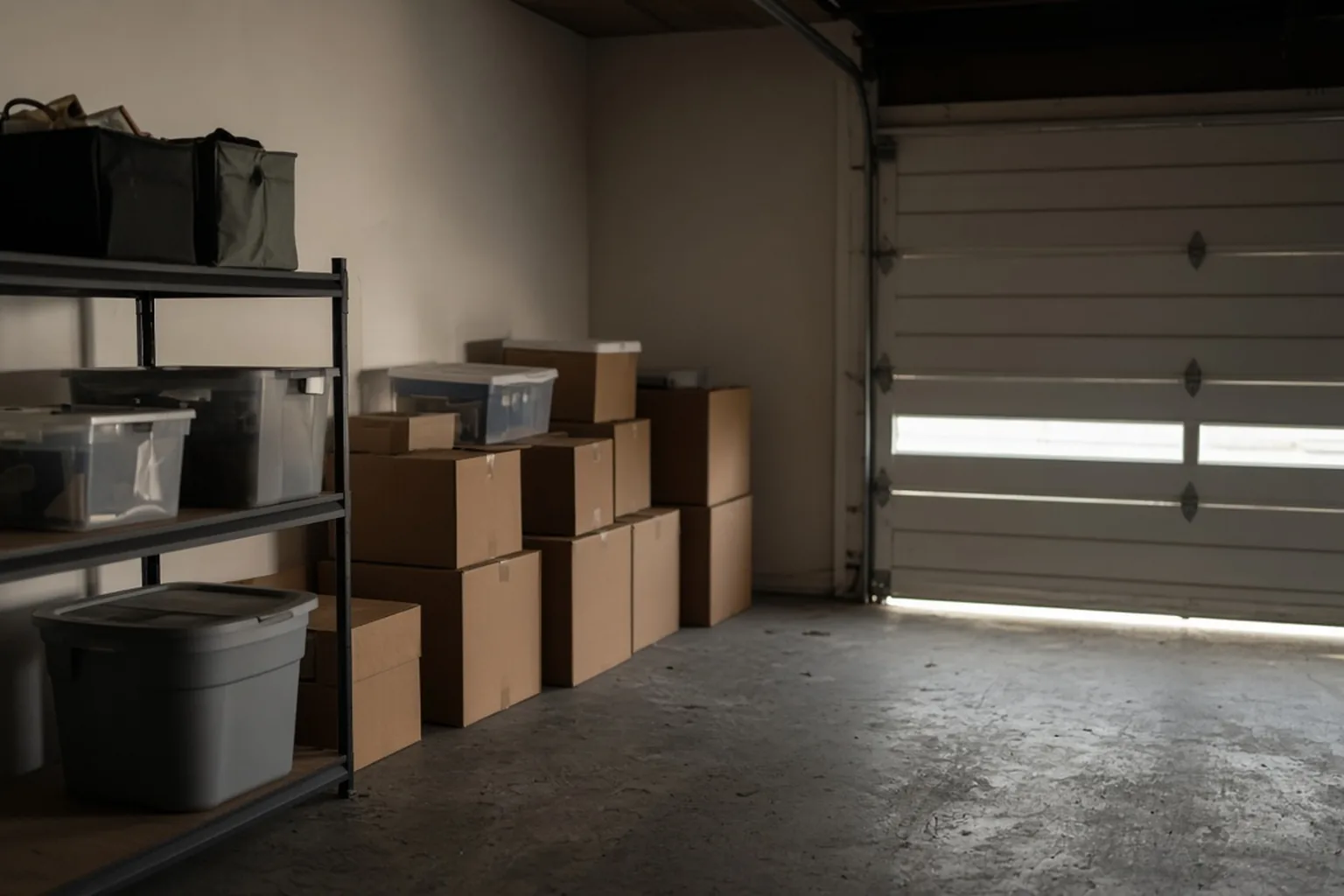 Cardboard boxes make easy nests and the gap under an overhead door makes an easy entrance. Plastic bins and a fresh door seal fix both.
Roof rat or Norway rat: which one is in my Birmingham house?
If a quote does not say which rat it is aimed at, ask before you sign. Norway rats call for foundation and slab work, plus exterior stations. Roof rats call for roofline sealing and tree trimming. The difference changes the whole plan. Indoors they stay in crawlspaces, basements, and ground floors, often coming up beside plumbing. They are heavier, with blunt noses and shorter tails, and they dig burrows under slabs, sheds, and along stream banks. Norway rats live low. Noise overhead right after dark, droppings in attic insulation, and gnaw marks at soffits all point to roof rats. Indoors they nest in attics, upper wall voids, and the space above garage ceilings. They are sleek and dark, with a tail longer than the head and body together, and they travel along tree limbs, vine-covered fences, and utility lines to reach the roof. Roof rats live up high. Alabama Extension separates the two rats by habitat, and in Birmingham both are common. Where you hear them or find droppings is the quickest clue.
How quickly can a few rodents turn into an infestation?
The same problem found in February may involve several nests, soiled insulation, and chewed wiring, which is a bigger job with a bigger bill. A few droppings in the pantry in October usually means a weekend of trapping and sealing. That is the practical case for acting at the first sign. There is no long freeze to thin the population, as there is farther north. Summer highs near 91F keep rodents well fed outdoors, and with winter lows around 33F, a heated house or warm attic lets breeding continue straight through December and January. In Birmingham the weather does little to interrupt that cycle. Rats are slower per litter but still add up: Alabama Extension estimates that one pair left unchecked can lead to more than 640 rats in a year. A litter of five or six arrives about 20 days after mating, and those young are breeding themselves within weeks. House mice have five to ten litters a year. Faster than most people expect, and the numbers Alabama Extension publishes show why waiting a month costs you.
 This is what a proper seal looks like: metal mesh fastened with screws and sealed at the edges. Foam or caulk on its own gets chewed through.
Why rat bait is slow, and when it still makes sense.
If a provider proposes bait in living space or the attic, ask why trapping would not work instead, and where each placement will go. Bait fits best outdoors in locked, tamper-resistant stations along rat runways, after the house is sealed so poisoned rats cannot get back inside. Alabama Extension's order of work is exclusion, sanitation, and then chemical control, which puts bait last for a reason. Loose pellets can be eaten by dogs, cats, or wildlife, and a poisoned rat can be eaten by an owl or hawk. A rat that fed in your yard can crawl into a wall cavity or above a ceiling before it dies, and in a Birmingham summer that smell shows up quickly. The delay has costs. That delay is deliberate: rats are suspicious feeders, and a bait that killed instantly would teach the rest of the colony to stay away. Alabama Extension says death comes about four or five days after the rodent first eats. Anticoagulant baits, the most common rodenticides, do not kill on contact.
How to confirm a Birmingham provider is properly licensed.
Get the answers in writing. Will any bait go inside the house, or only outdoors in locked stations? How many follow-up visits are included, and what happens if activity continues? What materials go into each opening? Will they inspect the roofline as well as the crawlspace? A license does not tell you whether the work will be good, so ask practical questions too. A company that hesitates, or a handyman offering to deal with rats using store-bought bait, is working outside that system. Ask for both when you request a quote. For you, that means any company sending someone to your Birmingham home should be able to give you its license number and the name of its certified operator. The certified operator behind that license must pass a 100-question exam. The Alabama Department of Agriculture and Industries requires a household pest control license for firms doing this work, and Alabama Extension's summary lists the annual structural professional services license for a main office at $175. Alabama regulates household pest control, and checking takes one question.
Month by month rodent activity in Birmingham.
Sealing done in late summer, before the fall surge, saves the most trouble for the least money. About 54 inches of rain a year keeps yards damp, so check slab edges and crawlspace vents for fresh burrows during this stretch. December through February, lows near 33F keep rodents indoors, where they breed steadily. Most new attic noise and kitchen sightings start now. Nights cool, outdoor food thins, and all three commensal rodents push into homes. September through November brings the fall surge. June through August, with highs around 91F, rodents chase shade and water, so leaky spigots, drains, and creek banks draw Norway rats close to houses. This is the window to trim branches and pull vines before summer. Roof rats move through trees and fence lines, and Norway rats reopen burrows softened by spring rain. March through May, outdoor populations grow as warmth returns. Rodents in Birmingham never fully go quiet, but the work shifts with the seasons.
What affects the price
- Roof pitch and attic access, since roof rat work often means ladders and crawling over insulation.
- How many trees and vines touch the roof and need cutting back.
- Whether both rat species are present, which means attic and ground-level work in one job.
- Number of follow-up visits, since Birmingham activity does not stop for winter.
- Crawlspace or slab construction, which changes where Norway rat sealing has to happen.
- Removal of droppings and soiled insulation once trapping is finished.
📊
What's your biggest concern about rodents?
When to call for help
The same goes for Norway rat burrows under a slab or along a foundation, which need sealing from outside and sometimes digging. Call as well if bait has been out for more than a week with no change, if you smell dead rodents in the walls, or if you manage a rental, restaurant, or anything that serves food. A lone mouse in the kitchen is the main case where handling it yourself makes sense. If you are hearing rats in the attic, it is usually time to call. Roof rat entry points tend to sit at the roofline, sometimes two stories up, and finding them takes a ladder, a strong light, and practice reading gnaw marks.
What you can do yourself
If you have rats rather than mice, paying for at least the inspection and sealing is usually the better use of money. A provider places bait in locked stations, seals the entries, and comes back to check. Anticoagulants take days to kill, a rat can die inside a wall or ceiling, and loose pellets are a hazard for dogs and cats. Store-bought bait is the other trap people fall into. They are wary of anything new, they follow routes you may never see, and roof rats enter high where most homeowners cannot safely work. Rats are harder. Cutting tree limbs and vines away from the roof is also worth doing yourself, since Alabama Extension lists those as the routes roof rats use. Snap traps along kitchen walls, door sweeps, steel wool around sink pipes, and sealed food containers will handle a mouse or two. DIY works well for house mice and for prevention.
Rodents in Birmingham
Birmingham is an urban city of about 197,000 people, founded in 1871 and built on the steel industry, with a civil rights history the whole country knows. For rodents, the details that matter are climate and how closely homes sit together. At about 644 feet of elevation in the humid subtropical South, Birmingham gets enough warmth and rain that rodents stay active through most of the year, with only a modest slowdown in midwinter. Yards with mature trees, fences, and utility lines give roof rats a way onto roofs, while slabs, sheds, and creek banks suit Norway rats. Against a median home value near $115,000, sealing gaps and trimming limbs early costs far less than replacing chewed wiring or insulation later. Alabama Extension's advice for the state follows the same order: exclusion, sanitation, and only then chemical control.
Local research
Rodents in Birmingham, AL: what the public record shows
Before you compare quotes, it helps to know which rodents actually live in Alabama, when they are busiest around Birmingham, and what the state figures look like. Everything below links to the agency or university page it came from.
Hole size a rat has entered through
Rats also crawl along pipes up to 3 inches in diameter, so seal pipe penetrations as well as foundation gaps.
Alabama Cooperative Extension SystemRodent species recorded in Alabama
- House mouse (Mus musculus) — Enters at 1/4 inch; 5-10 litters per year; eats about 200 small meals a night.
- Norway rat (Rattus norvegicus) — Burrowing rat of basements, sewers and ground floors; tail shorter than head plus body.
- Roof rat (Rattus rattus) — Climber of attics and trees in warm and coastal regions; tail longer than head plus body.
When rodents are busiest around Birmingham
Year-round, fall surge. Roof rats dominate Florida, Texas and Gulf Coast attics.
Based on Birmingham’s humid subtropical climate profile.
Alabama Extension treats the Norway rat (under buildings and slabs, stream banks), roof rat (trees, vine-covered fences, attics, entering from roofs and utility lines) and house mouse as the three commensal rodents; control is exclusion, sanitation, then chemical control.
Rules that apply in Alabama
For context, nationally
- 1/4 inch (the width of a pencil) — Smallest gap a mouse can enter. CDC
- 890; 35% fatal; 94% west of the Mississippi — Hantavirus cases reported since 1993 (through 2023). CDC
Sources: Alabama Cooperative Extension System; CDC; Pest Notes: House Mouse; Pest Notes: Rats. Figures are quoted as the source prints them. How we check our sources
Simple ways to keep rodents away
- Cut branches back several feet from the roof so roof rats cannot jump across.
- Pull vines off fences and walls that connect to the house.
- Fit metal guards on pipes and downspouts up to 3 inches wide that run up exterior walls.
- Pick up fallen fruit and nuts, and keep pet food in sealed metal cans.
- Stack firewood and debris away from the foundation and up off the ground.
- Close foundation and crawlspace gaps half an inch or wider with hardware cloth or concrete patch.
- Fix dripping outdoor faucets and drain lines that give rats steady water in summer.
 Before you call, sketch where you have seen droppings or heard noise and measure any gaps you found. It makes the first visit faster and the quotes comparable.
Did you know?
Leptospirosis cases among U.S. residents outside the territories stood at 21 through week 13 of 2026, compared with 22 at the same point in 2025.
About 35 percent of the hantavirus cases reported in the United States since 1993 have been fatal.
The CDC counts murine typhus and Lyme disease among illnesses rodents spread indirectly, through the fleas and ticks they carry.
Questions people ask
Why do I hear rats in my attic in Birmingham?
Most attic noise in Birmingham comes from roof rats, which Alabama Extension describes as climbers that use trees, vine-covered fences, and utility lines to reach the roof. They tend to move right after dark. Look for gnawed gaps at soffits, vents, and where lines enter the house, and cut back any branches touching the roof.
Are rats still active in Birmingham during winter?
Yes. With winter lows around 33F, Birmingham rarely stays cold long enough to stop rodents, so activity runs year-round. Fall brings a surge as they look for shelter, and indoor populations keep breeding through the winter. Expect new attic noise and kitchen sightings to pick up as fall nights cool, and they can continue through the winter months.
How small an opening can a rat get through?
Alabama Extension reports rats getting through holes as small as half an inch, and house mice need even less. Rats also climb pipes up to 3 inches in diameter, so a gas line or downspout running up a wall can lead straight to an attic gap. Seal both the gap and the climbing route.
Why didn't the rat poison work right away?
Anticoagulant baits are slow on purpose. Alabama Extension says a rodent dies about four or five days after it first eats the bait, which keeps the rest of the colony from learning to avoid it. The catch is that rodents may die inside walls or ceilings, so many Birmingham homeowners prefer locked outdoor stations plus trapping indoors.
How do I check whether a Birmingham pest control company is licensed?
Ask for the company's household pest control license from the Alabama Department of Agriculture and Industries and the name of its certified operator, who has to pass a 100-question state exam. Any company working in Birmingham should be able to show both without hesitation. Then ask practical questions about sealing and follow-up visits.
How fast do house mice multiply?
Very fast. Alabama Extension puts house mice at five to ten litters a year, with five or six young born about 20 days after mating. In a warm house with an open pantry, two mice spotted in October can turn into dozens by spring, which is why trapping and sealing right away matters.
What diseases can rodents spread in Alabama?
The CDC lists leptospirosis, salmonellosis, and rat-bite fever among diseases rodents spread directly, mostly through urine, droppings, and spoiled food. Hantavirus is rare in the Southeast, with 94 percent of U.S. cases west of the Mississippi. The useful step is safe cleanup: air the room, soak droppings with bleach solution, and never sweep.
Nearby cities
Related guides
Sources (6)
The facts in this article come from the public sources listed above. Every home is different, so ask the company you talk to about pricing and what’s included. Published by Rodent Exterminator · Updated October 11, 2026 · How we write these guides