The short version
Rodent control in Conway, Arkansas means trapping close to where the animals actually travel and sealing the gaps they use. House mice stay within 10 to 30 feet of the nest, so traps go along those runways, no more than 6 feet apart. Rats range much farther. Seal openings of 1/4 inch for mice and 1/2 inch for rats, ideally before the September to November push indoors.
- Conway deals with house mice, Norway rats and roof rats, each with different habits.
- Mice forage in a tiny circle, so a trap 15 feet off their path catches nothing.
- Properly set snap traps kill 75 to 88 percent of the time, per University of Arkansas Extension.
- A 3-foot strip of bare ground around the foundation takes away cover.
- Arkansas licenses rodent work under Classification 2, so ask to see it.
Use this if you own or rent a house in Conway and found signs of mice or rats, manage rentals near the colleges, or just moved into a newly built house and noticed activity in the garage. It also helps anyone comparing two quotes who wants to know whether a provider's plan matches what University of Arkansas Extension recommends.
What to look for
Three rodents cause nearly all the trouble in Conway homes. House mice live inside walls, cabinets and stored goods, and University of Arkansas Extension notes a single female can have as many as 13 litters in a year, averaging four to seven young each, so numbers climb fast. Norway rats are ground dwellers that burrow beside foundations, slabs and woodpiles. Roof rats are the climbers, slipping along fence tops and overhead utility lines at night and nesting in attics. Conway's weather keeps all three busy. Summer highs reach about 92 degrees and winter lows average around 28, which makes for winters mild enough that rodents that get indoors in fall can stay active and breeding right through them. With average humidity near 72 percent, crawl spaces and the ground under decks stay damp and sheltered, a setup Norway rats in particular like to dig into.
- 1Quick footsteps or rolling sounds in the attic just after dark, typical of roof rats.
- 2Fresh burrow holes, about the width of a fist, along the foundation or under a slab edge.
- 3Mouse droppings the size of rice grains clustered in a drawer or along a single baseboard.
- 4Gnaw marks on door corners, wiring or the edge of a plastic trash can.
- 5Dark greasy smudges on fence rails, rafters or the top of a wall where rats run repeatedly.
- 6Pet food bowls emptied overnight, or kibble found stashed somewhere it should not be.
Why it’s worth acting soon
- With up to 13 litters a year, a pair of house mice can fill a wall in a single season.
- Roof rats chew attic wiring and duct insulation, damage that stays hidden until something fails.
- Norway rat burrows can undercut slabs, walkways and the soil beside a foundation.
- Droppings and urine contaminate stored food and the insulation they nest in.
- Rats learn to avoid new objects, so a late, rushed trapping effort works worse than an early one.
Treatment options and typical costs
Runway snap trapping
Quoted after inspection
Snap traps set where rodents travel, along walls, behind appliances and on rafters for roof rats. University of Arkansas Extension puts properly set traps at 75 to 88 percent effective and recommends several traps no more than 6 feet apart. It fits most homes with mice or a small rat problem and leaves no bodies hidden in walls.
- Time
- Until catches stop, with regular checks
- Best for
- House mice indoors and roof rats in attics
Exclusion work
Quoted after inspection
Sealing every opening rodents can use: 1/4 inch and larger for mice, 1/2 inch and larger for rats. Expect hardware cloth, sheet metal and concrete patch rather than foam alone. Ask the provider to check roof returns, vents and where utility lines enter, since roof rats arrive from above along wires and branches.
- Time
- Depends on how many gaps are found
- Best for
- Homes with repeat activity every fall
Exterior bait stations for rats
Quoted after inspection
Tamper-resistant stations placed along fences and foundations to reduce a rat population that ranges across the yard. Norway rats cover an area 100 to 150 feet across, so placement has to follow the whole property. Ask what product goes in the stations, how they are locked, and how often they are checked.
- Time
- Ongoing, on a schedule the provider sets
- Best for
- Norway rats burrowing outdoors
Habitat cleanup and vegetation band
Quoted after inspection
Clearing a 3-foot weed-free band around the foundation, moving woodpiles and stacked lumber, and trimming limbs away from the roof. This is the University of Arkansas Extension approach to removing cover. It costs little and makes every other method work better.
- Time
- Depends on lot size and brush
- Best for
- Lots with heavy brush, woodpiles or overhanging trees
Prices are typical published ranges. Ask what’s included before you compare quotes.
 Under the sink is the first place to check: the hole where the pipe passes through the cabinet back is often cut much bigger than the pipe.
How far do mice and rats travel around a Conway house?
On a typical lot, that can be your whole yard plus a neighbor's. Traps and bait stations have to follow the runways from the burrow to the food, often along a fence or foundation. Roof rats travel 100 to 300 feet for food, usually at night and usually up high on fence tops and utility lines. You might find their nest in the attic and their food source two houses away. Ask any provider how they plan placement for the species you have. A single trap line in the kitchen will not touch a roof rat. Travel distance is the single most useful fact for setting traps in Conway, and the three local rodents could not be more different. House mice stay close. University of Arkansas Extension says a mouse usually works an area only 10 to 30 feet across. That is why traps need to be several to a room, no more than 6 feet apart, right where droppings show up. Norway rats roam a circle 100 to 150 feet across and seldom go more than 300 feet from their burrow.
Roof rat or Norway rat: which one is in your house?
They dig. In Conway's damp soil, look for fresh holes along the foundation, under slabs, beneath sheds and in woodpiles. Their entry points are low: crawl space vents, gaps under doors, cracked foundation patches. House mice can turn up in either place but rarely leave more than a scatter of small droppings. If you catch one, compare the tail to the body before you throw it away. That ten-second check tells you and the provider whether to look up or down. The answer changes where the work happens, so it is worth sorting out before anyone sets a trap. Roof rats are sleek and slim, with a tail longer than the head and body together. They climb well, nest high, and announce themselves with quick runs across the ceiling after dark. Their entry points tend to sit near the roofline: gaps at soffits, roof returns, vents and where cable lines meet the siding. Trimmed branches and tight roof openings matter most. Norway rats are heavier and blunt-nosed, with a shorter tail.
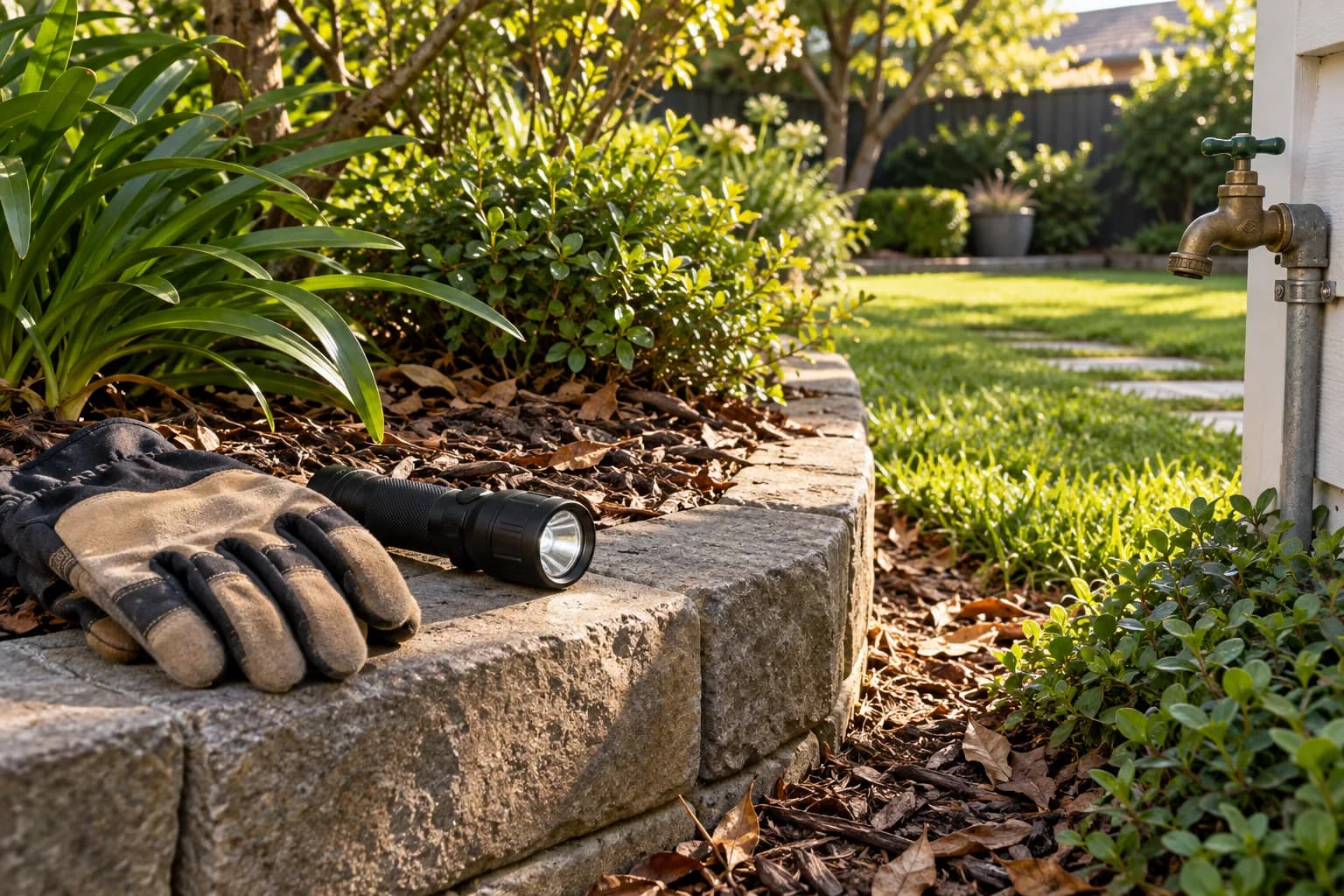 Dense shrubs against the house and a dripping hose bib give rodents cover and water. Trimming back and fixing drips makes the yard less inviting.
How to check a rodent company's Arkansas license.
What this means for a Conway homeowner: ask the company for its license number and confirm it covers Classification 2, not only termites or lawn work. A provider who handles rodent baiting and trapping should be comfortable answering that. It also helps to ask who will actually come to the house. Some companies send a licensed operator; others send a technician working under that operator's license. Either can be fine, but you should know who is responsible for the plan and who to call if bait stations or traps need attention later. Arkansas regulates commercial pest control more closely than many people realize, and the details are easy to check. The Pest Control Program at the Arkansas Department of Agriculture runs licensing under Act 488 of 1975. Operators are licensed by classification, and rodent work sits in Classification 2, Household Pest and Rodent Control. To earn it, an applicant has to pass that exam with at least 75 percent, and the exam fee is $100 for each classification.
A seasonal rodent timeline for central Arkansas.
Roof rats stay active in attics through this stretch. March through May brings spring rain, and some of Conway's 50 annual inches can flood burrows and push Norway rats to higher, drier spots, including garages and crawl spaces. June through August is hot, with highs around 92 degrees. Rodents shelter during the day and forage at night, often around pet food, gardens and garbage. Summer is the right time to clear the foundation band, trim limbs back from the roof, and patch openings before the next fall wave. Conway's rodent year has one big entry season and a long tail of indoor activity after it. September to November is when house mice and Norway rats move toward buildings as nights cool. This is the busiest time for new problems, and gaps you seal in August keep many of them out. December through February is mild enough that rodents already inside keep breeding. Winter lows average about 28 degrees, which is cold enough to keep them indoors but mild enough that breeding carries on.
Renting or buying new in Conway: who handles the rodents?
A new house brings a different issue. When fields and brushy lots are cleared for building, the rodents living there have to go somewhere, and the houses nearest the cleared ground are the first stop. New construction can also leave utility penetrations unsealed, and a mouse needs only 1/4 inch. If you just bought a new Conway house, walk the foundation and garage seals in late summer. It is easy work that prevents an unpleasant first winter. Conway's two nicknames, City of Colleges and growth corridor, point to two situations worth planning for: renting, and moving into a newly built house. If you rent, the structure usually belongs to the owner, so sealing gaps falls to the landlord, while tenants control food storage and should report signs in writing with photos and dates. A unit that sits empty between leases, with crumbs in the cabinets and nobody around to notice droppings, gives mice time to settle in. If one unit in a building has mice, ask the provider to inspect the shared walls and neighboring units too, since mice will not respect property lines inside a duplex.
What affects the price
- Which species is involved, since rat jobs cover more ground than mouse jobs.
- How many gaps need hardware cloth or sheet metal instead of a quick patch.
- Attic access for roof rat work, including low-clearance or blown-insulation attics.
- Number of follow-up trap checks included in the first price.
- Whether exterior bait stations are added on an ongoing service plan.
- Cleanup of droppings and soiled insulation after the animals are gone.
📊
What's your biggest concern about rodents?
When to call for help
In Arkansas, ask to see the company's license from the Department of Agriculture's Pest Control Program, specifically Classification 2 for household pests and rodents. Make the call earlier if wiring has been chewed or if you rent and the gaps are in parts of the building you cannot repair. Rats in particular are cautious around new objects, so a provider's experience with trap placement and pre-baiting matters. Call a provider when you see burrows along the foundation, hear movement in the attic, or keep catching mice past the second week.
What you can do yourself
A few house mice in the kitchen are a fair DIY job in Conway. Buy a dozen snap traps, set them right along the walls where droppings show up, and space them close together, since mice rarely wander more than 10 to 30 feet. Seal small gaps under sinks with steel wool and caulk. Rats change the math. A Norway rat colony burrowing under a shed or a roof rat family in the attic covers far more ground, learns to avoid traps quickly, and often enters through openings high on the house that need a ladder and sheet metal to fix. If you see rat signs, or if your mouse catches have not slowed after a couple of weeks, bring in someone with a Classification 2 license. Whatever you choose, clear that 3-foot band around the foundation yourself. It costs nothing but an afternoon.
Rodents in Conway
With a median home value around $210,000, exclusion work is usually a small fraction of what chewed wiring or ruined insulation costs to replace. The city dates to 1875 and sits at about 308 feet of elevation, and 50 inches of yearly rain keep the soil beside foundations soft enough for Norway rats to dig. If your house is newly built, do not assume it is sealed: utility penetrations and garage door seals still deserve a look before fall. If you rent, a move-out that leaves food behind and doors propped open gives mice an easy start. Neither label tells you anything about your own house, so judge it by its gaps, not its age or address. Conway is a suburban city of about 67,000 people, nicknamed the City of Colleges and often described as a growth corridor for central Arkansas.
Local research
Rodents in Conway, AR: what the public record shows
Before you compare quotes, it helps to know which rodents actually live in Arkansas, when they are busiest around Conway, and what the state figures look like. Everything below links to the agency or university page it came from.
Rodent species recorded in Arkansas
- House mouse (Mus musculus) — Enters at 1/4 inch; 5-10 litters per year; eats about 200 small meals a night.
- Norway rat (Rattus norvegicus) — Burrowing rat of basements, sewers and ground floors; tail shorter than head plus body.
- Roof rat (Rattus rattus) — Climber of attics and trees in warm and coastal regions; tail longer than head plus body.
When rodents are busiest around Conway
Fall entry (Sept-Nov). Norway rats and house mice move indoors as temperatures drop.
Based on Conway’s humid subtropical climate profile.
MP546 covers house mice, Norway rats and roof rats as Arkansas's commensal rodents; exclude mice at 1⁄4 inch and rats at 1⁄2 inch, keep a 3-foot weed-free band around foundations.
Rules that apply in Arkansas
For context, nationally
- 1/4 inch (the width of a pencil) — Smallest gap a mouse can enter. CDC
- 890; 35% fatal; 94% west of the Mississippi — Hantavirus cases reported since 1993 (through 2023). CDC
Sources: University of Arkansas System Division of Agriculture Cooperative Extension Service; CDC; Pest Notes: House Mouse; Pest Notes: Rats. Figures are quoted as the source prints them. How we check our sources
Simple ways to keep rodents away
- Keep a 3-foot strip around the foundation free of weeds, ivy and mulch piles.
- Trim tree limbs and vines at least several feet back from the roofline so roof rats cannot jump across.
- Stack firewood and lumber off the ground and away from the house.
- Store pet food and bird seed in sealed metal or heavy plastic bins.
- Cover vents and crawl space openings with hardware cloth fine enough to stop a mouse.
- Bring outdoor pet bowls in at night instead of leaving food out after dark.
- Fix dripping outdoor faucets and drain lines that give rodents a reliable drink.
 Before you call, sketch where you have seen droppings or heard noise and measure any gaps you found. It makes the first visit faster and the quotes comparable.
Did you know?
A Norway rat female can raise four to six litters a year and wean 20 or more young, while roof rats have three to five litters of up to eight.
Rat-bite fever is one of the diseases the CDC lists as spread directly by rodents, alongside leptospirosis, salmonellosis and hantavirus.
The CDC puts the smallest mouse-sized opening at 1/4 inch, roughly the width of a pencil, and notes rats can chew a hole that size bigger.
Questions people ask
Do roof rats live in Conway, Arkansas?
Noise in the ceiling just after dark is the classic sign. In Conway they tend to nest in attics and travel at night along fences and overhead utility lines, often ranging 100 to 300 feet for food. University of Arkansas Extension lists roof rats with house mice and Norway rats as the state's three commensal rodents. Yes.
How far apart should mouse traps be?
Set them against walls, behind appliances and in cabinet corners where droppings collect. A trap in the middle of the garage floor is wasted. University of Arkansas Extension says to put several traps no more than 6 feet apart wherever mice are active, because a mouse typically covers an area only 10 to 30 feet across. Close.
When do mice and rats move indoors in Conway?
Sealing gaps in late summer is the cheapest way to get ahead of it. Because winter lows average around 28 degrees, rodents that get in during fall usually keep breeding inside until spring. Expect the main push from September through November, when nights cool down in Conway and outdoor food thins out.
Does an exterminator need a license in Arkansas?
Ask any company you are considering for its license number and classification. Applicants need a 75 percent score on that exam. Under Act 488 of 1975, anyone doing rodent work for hire in Arkansas needs a license in Classification 2, Household Pest and Rodent Control, issued through the state Department of Agriculture. Yes.
What size hole can a rat get through?
Check the gaps where utility lines enter, since roof rats arrive along those lines. Rats can also gnaw a slightly smaller hole larger, so anything near that size around pipes, vents or door bottoms needs metal, not foam. University of Arkansas Extension uses 1/2 inch as the line for rats and 1/4 inch for mice.
Why are the traps not catching the rats?
Placement matters just as much: Norway rats rarely travel more than 300 feet from the burrow, so start at the burrow and the routes leading from it. Leave traps unset and baited for several days so the rats get used to them, then set them. Rats avoid new objects for a while, so freshly placed traps often sit untouched.
How much does rodent control cost in Conway?
Ask whether follow-up trap checks are included, and whether exclusion and cleanup are priced as separate items. The biggest swings come from species, since rats need more property coverage than mice, and from how much sealing the house needs. There is no published local price for Conway, so providers quote after an inspection.
Nearby cities
Related guides
Sources (6)
The facts in this article come from the public sources listed above. Every home is different, so ask the company you talk to about pricing and what’s included. Published by Rodent Exterminator · Updated October 11, 2026 · How we write these guides