The short version
Rodent control in Erie, PA starts with sealing, because a house mouse fits through an opening about the size of a dime and a rat through one about the size of a quarter, per Penn State Extension. Most Erie problems begin in fall, when mice and Norway rats move indoors ahead of winter lows near 20F. Seal with copper mesh and hardware cloth, trap, then clean up wet.
- Penn State says mice fit through a dime-sized hole and rats through a quarter-sized one.
- Mice and Norway rats push into Erie homes from September through November.
- Pointed, rice-sized droppings mean mice; blunt, raisin-sized droppings mean rats.
- Seal with copper mesh, hardware cloth, silicone and door sweeps before reaching for poison.
- Deer mouse droppings in sheds or camps call for wet cleanup, never a broom.
Erie homeowners with a basement mice seem to love, renters who share walls with neighbors, landlords tired of the same complaint every winter, and anyone opening a camp, shed or garage that sat closed since fall. If something started running in the ceiling once the heat came on, start here.
What to look for
Pennsylvania's state data lists three rodents: the house mouse, the Norway rat and the deer mouse. In Erie homes, house mice cause most of the trouble, Norway rats show up around foundations, garages and trash, and deer mice turn up in sheds and seasonal buildings. Penn State Extension offers an easy size check. Adult mice measure 5 to 8 inches including a long, nearly hairless tail. Adult rats measure 13 to 18 inches including the tail. If what ran past you was about the length of your hand, it was a mouse. The climate sets the timing. Summers are mild, with highs near 80F, and about 39 inches of rain a year keeps outdoor food plentiful. Then fall arrives, and with winter lows averaging 20F, rodents move into basements, wall voids, attached garages and attics. They stay through winter, and house mice keep breeding the whole time. Humidity near 73 percent can leave a basement damp, and a damp basement full of cardboard makes easy nesting.
- 1Pointed droppings the size of a rice grain in drawers or along basement walls, which Penn State ties to mice.
- 2Blunt droppings closer to a small raisin near the garage or trash cans, a rat sign.
- 3Scratching in walls or ceilings at night after the furnace starts running for the season.
- 4Gnawed corners on cereal boxes, dog food bags or stored birdseed.
- 5Shredded paper, fabric or insulation stuffed into a basement corner or behind the dryer.
- 6Greasy dark marks along foundation sills and pipes where rodents travel.
- 7Burrows in the soil along the foundation or under the porch, often from Norway rats.
Why it’s worth acting soon
- House mice can breed 5 to 10 times a year, and a warm basement lets them continue all winter.
- Chewed wiring in walls and basements is a fire risk, especially around older electrical work.
- Droppings and urine in a damp basement build up odor and contamination over a single winter.
- Norway rats burrowing under porches and along foundations can undermine steps and slabs.
- The CDC lists illnesses such as salmonellosis and LCM that rodents spread directly to people.
Treatment options and typical costs
IPM exclusion
Quoted after inspection
Penn State's sequence starts here: close entry points with copper mesh, hardware cloth and silicone sealant, and add door sweeps. In older homes that usually means the sill plate, gaps around pipes and wires, foundation cracks, vents and garage doors. Exclusion comes before any pesticide.
- Time
- Depends on how many openings the inspection finds
- Best for
- Any home with recurring fall rodents
Snap trapping
Quoted after inspection
Mouse-size or rat-size snap traps, chosen from the droppings, placed along walls and runways in basements, kitchens and garages. Traps are a nonchemical tool that fits the IPM approach and confirm when activity stops. Expect several checks over a few weeks.
- Time
- Until captures stop; ask how many checks are included
- Best for
- Active mice or rats inside
Targeted bait stations
Quoted after inspection
Locked stations set by a licensed applicator, used only after exclusion and trapping, mainly outdoors for Norway rats. Penn State's IPM framing keeps least-risk products for when they are truly needed. Ask which product goes in and exactly where stations will sit.
- Time
- Ongoing as needed
- Best for
- Persistent outdoor rat activity
Sanitation and cleanup
Quoted after inspection
Clearing basement clutter, moving pet food and birdseed into sealed containers, and cleaning droppings and nests with the CDC wet method. In a humid basement near the lake, tossing soiled cardboard and fabric also removes nesting material mice would reuse.
- Time
- Depends on how much material is soiled
- Best for
- Basements, garages and storage areas
Prices are typical published ranges. Ask what’s included before you compare quotes.
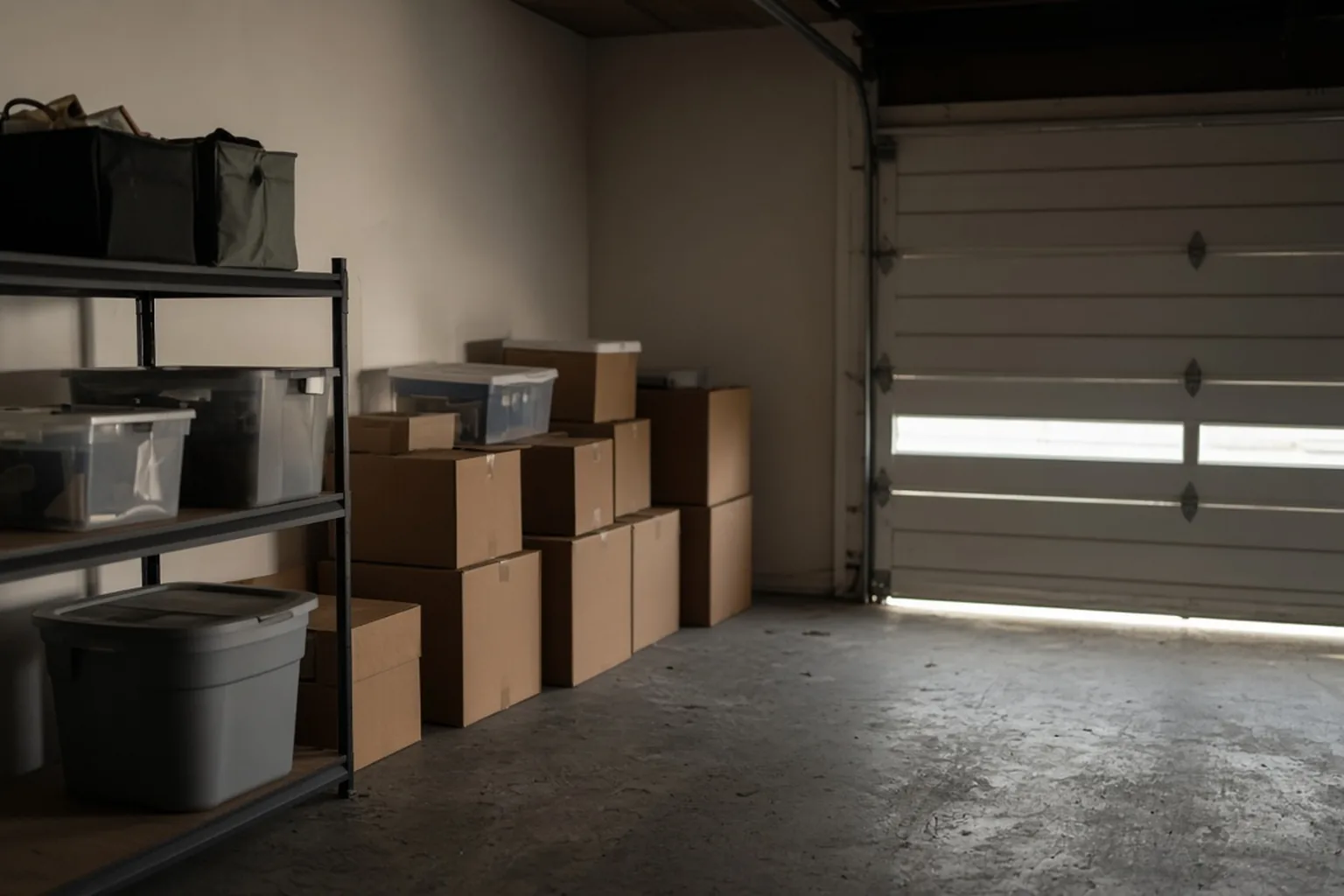 Cardboard boxes make easy nests and the gap under an overhead door makes an easy entrance. Plastic bins and a fresh door seal fix both.
Mouse or rat? Using Penn State's size and droppings guide in an Erie home.
The second is droppings, which you will find far more often than the animal. Mouse droppings are pointed at the ends and about the size of a grain of rice. Rat droppings are blunt and closer to a small raisin. Fresh ones are dark and soft, while old ones are dry and grayish. Getting this right decides trap size, placement and how hard to look outside. A mouse trap will not hold a rat. Deer mice, with white bellies and feet, point you toward sheds and garages rather than the kitchen. Before you buy traps for an Erie house, figure out whether you are dealing with mice or rats. Penn State Extension gives two easy tests. The first is size. Adult house mice are 5 to 8 inches long including the tail, and much of that length is a long, nearly hairless tail. Adult Norway rats are 13 to 18 inches including the tail and look heavy through the body. If you only caught a glimpse, ask yourself whether it would have fit in your palm.
Sealing an Erie house the Penn State way.
Silicone seals over the mesh and closes small cracks. Sweeps handle the gap under exterior and garage doors. Start low and work around the house: the sill plate where the house rests on the foundation, then utility entries, basement windows and doors, then the garage. Finish at the roofline if you hear noise overhead. Expect to find openings you never knew were there. When an Erie house settles, it shows up as hairline cracks in foundations, gaps where old pipes and wires were run, loose basement windows and doors that no longer close tight at the bottom. Each one is a possible mouse door, and Penn State Extension says a mouse only needs an opening about the size of a dime. The recommended materials are simple: copper mesh, hardware cloth, silicone sealant and door sweeps. Copper mesh packs into irregular gaps around pipes and will not rust in a damp basement. Hardware cloth covers vents and bigger openings while still letting air move.
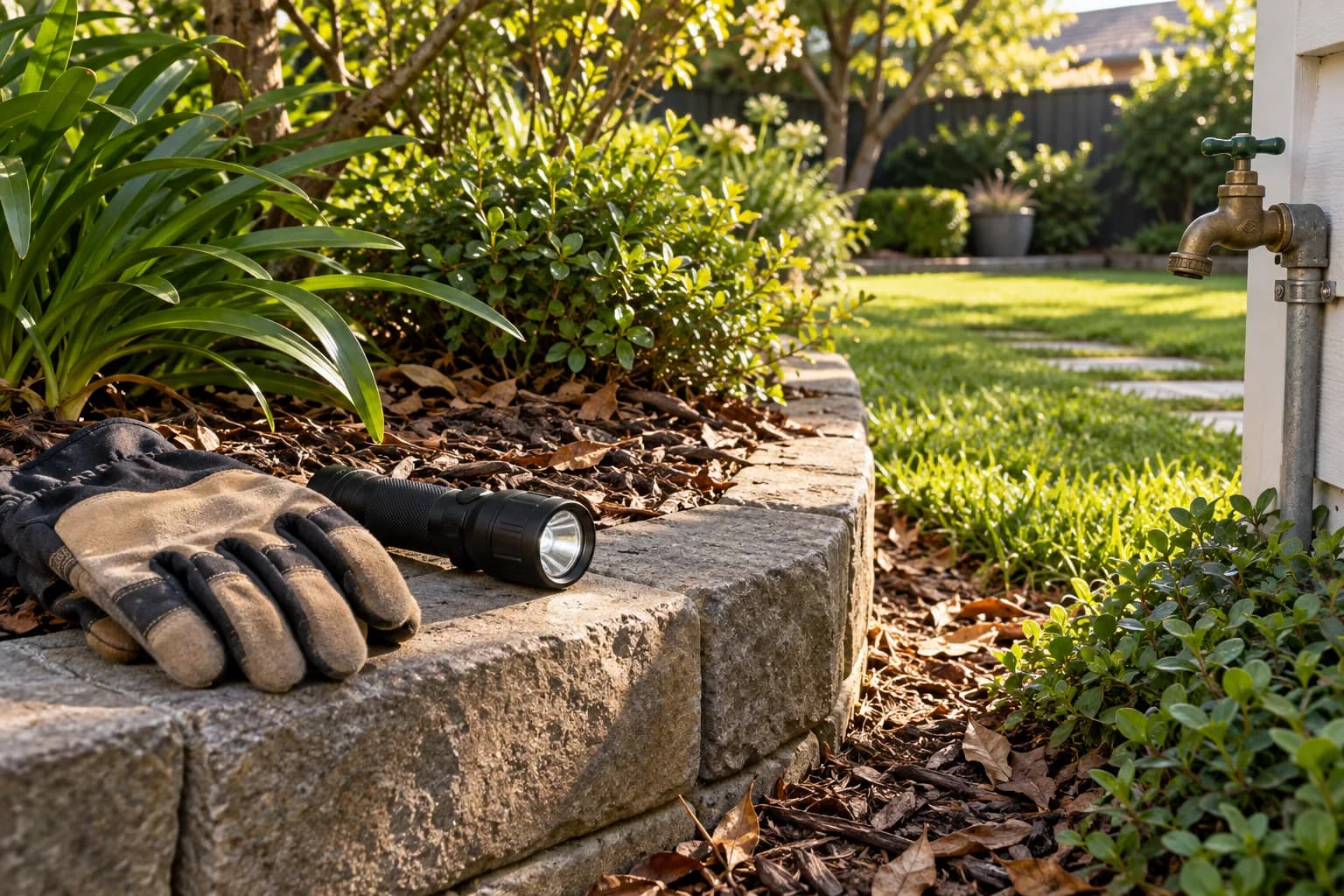 Dense shrubs against the house and a dripping hose bib give rodents cover and water. Trimming back and fixing drips makes the yard less inviting.
Why fall and winter are rodent season near Lake Erie.
By the time winter lows settle near 20F, any rodent that found a way in has built a nest. Winter is when the problem grows. House mice can breed 5 to 10 times a year, and a heated basement gives them no reason to pause. Droppings collect behind appliances and in storage areas. Then in spring, when sheds, garages and seasonal camps reopen, droppings that deer mice left over the winter become the cleanup concern. The practical calendar: seal in August and September, trap from October on, and clean carefully in April and May. Rodent pressure in Erie follows the thermometer. Summer highs near 80F and about 39 inches of rain a year keep mice and rats fed outdoors on gardens, compost, fallen fruit and garbage, so there is little reason to come inside. That changes from September through November. As nights cool and the first frosts arrive, mice trace foundations looking for the warm air leaking from basements. Norway rats move closer to buildings too, burrowing under porches and along garage slabs.
What should a first visit include under an IPM approach?
They should identify the species from droppings and size, and note any burrows outdoors. You should get a written plan listing entry points, the materials that will close them, where traps go, and when someone will come back to check. If bait is part of the plan, it belongs in locked stations, with the product named. A plan that starts with bait and skips sealing is not really IPM, whatever the paperwork calls it. For an Erie home with a settled foundation, the list of entry points can run long. Penn State Extension frames rodent control as integrated pest management: prevention, exclusion and nonchemical tools first, and least-risk products only when needed. A provider working that way spends most of the first visit inspecting, not baiting. Expect a full walk around the outside, looking at the foundation, sill plate, utility entries, vents, basement windows, garage doors and porch areas. Inside, the inspector should check the basement, kitchen, under sinks, behind appliances and the attic if there is overhead noise.
How to keep rodent control affordable in an Erie home.
Then pay a provider for what is hard to do alone, such as a full inspection, sealing at the foundation and roofline, and outdoor rat work if there are burrows. When you compare quotes, ask each one to list entry points by location, the materials used, the number of follow-up visits, and whether cleanup is included. A low quote that only drops bait tends to cost more over a few winters. A quote that seals everything and checks back is usually the better value, even when the first number is higher. With a median home value around $120,000, many Erie homeowners want to spend carefully on rodent work, and the IPM approach helps. The cheapest effective plan is usually the one that seals the house well once, so you are not paying for trapping every fall. Split the job. Do the easy parts yourself: copper mesh under sinks, a new sweep on the garage service door, pet food and birdseed in metal cans, basement clutter off the floor.
What affects the price
- Foundation type and condition, since stone and older block often have more gaps to fill.
- The number of entry points around utilities, vents and doors.
- Exterior rat work if Norway rats are burrowing along the foundation or under a porch.
- Duplexes and attached homes, where shared walls can mean treating more than one unit.
- How many trap-check visits are included through the winter.
- Cleanup of basement or attic material soiled by droppings.
📊
What's your biggest concern about rodents?
When to call for help
Call for help when droppings keep appearing after a few weeks of trapping, which usually means gaps are still open, or when you see signs of Norway rats such as blunt, raisin-sized droppings or burrows by the foundation. In an Erie house, entry points hide behind finished walls, under porches and around old utility lines, and finding them takes experience. It also makes sense to hand off heavy deer mouse cleanup in a shed or camp. The best time to call is early fall, before winter settles in.
What you can do yourself
Penn State Extension's IPM approach works well for homeowners, and it is where any good provider starts too. Identify what you have from the droppings. Seal openings with copper mesh, hardware cloth and silicone. Add door sweeps. Set snap traps along walls. For a mouse or two in the kitchen, that is often enough. A provider earns the fee in a few situations. An older home can have many small gaps, some behind siding or under porches, and missing a few means mice keep arriving. Norway rats are wary of traps and may need exterior stations. A heavy infestation also leaves cleanup that is unpleasant and, in a damp basement, smelly. The one move to avoid is going straight to poison. It skips the steps that actually keep rodents out, and mice that eat bait often die where you cannot reach them.
Rodents in Erie
Winter is the real driver, though: with lows averaging 20F, rodents that get in during October usually stay until April. The median home value is about $120,000, which is one reason many owners want to handle what they can themselves, and Penn State Extension's IPM guidance supports that. Humidity averages near 73 percent, so a basement can run damp, and damp clutter is ideal nesting. The city was founded in 1795, but the age that matters for rodents is your own house: settled foundations, utility penetrations and basement gaps wider than a dime all let mice in. Erie is an urban city of about 94,000 at 728 feet on the shore of Lake Erie, known for the lake and for Presque Isle.
Local research
Rodents in Erie, PA: what the public record shows
Before you compare quotes, it helps to know which rodents actually live in Pennsylvania, when they are busiest around Erie, and what the state figures look like. Everything below links to the agency or university page it came from.
Opening a mouse can pass through
Penn State Extension's exclusion threshold for Pennsylvania homes.
Penn State ExtensionTelling mice from rats by droppings
Identification decides trap size and placement.
Penn State ExtensionRodent species recorded in Pennsylvania
- House mouse (Mus musculus) — Enters at 1/4 inch; 5-10 litters per year; eats about 200 small meals a night.
- Norway rat (Rattus norvegicus) — Burrowing rat of basements, sewers and ground floors; tail shorter than head plus body.
- Deer mouse (Peromyscus maniculatus) — Primary U.S. hantavirus carrier; lives throughout Washington and the interior West.
When rodents are busiest around Erie
Fall entry; winter infestations. Upper Midwest and Northeast: mice in walls and garages all winter.
Based on Erie’s humid continental climate profile.
Penn State Extension frames mouse control as IPM: prevention, exclusion and nonchemical tools first, least-risk products only if needed.
For context, nationally
- 1/4 inch (the width of a pencil) — Smallest gap a mouse can enter. CDC
- 890; 35% fatal; 94% west of the Mississippi — Hantavirus cases reported since 1993 (through 2023). CDC
Sources: Penn State Extension; CDC; Pest Notes: House Mouse; Pest Notes: Rats; Hantavirus. Figures are quoted as the source prints them. How we check our sources
Simple ways to keep rodents away
- Walk the foundation in late summer and stuff any dime-sized gap with copper mesh.
- Seal over the mesh around pipes, wires and dryer vents with silicone.
- Add door sweeps to exterior doors and the garage service door.
- Cover foundation and crawl space vents with hardware cloth.
- Move basement storage out of cardboard and into lidded plastic bins.
- Keep basement clutter off the floor so fresh droppings are easy to spot.
- Store birdseed, grass seed and pet food in metal cans.
- Stack firewood off the ground and well away from the house.
 A good rodent quote lists the inspection, the number of trapping visits, each opening to be sealed and the material for it, and any cleanup.
Did you know?
Penn State Extension uses dropping shape as a shortcut: pointed ends mean a mouse, blunt ends mean a rat, and that tells you which trap size to buy.
A good share of a house mouse's 5 to 8 inches is its long, nearly hairless tail.
Lymphocytic choriomeningitis, usually shortened to LCM, is one of the illnesses the CDC lists as spread directly by rodents such as the house mouse.
Questions people ask
How small a hole can a mouse get through in a Pennsylvania home?
In an Erie basement, check the sill plate, gaps around pipes and wires, foundation cracks and garage door corners, then pack them with copper mesh and seal over it with silicone. That is why sealing has to be thorough. For a mouse, Penn State Extension says a dime-sized opening is enough, and a rat needs one about the size of a quarter.
When do mice start coming into Erie homes?
Sealing in late summer is the best defense, and setting traps the moment droppings appear keeps a few mice from becoming a season-long problem. Mice follow foundations and pipes into basements, walls and attached garages, then stay all winter. Usually from September through November, as nights cool toward Erie's average winter low of about 20F.
Is it a mouse or a rat in my house?
The answer decides which trap size you buy and where you place it. Mouse droppings are pointed and rice-sized, while rat droppings are blunt and closer to a small raisin. Penn State Extension says adult mice run 5 to 8 inches with the tail and rats 13 to 18 inches. Check size and droppings.
Do deer mice in Pennsylvania carry hantavirus?
Still, treat droppings in sheds, camps and garages with care: air the space out for 30 minutes, soak with a 1:9 bleach mix, and never sweep. cases since 1993. Deer mice are the main carrier, and Pennsylvania lists them among its rodents, but hantavirus is far more common out West, where the CDC places 94% of U.S.
Is spray foam enough to seal mouse holes?
If your Erie home has an older stone or block foundation, larger cracks may also need a mortar patch. Pack mesh into the gap first, then seal over it. Penn State Extension recommends copper mesh, hardware cloth and silicone sealant, plus door sweeps. Not on its own, because rodents chew through foam.
Should I put poison in my basement for mice?
Seal and trap first, and if bait is needed, use locked stations set by a licensed applicator. Poison in a basement can leave mice dying inside walls and is a hazard to pets and kids. Penn State Extension frames mouse control as IPM: prevention, exclusion and nonchemical tools such as traps first, and least-risk products only if needed.
How do I clean mouse droppings safely?
Throw away soiled cardboard rather than trying to clean it. The CDC warns against sweeping or vacuuming, which puts particles in the air. Let it soak 5 minutes, then wipe up with paper towels and bag it. Open windows for 30 minutes, wear gloves, and spray droppings with 1.5 cups of bleach per gallon of water.
Nearby cities
Related guides
Sources (6)
The facts in this article come from the public sources listed above. Every home is different, so ask the company you talk to about pricing and what’s included. Published by Rodent Exterminator · Updated October 11, 2026 · How we write these guides