The short version
To get rid of mice or rats in Fishers, IN, find and close the openings first, then trap. House mice squeeze through gaps of 1/4 inch, and once Fishers winter nights fall toward 20F they settle into garages and walls until spring. Snap traps along walls clear what is inside, and Indiana requires no permit to trap mice or Norway rats.
- Fishers sees most new mouse activity from late September through November.
- Attached garages are the usual first stop before mice reach the house.
- Poison inside the walls often trades a mouse problem for an odor problem.
- Indiana DNR lists mice and Norway rats among animals you may trap without a permit.
- A chewed wire, a bite, or droppings in a nursery calls for help right away.
Read this if you live in Fishers and have found droppings in the garage, heard scratching in a wall, or noticed a gnawed bag of dog food. It also fits landlords with rental homes, parents worried about bait around small kids, and anyone who has tried traps for weeks without the activity stopping.
What to look for
Indiana's structural rodents are the house mouse and the Norway rat, and the mouse is the one most likely to end up indoors in Fishers. House mice are small, quick, and curious, and they set up nests inside the structure itself: in garage wall cavities, behind dishwashers, under bathtubs, and in insulation above basement ceilings. Norway rats are bigger and stay closer to the ground, digging burrows beside foundations, under decks, and near sheds, then entering through low openings. Timing here is tied to the Midwest cold. Mice spend summer in fields, shrub beds, and garden edges around neighborhoods. When fall nights cool off and the first freezes come, they look for heat, and the garage is often their first stop. Wet weather plays a part too. Around 42 inches of rain a year and roughly 72% average humidity keep soil soft for rat burrows and leave puddles, gutters, and window wells as water sources.
- 1Droppings on the garage floor near the water heater, chest freezer, or stored lawn bags.
- 2A nest of leaves and shredded paper in the car's engine bay or air filter box.
- 3Nighttime rustling behind kitchen cabinets or under the dishwasher.
- 4Gnaw marks on the garage door's rubber seal, especially at the corners.
- 5Small tunnels or holes in insulation above an unfinished basement ceiling.
- 6Burrows near the foundation or under a deck, with smooth, packed edges from regular use.
Why it’s worth acting soon
- Chewed engine wiring in a garaged car can mean a costly repair.
- A few mice in October often become a breeding group by January.
- Droppings and urine soak into stored items, insulation, and cardboard boxes.
- Norway rats can undercut deck footings, steps, and slab edges over time.
- Every week mice stay inside makes final cleanup larger.
1/4 inch, about a pencil's widthGap a mouse can fit throughCDC 51%Midwest homeowners who have encountered rodents at some point (Harris Poll for NPMA, Sept 2022; not an annual rate)NPMA / Harris Poll Treatment options and typical costs
Garage-first exclusion
Quoted after inspection
The provider seals the garage door corners, the gap where the door frame meets the slab, utility lines entering the garage, and any opening into the house wall. Because the attached garage is the usual gateway in Fishers homes, closing it off often solves most of the problem. Ask them to include the house side too.
- Time
- Depends on the garage's condition
- Best for
- Homes where activity starts in the garage
Whole-house sealing
Quoted after inspection
A wider job covering the foundation, siding gaps, roof vents, dryer vent, and utility penetrations, using steel wool, hardware cloth, sealant, and metal flashing. This fits houses where mice appear in several rooms or upper floors. Ask for a written list of every opening sealed.
- Time
- Depends on how many gaps turn up
- Best for
- Activity in several rooms or recurring every fall
Snap trapping with scheduled checks
Quoted after inspection
Traps placed along garage walls, under cabinets, and in basement utility areas, checked over a few weeks. This removes the mice already inside without leaving them to die in walls. Ask whether traps go in locked covers if there are kids or pets at home.
- Time
- Until catches stop
- Best for
- Active indoor infestations
Prices are typical published ranges. Ask what’s included before you compare quotes.
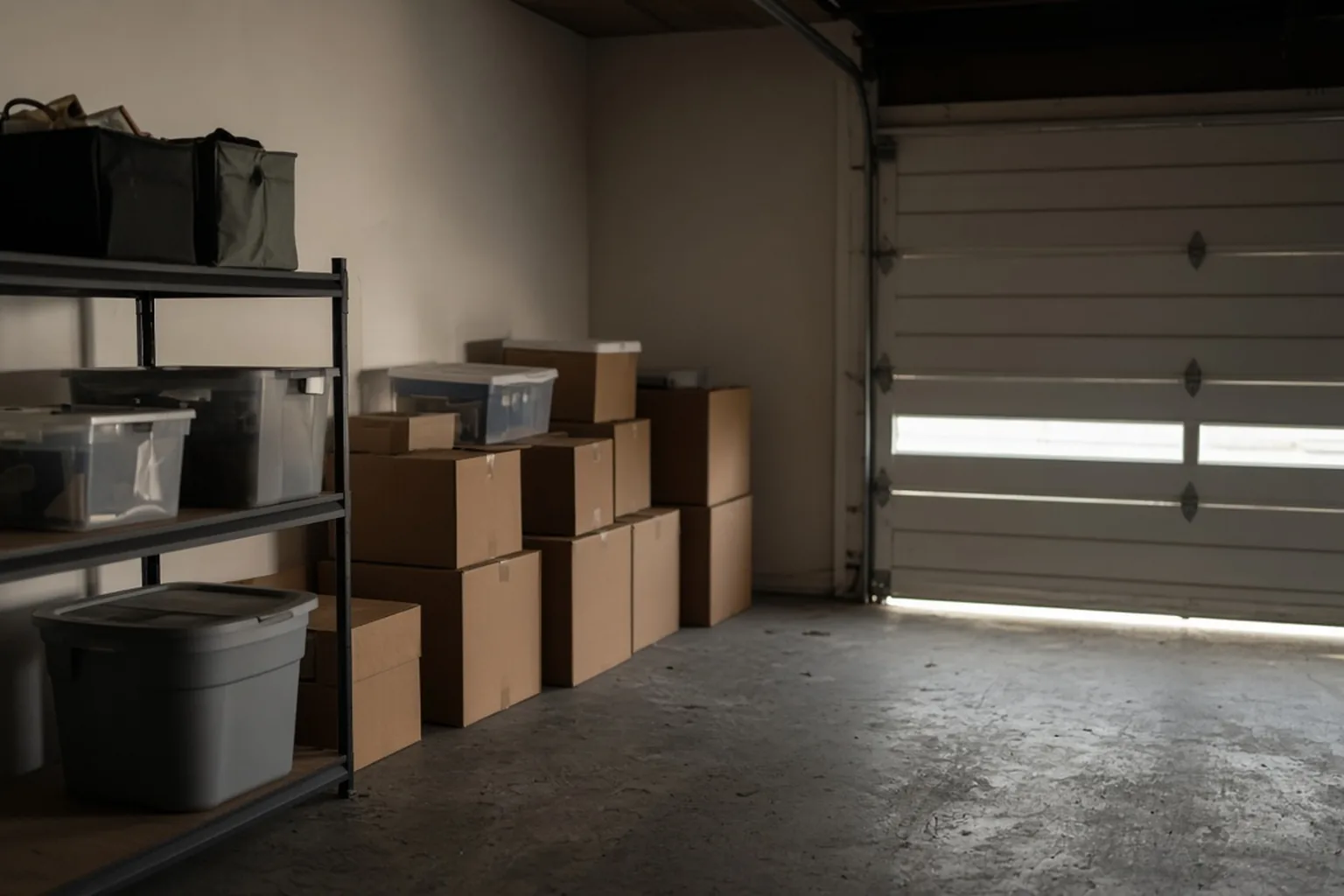 Cardboard boxes make easy nests and the gap under an overhead door makes an easy entrance. Plastic bins and a fresh door seal fix both.
Five mistakes that keep mice coming back to Fishers homes.
One: trapping without sealing. Traps catch the mice inside, but if the gap at the garage door corner or the AC line stays open, new mice walk right in. Across Fishers, where cold nights keep pushing mice indoors from fall until March, an open gap means a steady supply. Two: using foam alone. Mice chew through expanding foam. Pack steel wool first, then seal over it. Three: putting traps in the middle of the floor. Mice run along walls. Set traps flush against the baseboard with the trigger facing the wall. Four: poisoning inside the house. Bait-killed mice often die in walls, and with windows closed in winter the smell lingers. Five: feeding birds next to the house. Spilled seed under a feeder near the deck draws mice and rats every night. Move feeders away from the house and clean up spills. Fix these five and most mouse problems either stop or shrink to an occasional visitor. Most repeat mouse problems trace back to the same handful of missteps.
The Fishers garage in winter: what mice do from December to March.
Winter lows around 20F make the outdoors a hard place to survive, and the garage offers shelter, nesting material, and often food. During these months, mice nest in boxes, lawn equipment, and the insulation in garage walls. They raid stored seed, pet food, and anything in cardboard. They also explore car engine bays, which hold warmth for a while after you park. The garage is also a staging area. Mice follow pipes and wires through gaps in the wall shared with the house, ending up behind the kitchen, laundry room, or basement ceiling. To break the cycle in winter, keep snap traps along the garage walls and check them every few days. Store food in metal bins. Pop the hood of a parked car once a week to look for nests. When the weather allows, seal the gap between the garage and the house so mice have nowhere to go next. By spring, you should be catching nothing. Once a mouse settles in a Fishers garage, it rarely leaves before spring.
 Fall is when rodents head indoors. Leaf piles against the foundation hide burrows and gaps, so clear them and walk the wall before the first cold snap.
When is a rodent problem in Fishers an emergency?
Chewed wiring is the top concern. If you smell hot plastic, see sparks, or find gnawed wires near outlets or in the attic, turn off power to that circuit if you safely can and call an electrician as well as a pest provider. A bite or scratch from a rodent is another. CDC lists rat-bite fever among diseases rodents spread directly. Wash the wound well and contact a doctor. Droppings in a nursery, a food prep area, or on a child's toys need cleanup right away using the bleach method: air out, wear gloves, soak with solution for 5 minutes, and wipe. A rat seen inside the living space of a Fishers home, especially during the day, can signal a large population outside. That calls for a prompt inspection. In each case, ask the provider how quickly they can come out. Most mouse problems can wait a day or two for an inspection, but a few situations call for faster action.
Renting or leasing in Fishers: who pays for rodent control?
In many leases, structural repairs fall to the owner, and sealing gaps in the foundation, siding, or garage door is structural work. Tenants are often responsible for keeping food stored and the home reasonably clean. Read your lease, and if it is unclear, ask in writing. If you rent a house in Fishers and see mice, notify the landlord or property manager right away with dates and photos. Early reporting helps everyone, since a small mouse problem in October can grow by January. For landlords, an inspection between tenants is the cheapest time to seal gaps. In attached rentals, mice travel between units, so coordinating treatment across neighbors works better than treating one unit at a time. Ask providers whether they offer a plan that covers several units or follow-up visits when a tenant calls. Clear communication makes the bill easier to sort out. Responsibility for rodent control in a rental usually depends on the lease and on what caused the problem.
What happens on the day a provider comes out?
Before they leave, ask for the plan and price in writing so you can compare it with other quotes. Expect the first visit to a Fishers home to be mostly inspection, with little or no treatment until the provider knows where rodents are getting in. The technician usually starts outside, walking the foundation and checking the garage door seals, dryer vent, roof vents, window wells, and every spot where pipes and wires enter. They look for gnaw marks, droppings, burrows, and rub marks. Inside, they check the garage, kitchen, laundry room, basement utility area, and attic access. They look under sinks and behind appliances for droppings and nest material. After the walk-through, they should explain what species they found, where the rodents are getting in, and what they recommend. A good plan names each opening and the material they will use to seal it. Some providers seal and set traps during that first visit. Others schedule the sealing for a second one. Either way, ask how many follow-up checks are included and what happens if activity continues.
What affects the price
- Whether the work covers only the garage or the full house.
- The condition of the garage door seal and frame, which may need replacing.
- Signs of Norway rats outside, which add exterior stations and burrow treatment.
- Basement layout, since finished ceilings limit access to runways.
- How many trap checks you want through December and January.
- Any cleanup of nests in insulation or stored belongings.
📊
What's your biggest concern about rodents?
When to call for help
Call right away if you smell hot plastic or see chewed wiring, if anyone has been bitten, if you find droppings in a baby's room or on food prep surfaces, or if you see rat burrows by the foundation. Call for help when trapping keeps catching mice for more than two weeks, which means new ones are still getting in. Families with small children or pets who do not want any bait inside should say so up front and ask how the provider will handle trapping instead.
What you can do yourself
Plenty of Fishers homeowners solve a mouse problem on their own. If you find one or two mice in the garage, a handful of snap traps set flush against the wall, plus steel wool and sealant in the gap you found, usually ends it. A new door sweep and a garage door bottom seal cost little and block the most common entry. Where DIY struggles is the second wave. If you keep catching mice, there is an opening you have not found, and it is often somewhere awkward: the top of the foundation behind siding, a roof vent, or a gap around an air conditioner line. Rats are also tough to trap on your own because they avoid new objects for days. A provider brings ladders, experience, and a checklist of likely gaps. Some people hire out only the inspection and sealing, then handle the trapping themselves.
Rodents in Fishers
The humid continental climate brings summer highs near 84F, winter lows around 20F, and about 42 inches of rain a year, so mice have plenty to eat outdoors through summer and a strong reason to come inside when fall turns cold. The city sits at about 817 feet of elevation, well inland, so the usual Midwest timing holds. With a median home value near $380,000, sealing once usually costs less than replacing wiring or insulation later. Fishers is a suburban city of about 102,000 people near Indianapolis, founded in 1872 and now known as a highly rated suburb and as the home of Conner Prairie. Its rodent pattern follows its suburban layout: attached garages, mulched beds against the foundation, bird feeders, decks, and gardens put food and shelter right next to the house.
Local research
Rodents in Fishers, IN: what the public record shows
Before you compare quotes, it helps to know which rodents actually live in Indiana, when they are busiest around Fishers, and what the state figures look like. Everything below links to the agency or university page it came from.
Rodent species recorded in Indiana
- House mouse (Mus musculus) — Enters at 1/4 inch; 5-10 litters per year; eats about 200 small meals a night.
- Norway rat (Rattus norvegicus) — Burrowing rat of basements, sewers and ground floors; tail shorter than head plus body.
When rodents are busiest around Fishers
Fall entry; winter infestations. Upper Midwest and Northeast: mice in walls and garages all winter.
Based on Fishers’s humid continental climate profile.
Rules that apply in Indiana
For context, nationally
- 1/4 inch (the width of a pencil) — Smallest gap a mouse can enter. CDC
- 890; 35% fatal; 94% west of the Mississippi — Hantavirus cases reported since 1993 (through 2023). CDC
Sources: Indiana DNR Division of Fish & Wildlife; CDC; Pest Notes: House Mouse; Pest Notes: Rats. Figures are quoted as the source prints them. How we check our sources
Simple ways to keep rodents away
- Replace the garage door bottom seal before fall if it is cracked or chewed.
- Keep the garage door closed in the evening, when mice are most active.
- Move bird seed and dog food out of paper sacks and into lidded metal cans.
- Pull mulch back a few inches from the foundation to remove hiding cover.
- Keep the car's engine bay clear of leaves and check it during cold snaps.
- Seal gaps where air conditioning lines and cable wires enter the house.
- Keep firewood racks off the ground and several feet from walls.
 A good rodent quote lists the inspection, the number of trapping visits, each opening to be sealed and the material for it, and any cleanup.
Did you know?
About 35% of the 890 hantavirus cases reported in the U.S. from 1993 through 2023 were fatal.
U.S. residents outside the territories reported 21 leptospirosis cases through early April 2026, nearly matching the 22 in the same stretch of 2025.
Salmonellosis is on CDC's list of illnesses rodents spread directly, usually through food soiled by droppings.
Questions people ask
Why do mice end up in Fishers garages first?
Gaps at the door corners let them in easily. Once Fishers nights drop toward the 20F winter average, the garage becomes the closest heated shelter, and from there mice follow pipes into the house. An attached garage is warm, dark, and full of things mice like: stored seed, pet food, cardboard boxes, and car engines.
Do I need a license to trap mice in Indiana?
The Indiana Department of Natural Resources allows mice, Norway rats, voles, shrews, and moles to be captured or killed year-round without one. You can set traps whenever a problem shows up, and you can hire any provider you choose for the work. No license or permit is required.
Is poison a good way to get rid of mice?
Snap traps let you see each catch. If bait is used outdoors, it should be in locked stations. It is usually not the best first move indoors. A mouse that eats bait often dies inside a wall or ceiling, and the odor can last for weeks with the windows closed in winter.
Could mice damage my car in Fishers?
During cold snaps in Fishers, a parked car in the garage is warm for a while after you drive it, which draws mice in. Check under the hood if you see droppings or nesting material. Yes. Mice and rats nest in engine bays and air filter boxes and sometimes chew wiring.
When is a rodent problem an emergency?
CDC lists rat-bite fever among illnesses rodents spread directly, so clean any bite and call a doctor. Otherwise, most mouse problems can wait a day or two for an inspection. Treat it as urgent if you smell burning plastic, see chewed wiring, find droppings on food surfaces or in a nursery, or someone has been bitten.
How do I clean mouse droppings out of a garage?
Bag everything and wash your gloved hands. Never sweep or blow out a garage with a leaf blower. Open the garage door and let it air out for 30 minutes. Put on rubber gloves, spray droppings with 1.5 cups of bleach per gallon of water, wait 5 minutes, and wipe them up with paper towels.
How long does rodent control take?
If mice keep turning up in a Fishers home after that, an entry point was missed. Rats can take longer because they avoid new traps at first. It depends on how fast every opening gets sealed. Once gaps are closed and snap traps line the walls, catches should taper off and then stop.
Nearby cities
Related guides
Sources (6)
The facts in this article come from the public sources listed above. Every home is different, so ask the company you talk to about pricing and what’s included. Published by Rodent Exterminator · Updated October 11, 2026 · How we write these guides