The short version
Rodent control in Trenton, New Jersey comes down to three steps: seal openings as small as 1/4 inch, trap the mice or Norway rats already inside, and remove the food and cover that draw them in. Expect the heaviest indoor activity from September through November, when winter lows averaging 25F start pushing rodents toward heat.
- House mice and Norway rats are the two structural rodents to plan for in Trenton.
- September through November is the main season rodents move indoors.
- A mouse needs only a 1/4-inch opening, about the width of a pencil.
- New Jersey has no reported hantavirus cases, but droppings still call for careful wet cleanup.
- New Jersey applicators complete 40 hours of on-the-job training per category before licensing.
This page is for Trenton residents who have found droppings, gnaw marks or a rat in the yard and want a clear plan. That includes homeowners, renters working with a landlord, and people who manage small apartment buildings or storefronts. If you share walls with neighbors, pay close attention to the sections on sealing and coordinating work, since rodents move freely between connected spaces.
What to look for
In an urban city of about 90,000 people, trash tends to be concentrated, so one rat colony can easily feed off several properties. Winter lows near 25F then push both species toward heated buildings, with most of the movement from September through November. Summers average about 86F, so outdoor rat colonies grow through the warm months. The weather sets the calendar. According to University of California IPM, a female has 4 to 6 litters a year and weans 20 or more young. They dig burrows along foundations, under slabs and in overgrown corners, then forage 100 to 500 feet looking for food. Norway rats live mostly outside and underground. They breed 5 to 10 times a year and slip through a gap about the width of a pencil, so a single open pipe penetration can supply a steady stream of newcomers. Mice live indoors, nesting in insulation, cabinet bases and the hollow spaces behind appliances. House mice and Norway rats divide the territory.
- 1Small, dark droppings with pointed ends in drawers, under sinks or behind the stove.
- 2Larger droppings, closer to the size of a raisin, near basement walls or trash areas, which point to rats.
- 3Burrow holes with packed dirt runways along the foundation, a fence line or under a concrete pad.
- 4Gnawed corners on doors, baseboards or plastic trash bins.
- 5Scratching inside walls or ceilings at night, often loudest in late fall.
- 6Shredded paper, fabric or insulation bunched into a loose ball in a hidden corner.
- 7Smudge marks along pipes and wall bases where rodents brush past again and again.
Why it’s worth acting soon
- Mice breeding 5 to 10 times a year can turn a few animals into dozens within one winter.
- Norway rat burrows loosen soil along foundations and under slabs.
- The CDC calls rats a key urban reservoir for leptospirosis, which spreads through urine.
- Chewed electrical wiring is a real fire risk.
- In a connected building, an untreated problem in one unit spreads to the next.
Treatment options and typical costs
Sealing and rodent-proofing
Quoted after inspection
Closing gaps around pipes, vents, doors and the foundation with steel wool, hardware cloth, metal flashing or mortar. The CDC's benchmark is 1/4 inch, the width of a pencil, and rats will chew small holes wider if left alone. In older or shared-wall buildings, sealing interior pipe chases matters as much as the exterior.
- Time
- Depends on the number of openings found
- Best for
- Long-term prevention in any building
Interior trapping
Quoted after inspection
Snap traps or enclosed multi-catch traps placed along walls where droppings and rub marks show regular travel. This is the main tool for mice indoors, because they forage close to the nest. A provider should plan to return and check traps rather than set them once and walk away.
- Time
- Continues until captures stop
- Best for
- Mice inside kitchens, basements and wall voids
Burrow and exterior rat control
Quoted after inspection
Treating or collapsing active burrows and placing locked bait stations along the perimeter, trash areas and fence lines. Because Norway rats forage 100 to 500 feet from the nest, the work often has to reach beyond one yard, which can mean talking with neighbors or a property manager.
- Time
- Ongoing, with scheduled station checks
- Best for
- Properties with burrows or rats seen outdoors
Contaminated area cleanup
Quoted after inspection
Removing droppings, nests and soiled insulation and disinfecting with the CDC method: ventilate for 30 minutes, apply a 1:9 bleach solution, let it sit 5 minutes, wipe with paper towels, and never sweep or vacuum dry material. Useful after the rodents are gone.
- Time
- Depends on the size of the affected area
- Best for
- Basements, storage rooms and attics with heavy droppings
Prices are typical published ranges. Ask what’s included before you compare quotes.
 Crawl spaces are where rats and mice get comfortable. Vent screens, the sill plate and any gap around pipes are worth a careful look.
Why do Norway rats do so well in Trenton?
Rats thrive where food, water and shelter sit close together, and a dense urban city like Trenton supplies all three. Norway rats nest in burrows dug along foundations, under concrete pads and beside fences, then forage up to 500 feet for a meal. Overflowing trash, pet food left outside, compost and bird feeders all qualify. Their breeding pace makes a small colony grow fast. University of California IPM puts a female Norway rat at 4 to 6 litters a year, weaning 20 or more young. Summers averaging around 86F give those litters a long, comfortable season outdoors. Water is part of the picture. With roughly 47 inches of rain a year, there is usually a puddle, a clogged gutter or a damp drain nearby. The CDC names rats as a key urban reservoir for leptospirosis, so standing water near a burrow is worth fixing for more than one reason. One property can't solve a block-wide rat problem alone. Removing food and sealing your foundation makes your building the least appealing one on the street, which is often enough.
When is a rodent problem in Trenton an emergency?
Most mouse problems are urgent but not emergencies. A few situations call for faster action. A rat inside the living space, especially near a crib or where small children play, is one. Rats bite when cornered, and rat-bite fever is on the CDC's list of illnesses rodents spread directly. Keep kids and pets out of the room and shut the door until the animal is trapped or removed. Chewed wiring is another. If you find gnawed insulation on electrical cables, or smell hot plastic near an outlet, have an electrician check it before anything else. Droppings in a food business are a third. A Trenton restaurant or grocery with rodent evidence in prep areas faces contamination problems and needs a licensed provider right away. Last, a strong dead-animal smell inside a wall means a rodent died somewhere you can't reach. The odor isn't dangerous by itself, but removal may require cutting a small opening in drywall, and it usually signals that poison bait was used indoors.
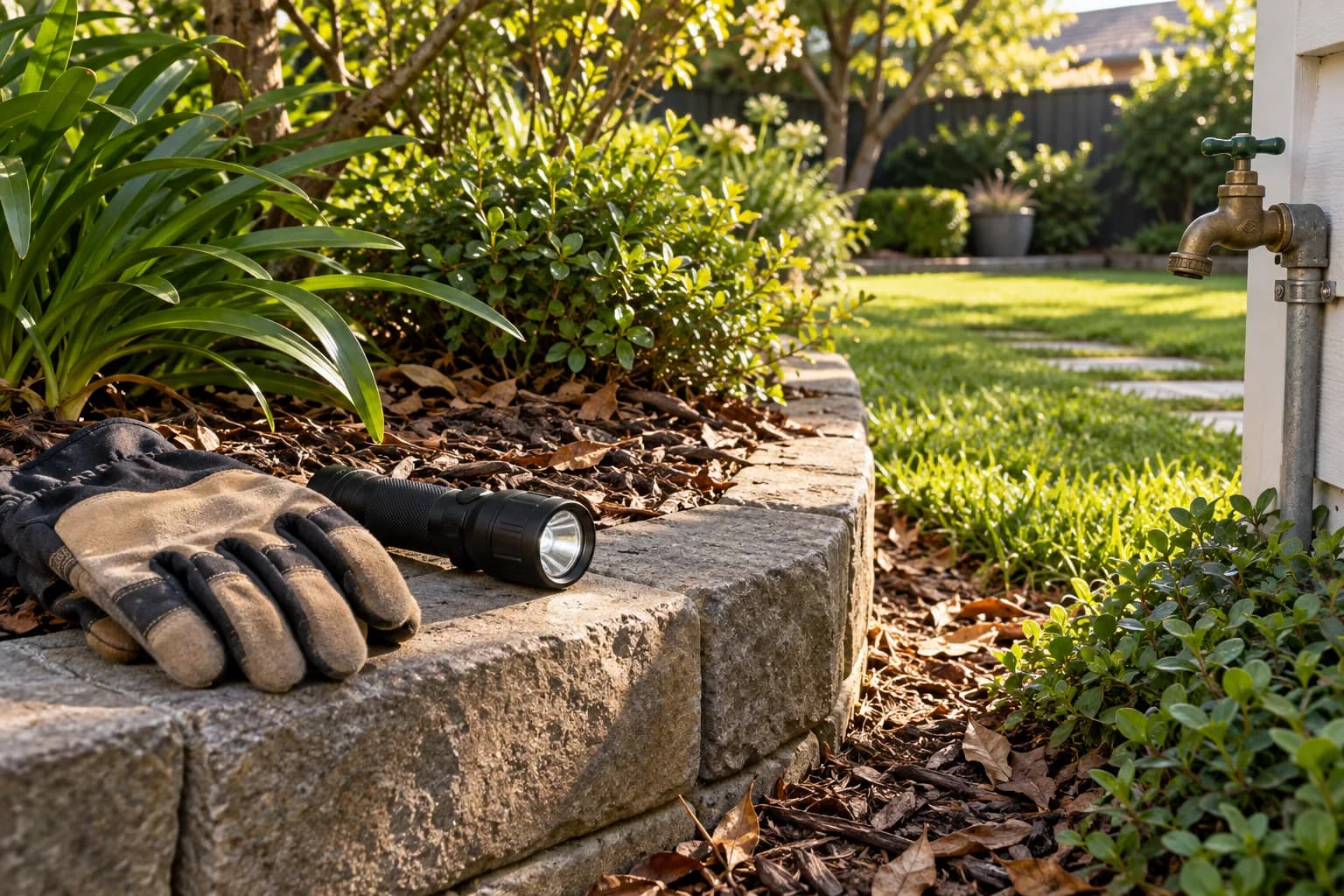 Dense shrubs against the house and a dripping hose bib give rodents cover and water. Trimming back and fixing drips makes the yard less inviting.
Sharing walls with neighbors: rodents in connected buildings.
If your home shares a wall, a basement or a roofline with neighbors, you're managing one rodent population spread across several units. Mice that fit through a 1/4-inch gap pass easily from one unit to the next through pipe chases, utility openings and gaps behind kitchen cabinets. Start inside your own space. Seal under the sink, behind the stove and dishwasher, and anywhere pipes pass through a wall or floor. Steel wool packed tight and covered with caulk or patching compound stops mice better than foam alone, which they chew straight through. Then talk to the people next door or to the building owner. A Trenton unit that traps and seals while its neighbor does nothing will keep catching mice all fall, because the source sits a few feet away inside the shared wall. When you hire a provider for a connected building, ask whether the plan covers shared spaces such as basements, utility rooms and trash areas. Treating one unit in isolation tends to push the problem sideways. Get the scope in writing so every party knows what is covered.
What does a New Jersey 7A license tell you about a provider?
It tells you the applicator was trained and tested for household pest and rodent work. New Jersey has certified pesticide applicators through the NJDEP Pesticide Control Program since 1975. A commercial applicator first passes a Core exam, then adds categories, and rodent control sits under category 7A, General and Household Pest Control. Training happens on the job before the license is issued. According to Rutgers Pesticide Applicator Training, a new commercial applicator completes 40 hours of on-the-job training in each category first. The license is valid for one year, and staying certified takes 8 Core credits and 16 category credits within five years. That ongoing education matters for rodent work because bait products, station designs and rules change over time. For a Trenton homeowner, the license is a sensible first filter, not the whole story. Once you've confirmed it, ask how the company finds entry points, what it uses to seal them, how it keeps bait away from children and pets, and what follow-up the price includes.
How to compare two rodent quotes for a Trenton home.
Line up the quotes by scope, not by the total. A quote that covers only bait or traps will come in lower than one that includes sealing, but the cheaper one often leads to a second call when the cold returns. With median home values in Trenton near $110,000, every dollar counts, so it pays to know exactly what you are buying. Check each quote against these questions. Which openings did the inspector find, and which will be sealed? Look for specific locations and materials such as steel wool, hardware cloth, flashing or mortar. Does the plan cover rats outside, mice inside, or both? If burrows were found, exterior work should be listed. How many return visits are included, and what does an extra one cost? Is cleanup of droppings and nesting material part of the job, done to CDC guidance? Is the applicator licensed in New Jersey category 7A? The stronger quote is the one that answers all five in writing.
What affects the price
- The number and size of openings, especially around utility lines and pipe chases.
- Whether rats are burrowing outside, which adds exterior work and station service.
- Building type, since a detached house is simpler to seal than a multi-unit building with shared walls.
- Basement condition, because cracked foundations and floor drains take extra sealing.
- How much cleanup is needed and whether insulation must be replaced.
- Whether the plan is a one-time job or ongoing service.
📊
What's your biggest concern about rodents?
When to call for help
Ask any provider for the license and which category it covers. In New Jersey, rodent work falls under category 7A, General and Household Pest Control, and an applicator must pass a Core exam plus the category exam. The same applies when mice keep turning up after two weeks of trapping and sealing, when you smell a dead rodent inside a wall, or when droppings show up in a business's food prep area. Call for help as soon as you see rats, since Norway rats are hard to clear from one property and often have burrows you can't reach.
What you can do yourself
Handling a few mice yourself is realistic. Snap traps are cheap, and set flat against the wall along a known path they work well. Pack steel wool tightly into pipe gaps under sinks and caulk over it, and add door sweeps anywhere you see daylight. With Trenton's median home value around $110,000, doing the simple work yourself often makes good sense, and for a single-family home it may be all you need. Rats change the math. A colony may live under a neighbor's slab or along a shared fence line, and reaching the burrows takes more than a few traps on your side. Pros also take on jobs that are unpleasant or risky for a homeowner, like pulling contaminated insulation or placing bait in locked stations away from children and pets. If you go the DIY route, give it two weeks of honest effort, then reassess.
Rodents in Trenton
Trenton was founded in 1719 and is now New Jersey's state capital, an urban city of about 90,000 people known for the Trenton Makes Bridge. Whatever a building's age, foundations, pipe runs and utility entries are where mice find their gaps. Density matters too: when buildings sit close together, trash and food are concentrated and rats move easily from one lot to the next. The city sits only about 52 feet above sea level and gets roughly 47 inches of rain a year, enough to keep soil soft and leave puddles rats can drink from. Humidity averages around 65%, and summer highs near 86F keep outdoor colonies growing until fall. With a median home value near $110,000, many residents weigh costs carefully, which makes cheap prevention like door sweeps and steel wool especially worthwhile.
Local research
Rodents in Trenton, NJ: what the public record shows
Before you compare quotes, it helps to know which rodents actually live in New Jersey, when they are busiest around Trenton, and what the state figures look like. Everything below links to the agency or university page it came from.
Hantavirus in New Jersey
The state health department still lists rodent infestation in and around the home as the primary exposure risk.
New Jersey Department of HealthRodent species recorded in New Jersey
- House mouse (Mus musculus) — Enters at 1/4 inch; 5-10 litters per year; eats about 200 small meals a night.
- Norway rat (Rattus norvegicus) — Burrowing rat of basements, sewers and ground floors; tail shorter than head plus body.
When rodents are busiest around Trenton
Fall entry (Sept-Nov). Norway rats and house mice move indoors as temperatures drop.
Based on Trenton’s humid subtropical climate profile.
New Jersey's commercial pesticide program began in 1975 under the NJDEP Bureau of Licensing and Registrations; applicants pass a Core exam then add categories such as 7A.
Rules that apply in New Jersey
For context, nationally
- 1/4 inch (the width of a pencil) — Smallest gap a mouse can enter. CDC
- 890; 35% fatal; 94% west of the Mississippi — Hantavirus cases reported since 1993 (through 2023). CDC
Sources: New Jersey Department of Health; Rutgers Pest Management Office, Rutgers, The State University of New Jersey; CDC; Pest Notes: House Mouse; Pest Notes: Rats. Figures are quoted as the source prints them. How we check our sources
Simple ways to keep rodents away
- Use metal trash cans with tight lids and keep them off bare soil, where rats like to dig.
- Pack steel wool into gaps around pipes under sinks and behind the washer, then caulk over it.
- Install door sweeps and check garage and basement doors for daylight at the bottom.
- Fix downspouts and slope soil away from the foundation, since about 47 inches of yearly rain keeps ground soft.
- Feed pets indoors and pick up bowls overnight.
- Store basement items in sealed plastic bins on shelves, not on the floor.
- Clear weeds, ivy and debris from foundations and fence lines where burrows hide.
- Coordinate with neighbors on trash and clutter, because rats ignore property lines.
 A good rodent quote lists the inspection, the number of trapping visits, each opening to be sealed and the material for it, and any cleanup.
Did you know?
Of the 890 U.S. hantavirus cases reported from 1993 through 2023, 94% occurred west of the Mississippi River.
A single female Norway rat can wean 20 or more young in a year.
New Jersey's commercial applicator license is valid for only one year at a time.
Questions people ask
Why do I see more mice in Trenton in the fall?
Cold nights drive them in. Trenton's winter lows average around 25F, and from September through November house mice and Norway rats move toward heated buildings. A mouse needs just a 1/4-inch opening, so late summer is the time to close gaps before that seasonal shift begins.
Has hantavirus been found in New Jersey?
No. New Jersey's Department of Health has no record of a reported hantavirus case anywhere in the state. The department still names rodent infestation in and around the home as the main exposure risk, which is why the CDC's wet cleanup method is worth following in Trenton basements and garages.
What license should a rodent company have in New Jersey?
Look for a commercial applicator licensed in category 7A, General and Household Pest Control. New Jersey requires 40 hours of on-the-job training in each category before licensing, plus a Core exam. The license renews every year, and applicators must earn 8 Core and 16 category credits within five years to stay certified.
Can rats get into my house from my neighbor's yard?
Yes, easily. Norway rats forage 100 to 500 feet from the nest, so in a dense Trenton neighborhood the burrow could be several lots away. Sealing your own foundation and trash area still helps, but lasting control often means neighbors or a landlord dealing with the colony at its source.
Should I worry about leptospirosis from rats?
It's uncommon, but worth basic care. The CDC calls rats a key urban carrier, and federal surveillance counted 21 U.S. cases in the first 13 weeks of 2026. Because the bacteria travel in urine, wear gloves when cleaning areas rats use, wash up after yard work, and don't let water stand near burrows.
How do I clean up after mice?
Ventilate first. Open windows for 30 minutes, then put on gloves and soak droppings and nest material with a 1:9 bleach solution, about 1.5 cups of bleach per gallon. Wait 5 minutes, wipe with paper towels and throw them out. The CDC warns against sweeping or vacuuming dry droppings because that raises dust.
Why do mice keep coming back after I trap them?
The entry points are still open. Trapping removes the mice you have, but a pencil-width gap lets new ones in, especially once Trenton's fall cold arrives. Pair trapping with sealing around pipes, vents and doors, and check shared walls and pipe chases if you live in a connected building.
Nearby cities
Related guides
Sources (6)
The facts in this article come from the public sources listed above. Every home is different, so ask the company you talk to about pricing and what’s included. Published by Rodent Exterminator · Updated October 11, 2026 · How we write these guides