The short version
Rodent control in Waukesha, Wisconsin, starts with exclusion, which UW-Madison Extension treats as the core of rodent management. Block openings over 1/4 inch for mice and 1/2 inch for rats, and for Norway rats proof a band 36 inches above and below grade. Then set at least a dozen traps. Mice push indoors in fall as lows head toward 15F.
- UW-Madison Extension puts exclusion first and trapping second.
- Use 24-gauge, 1/4-inch hardware cloth for mice and 1/2-inch for rats.
- Norway rat proofing covers a band 36 inches above and below ground level.
- A dozen traps is the minimum for a house; mice traps ideally 3 feet apart.
- Rats keep testing new sealing for about two weeks, so watch it closely.
This is for Waukesha homeowners finding mice in the kitchen or garage, people with rat burrows along the foundation, and renters who need to know what to report. It's also for anyone who has set two or three traps without much luck and wants to know what a proper setup looks like.
What to look for
Three rodents cause most of the trouble in Waukesha homes. House mice nest in walls, kitchens, and garages and stay all winter once inside. Deer mice spend summer outdoors and move into garages, sheds, cabins, and attics as the weather cools. Norway rats burrow along foundations and work the line where the building meets the soil, looking for openings. Waukesha's climate drives a strong seasonal pattern. Summers are mild, averaging 82F, and about 33 inches of rain a year keeps yards growing through the warm months. Winter is the defining season: lows average about 15F, and as temperatures drop in fall, rodents move indoors. Across the Upper Midwest, mice live in walls and garages all winter, breeding the entire time. UW-Madison Extension's guidance treats exclusion as the core of rodent management. That fits Waukesha well. Trapping removes the mice already in your walls, but in a climate this cold, rodents keep arriving all fall until the openings are closed.
- 1Droppings along garage walls, in kitchen drawers, or behind the furnace.
- 2Burrows along the foundation, often right at the soil line.
- 3Gnaw marks on fresh sealant, foam, or weatherstripping.
- 4Scratching in the walls or ceiling at night, starting in September or October.
- 5Shredded nesting material in boxes, insulation, or a seldom-used drawer.
- 6Chewed bags of bird seed, grass seed, or pet food in the garage.
- 7A stale, musky odor in a closed cabinet or storage area.
Why it’s worth acting soon
- Mice that get in during fall breed through Waukesha's long winter inside walls.
- Gnawed wiring in garages, walls, and attics is a fire hazard.
- Droppings contaminate stored food and kitchen surfaces.
- Norway rat burrows along the foundation can undermine soil and slab edges.
- Deer mouse droppings in closed sheds and garages pile up and need careful cleanup.
Treatment options and typical costs
Exclusion with the right materials
Quoted after inspection
Blocking openings over 1/4 inch for mice and 1/2 inch for rats, using 24-gauge, 1/4-inch hardware cloth for mice and 1/2-inch hardware cloth for rats, as UW-Madison Extension specifies. For Norway rats, that includes a band 36 inches above and below grade.
- Time
- Depends on how much foundation work is needed
- Best for
- Every home, before fall
Trapping at proper density
Quoted after inspection
At least a dozen traps for a private home, with mouse traps no more than 10 feet apart and 3 feet preferred, and rat traps at least 20 feet apart. UW-Madison Extension also says to move traps that haven't caught anything after seven days.
- Time
- Until captures stop, moving idle traps after seven days
- Best for
- Mice and rats already inside
Post-sealing monitoring
Quoted after inspection
Checking new exclusion work for about two weeks, since UW-Madison Extension notes rats may keep trying to break through fresh rodent proofing. Any new gnawing gets patched quickly. Ask whether follow-up checks are part of the quote.
- Time
- About two weeks after sealing
- Best for
- Homes with Norway rats
Exterior bait stations
Quoted after inspection
Locked stations outside along the foundation for persistent Norway rat activity, used alongside exclusion and trapping. Ask what product goes in, how stations are anchored, and how they're kept away from pets and children.
- Time
- Ongoing, with scheduled service
- Best for
- Norway rats burrowing outdoors
Prices are typical published ranges. Ask what’s included before you compare quotes.
 Bathroom vanities hide the same plumbing gaps as the kitchen. A quick look with a flashlight shows droppings or rub marks long before you see a mouse.
The 36-inch band: rat-proofing a Waukesha foundation.
Ask whether below-grade proofing is part of their quote. If you see active burrows along your foundation, this is usually a job for a provider with the right tools. Winter lows near 15F make digging impractical for months. Around Waukesha, the best time for this work is late summer, before the ground freezes and before fall entry starts. Burying hardware cloth vertically along the foundation, down to about 36 inches, blocks that route. Rats burrow along the foundation to find gaps in the footing or around buried utility lines. The below-grade part is what most people skip. Close anything over 1/2 inch with 1/2-inch hardware cloth, mortar, or metal flashing. Check where siding meets the foundation, around pipes and AC lines, dryer vents, basement windows, and the bottom of the garage door. The above-grade part is familiar work. That's why UW-Madison Extension recommends rat-proofing as a band: block all openings from 36 inches above grade to 36 inches below. They work the whole foundation line, and they dig. Norway rats don't just look for holes at ground level.
Why a dozen traps is the starting point in a Waukesha house.
In a Waukesha house in October, a dozen well-placed traps usually make a fast difference. Shift it toward fresh signs. A trap that's caught nothing in a week is probably off the route. UW also gives a rule for traps that aren't working: move them after seven days. Check them daily. Set traps against walls, with the trigger facing the wall, where you see droppings or grease marks. Placement matters as much as number. UW calls for rat traps a minimum of 20 feet apart, along foundations, walls, and burrow routes. Rats are different. A kitchen, garage, and basement together easily reach a dozen. A single wall with mouse activity might need three or four traps. Mice don't range far from their nest, so UW recommends mouse traps no more than 10 feet apart, with 3 feet preferred. Spacing explains why. Most homeowners set two or three, which is why so many trapping efforts stall. In a warehouse, they note, 50 to 100 is not excessive. UW-Madison Extension's applicator training sets a clear minimum: a dozen traps for a private dwelling.
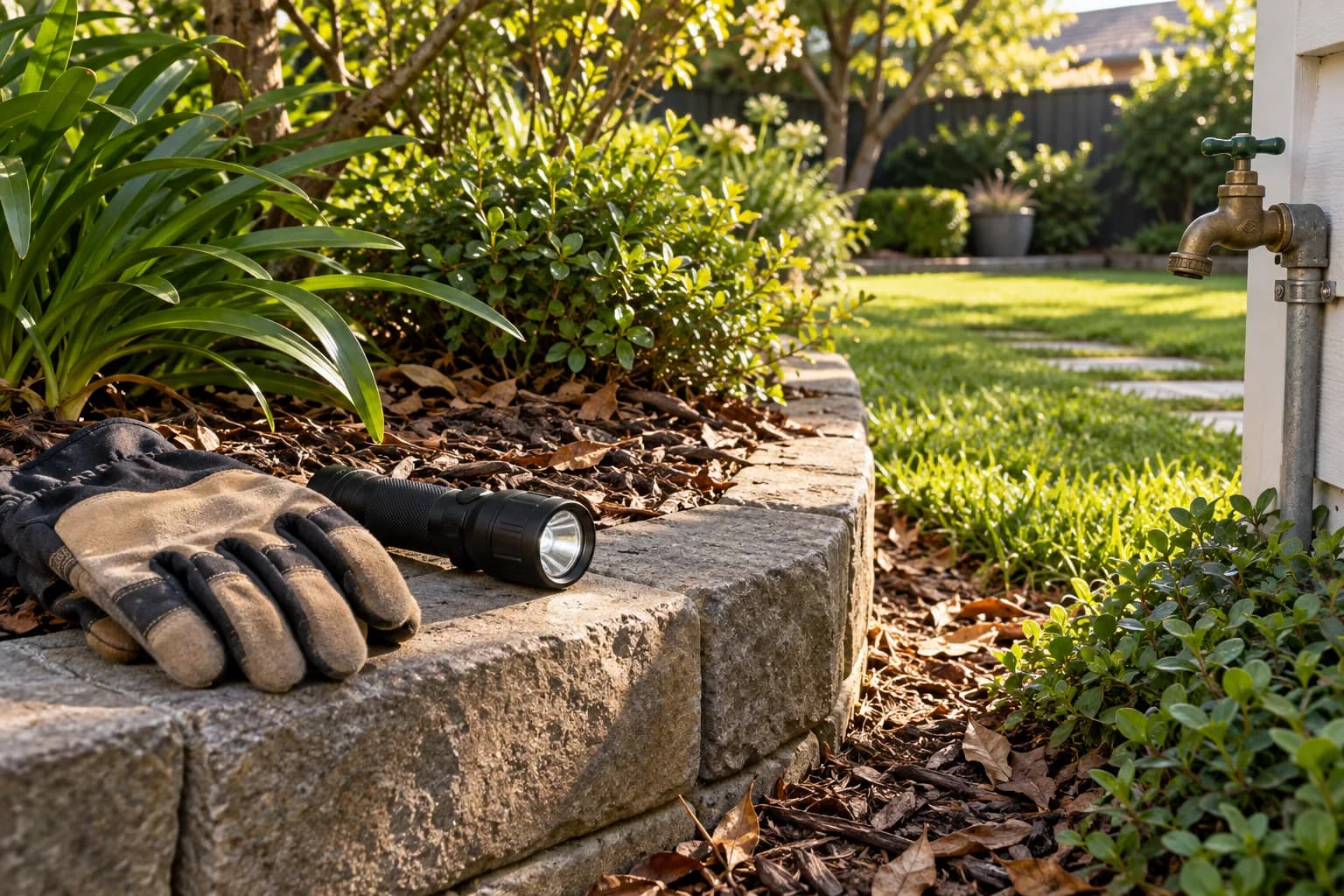 Dense shrubs against the house and a dripping hose bib give rodents cover and water. Trimming back and fixing drips makes the yard less inviting.
Choosing the right hardware cloth for mice and rats.
It's easy to chew, and in a cold climate it often cracks. Avoid relying on foam alone. Fasten hardware cloth with screws and washers or masonry anchors, and overlap seams. Rodents will push at loose corners. Secure the edges well. Use the 1/2-inch mesh for the buried band along the foundation if Norway rats are active. Use the 1/4-inch mesh over foundation vents, dryer vent openings, gaps around utility lines, and anywhere mice could get in. In a Waukesha home, you'll often need both. It's sturdier and easier to work with in large sections, which helps for below-grade foundation proofing. For rats, 1/2-inch hardware cloth works, since rats need an opening over 1/2 inch. The 24-gauge wire is stiff enough that mice can't easily chew or push through it. Mice fit through anything over 1/4 inch, so a larger mesh won't stop them. For mice, use 24-gauge hardware cloth with 1/4-inch openings. UW-Madison Extension is specific about what to use. Hardware cloth is the backbone of rodent exclusion, but the wrong mesh lets rodents right through.
What happens in the two weeks after you seal a Waukesha home.
If you hire a provider, ask whether follow-up checks during these two weeks are included. If you seal in October, you're dealing with testing and new arrivals at the same time. If you seal in late summer, the two-week testing period ends before the fall push begins. Around Waukesha, timing matters. Any rodents trapped inside by the new sealing will be looking for a way out, and they'll be active. Keep traps set inside during this period. Patch anything that's been damaged right away, using stronger material if needed. Look for fresh gnaw marks on sealant, bent hardware cloth, or soil disturbed along the foundation. During those two weeks, check your sealing work every few days. Mice do the same on a smaller scale. When an opening they've been using is suddenly closed, they come back to it, gnaw at the edges, and look for weak spots nearby. That's because rats have established routes. UW-Madison Extension notes that rats may keep trying to break through fresh rodent proofing for about two weeks. Sealing a house doesn't end the problem the day it's finished.
Waukesha's long winter and the rodents that come with it.
This is the time to seal, before the cycle starts again. June through August: With summers averaging 82F and about 33 inches of rain a year, outdoor rodents breed. Clean any droppings wet, with ventilation and diluted bleach. March through May: Deer mice move back outside, and people open sheds and garages for spring. Trapping works well now because they're confined. Across the Upper Midwest, mice stay all winter and keep breeding, so numbers can grow even without new arrivals. December through February: Rodents that got in settle into walls and garages for the winter. Most Waukesha households first notice scratching in walls, droppings in the garage, or chewed seed bags during these weeks. October and November: The main entry window. Mice slip into garages, and deer mice head for sheds and attics. September: The first cool nights bring early arrivals. With lows averaging about 15F, outdoor survival gets hard, and mice, deer mice, and rats look for heated buildings as soon as fall arrives. Waukesha's winter is the main reason rodents end up inside.
What affects the price
- The number of openings and whether they need 1/4-inch or 1/2-inch hardware cloth.
- Whether the 36-inch band for Norway rats requires digging below grade.
- Garage door seals, dryer vents, and utility penetrations.
- How many traps are needed, starting at a dozen for a typical house.
- Follow-up visits during the two weeks rats test new sealing.
- Droppings cleanup in garages, sheds, or attics.
📊
What's your biggest concern about rodents?
When to call for help
A provider can reinforce those spots. And if you've sealed openings yourself but find fresh gnawing on the patches, that's rats testing the work, which UW-Madison Extension says can go on for about two weeks. Call too if mice keep turning up after you've set a dozen traps and sealed what you can find, or if you hear activity in several parts of the house. Call a provider when you find burrows along the foundation, since proofing a band 36 inches above and below grade usually means digging and hardware cloth work.
What you can do yourself
You can handle a lot of Waukesha mouse work yourself if you follow UW-Madison Extension's numbers. Start with sealing: 24-gauge, 1/4-inch hardware cloth over vents and gaps, steel wool packed into small holes with sealant over it, and a new garage door seal if yours is worn. Then trap seriously. A dozen traps is UW's minimum for a house, spaced about 3 feet apart along walls where you see droppings and never more than 10 feet apart. Where a provider earns the fee is with Norway rats. Rat proofing covers a band from 36 inches above grade to 36 inches below, which means digging along the foundation and installing 1/2-inch hardware cloth underground. Rat traps go at least 20 feet apart across the yard, and rats keep testing fresh sealing for about two weeks. A sensible split: you trap mice, store food in sealed bins, and keep the garage tidy. A provider handles rat proofing and any outdoor stations.
Rodents in Waukesha
Waukesha is a suburban city of about 72,000 people, founded in 1834 and known as a guitar town and the hometown of Les Paul. It's suburban, and wherever a house has a garage or a basement, rodents have plenty of ways in. The city sits at 820 feet in a humid continental climate with mild summers averaging 82F, hard winters with lows around 15F, about 33 inches of rain a year, and 72% average humidity. Those winters are the main driver of rodent problems: when temperatures drop in fall, mice, deer mice, and rats push toward heated buildings and stay until spring. Around Waukesha, a basement or attached garage, where a house has one, is usually where activity shows up first. With a median home value near $285,000, investing in proper hardware cloth and foundation proofing once costs far less than repairing chewed wiring or insulation year after year.
Local research
Rodents in Waukesha, WI: what the public record shows
Before you compare quotes, it helps to know which rodents actually live in Wisconsin, when they are busiest around Waukesha, and what the state figures look like. Everything below links to the agency or university page it came from.
Rodent species recorded in Wisconsin
- House mouse (Mus musculus) — Enters at 1/4 inch; 5-10 litters per year; eats about 200 small meals a night.
- Norway rat (Rattus norvegicus) — Burrowing rat of basements, sewers and ground floors; tail shorter than head plus body.
- Deer mouse (Peromyscus maniculatus) — Primary U.S. hantavirus carrier; lives throughout Washington and the interior West.
When rodents are busiest around Waukesha
Rodents move indoors as Wisconsin temperatures drop in fall.
UW-Madison Extension's applicator training treats exclusion as the core of rodent management, with trapping second.
For context, nationally
- 1/4 inch (the width of a pencil) — Smallest gap a mouse can enter. CDC
- 890; 35% fatal; 94% west of the Mississippi — Hantavirus cases reported since 1993 (through 2023). CDC
Sources: University of Wisconsin-Madison Division of Extension; CDC; Pest Notes: House Mouse; Pest Notes: Rats; Hantavirus. Figures are quoted as the source prints them. How we check our sources
Simple ways to keep rodents away
- Cover vents and small openings with 24-gauge, 1/4-inch hardware cloth.
- Replace worn garage door seals and add sweeps to exterior doors.
- Keep bird seed, grass seed, and pet food in metal bins with tight lids.
- Check the foundation line for burrows each spring and fall.
- Seal utility penetrations with steel wool and sealant before September.
- Keep firewood and stored items off the ground and away from walls.
- Air out closed sheds and garages before cleaning droppings in spring.
 Before you call, sketch where you have seen droppings or heard noise and measure any gaps you found. It makes the first visit faster and the quotes comparable.
Did you know?
UW-Madison Extension says 50 to 100 traps is not excessive for a warehouse, compared with a minimum of a dozen for a house.
CDC lists lymphocytic choriomeningitis, or LCM, among the infections rodents can spread directly to people, alongside leptospirosis and salmonellosis.
Roof rats, the warm-climate climbing cousin of the Norway rat, have 3 to 5 litters a year with up to 8 young each.
Questions people ask
How many mouse traps do I need for my Waukesha house?
UW-Madison Extension calls a dozen traps the minimum for a private dwelling. Space mouse traps no more than 10 feet apart, ideally about 3 feet, along walls where you see droppings. Most Waukesha homeowners who struggle with mice are using too few traps spread too far apart.
What hardware cloth should I use to keep mice out?
UW-Madison Extension specifies 24-gauge hardware cloth with 1/4-inch openings for mice, since they fit through anything over 1/4 inch. For rats, 1/2-inch hardware cloth works. On a Waukesha home, use it over foundation vents, dryer vent openings, and any gap too large for steel wool.
When do mice come inside in Waukesha?
Mostly from September through November, as temperatures drop toward Waukesha's 15F winter average. Once inside, mice stay in walls and garages all winter. Sealing in August, before the cold sets in, keeps most of them out rather than trapping them later.
Why are rats still chewing at the spots I sealed?
That's normal at first. UW-Madison Extension notes rats may keep trying to break through fresh rodent proofing for about two weeks. Check your Waukesha sealing work every few days during that time and patch any new damage. If gnawing continues past two weeks, the material may need upgrading.
How far down do I need to rat-proof my foundation?
UW-Madison Extension recommends blocking all openings in a band 36 inches above and 36 inches below grade, because Norway rats work the foundation line and burrow. Around Waukesha, that often means burying 1/2-inch hardware cloth along the foundation where burrows are active.
Should I move traps that aren't catching anything?
Yes, after a week. UW-Madison Extension advises moving unproductive traps after seven days. Shift them to spots with fresh droppings, gnaw marks, or grease trails. Don't move them sooner, since rats in particular may need several days to approach a new trap.
Are deer mice in Wisconsin a hantavirus risk?
The risk is low. Wisconsin wasn't among the states in CDC's provisional count of 17 hantavirus cases for 2025, and 94% of U.S. cases since 1993 occurred west of the Mississippi. Deer mice do live around Waukesha, though, so clean droppings wet with diluted bleach and never sweep.
Nearby cities
Related guides
Sources (6)
The facts in this article come from the public sources listed above. Every home is different, so ask the company you talk to about pricing and what’s included. Published by Rodent Exterminator · Updated October 11, 2026 · How we write these guides