The short version
Rodent control in Ames, Iowa works best as sealing plus trapping, done before the fall move-in. Deer mice and white-footed mice head indoors from September into November as outdoor food runs out, while house mice stay all year. Close every gap of 1/4 inch or more with steel wool and metal flashing, then set snap traps in pairs along the walls.
- Native mice move into Ames buildings in fall; house mice live indoors year-round.
- Any gap a pencil fits through is wide enough for a mouse.
- Pack steel wool before foam, because foam on its own gets chewed open.
- Iowa State favors paired snap traps over glue boards, poison-first plans and ultrasonic plug-ins.
- Stored corn, bird seed and pet food are what keep mice in a house all winter.
This is for Ames homeowners who found droppings in a pantry or garage, landlords and tenants sorting out mice in a rental near campus, and anyone keeping bird seed, deer corn or pet food in an outbuilding. It also fits people who already set a few traps, caught some mice, and want to know why more keep showing up.
What to look for
Ames has two mouse problems stacked on top of each other. The first is the house mouse, which lives its whole life indoors and keeps breeding through winter in wall voids, under appliances and behind stored boxes. The second is a seasonal wave of native mice. Iowa State's mouse damage guidance says deer mice and white-footed mice raise their young outdoors in spring and summer, then come inside as fields and gardens stop producing food. Around Ames that switch lines up with the first hard frosts, so most trouble starts between September and November. The weather sets this up. Summer highs near 84 degrees and about 36 inches of yearly rain grow plenty of seed for mice to fatten on, then winter lows near 12 degrees make a heated basement very appealing. Norway rats show up less often, mostly around feed storage, compost or outbuildings, and they dig burrows rather than climbing into attics the way mice do.
- 1Dark, rice-sized droppings along baseboards, in cabinet corners or on top of stored boxes.
- 2Little piles of corn kernels, sunflower hulls or kibble tucked into a drawer, boot or wall cavity.
- 3Light running or scratching in the ceiling after dark, loudest on the coldest nights.
- 4Shredded insulation, paper or fabric balled into a loose nest near the furnace or water heater.
- 5Chewed corners on cereal boxes, seed bags or the plastic lids of garage storage bins.
- 6A stale, ammonia smell inside a cupboard or closet that stays shut for weeks.
- 7Greasy gray rub marks where mice squeeze past a pipe hole or along the same wall edge.
Why it’s worth acting soon
- House mice keep breeding indoors all winter, so a few in October can be dozens by February.
- Mice gnaw wiring insulation inside walls and attics, a fire hazard you cannot see.
- Urine and droppings soak into insulation and ductwork, and the cleanup grows every month.
- Deer mouse nests can carry hantavirus, and disturbing old nests is how people get exposed.
- Hidden caches of seed in wall voids draw insects and keep pulling new mice back.
890, with 94% west of the MississippiU.S. hantavirus cases reported, 1993 to 2023CDC 17, none of them in IowaProvisional U.S. hantavirus cases in 2025CDC NNDSS Treatment options and typical costs
Paired snap-trap program
Quoted after inspection
Snap traps set two at a time along walls, with the baited ends pointing in opposite directions, is the method Iowa State's extension guide recommends. It works because mice travel along edges rather than across open floor. It suits most Ames homes with a modest indoor population, and counting catches tells you whether new mice are still getting in.
- Time
- Until catches stop, with checks the provider schedules
- Best for
- Active mice in kitchens, basements and garages
Exclusion and sealing
Quoted after inspection
The provider checks the foundation, sill plate, utility openings, garage door seals, roof edges and attic vents, then closes anything 1/4 inch or wider. Steel wool goes in first and gets covered with foam, and metal flashing handles bigger gaps. This is the step that ends the yearly fall move-in instead of just catching this year's mice.
- Time
- Depends on how many openings turn up
- Best for
- Homes that get mice every autumn
Exterior bait stations as a second step
Quoted after inspection
Locked, tamper-resistant stations around the outside can thin a heavy outdoor population, but Iowa State advises against poison as the first response. Mice that eat bait may die inside a wall and leave an odor. Ask whether the provider plans to use bait at all, where the stations go, and how pets and kids are kept away.
- Time
- Ongoing, checked at each service visit
- Best for
- Field-edge lots, outbuildings and heavy outdoor pressure
Droppings and nest cleanup
Quoted after inspection
Once trapping is finished, nests and droppings in attics, garages and storage areas have to come out. The CDC method is to air the space, soak everything with diluted bleach, and wipe it up rather than sweep. Some providers price this as a separate job, and it matters most where deer mice were nesting.
- Time
- Depends on how much nesting is found
- Best for
- Attics, sheds and garages with heavy droppings
Prices are typical published ranges. Ask what’s included before you compare quotes.
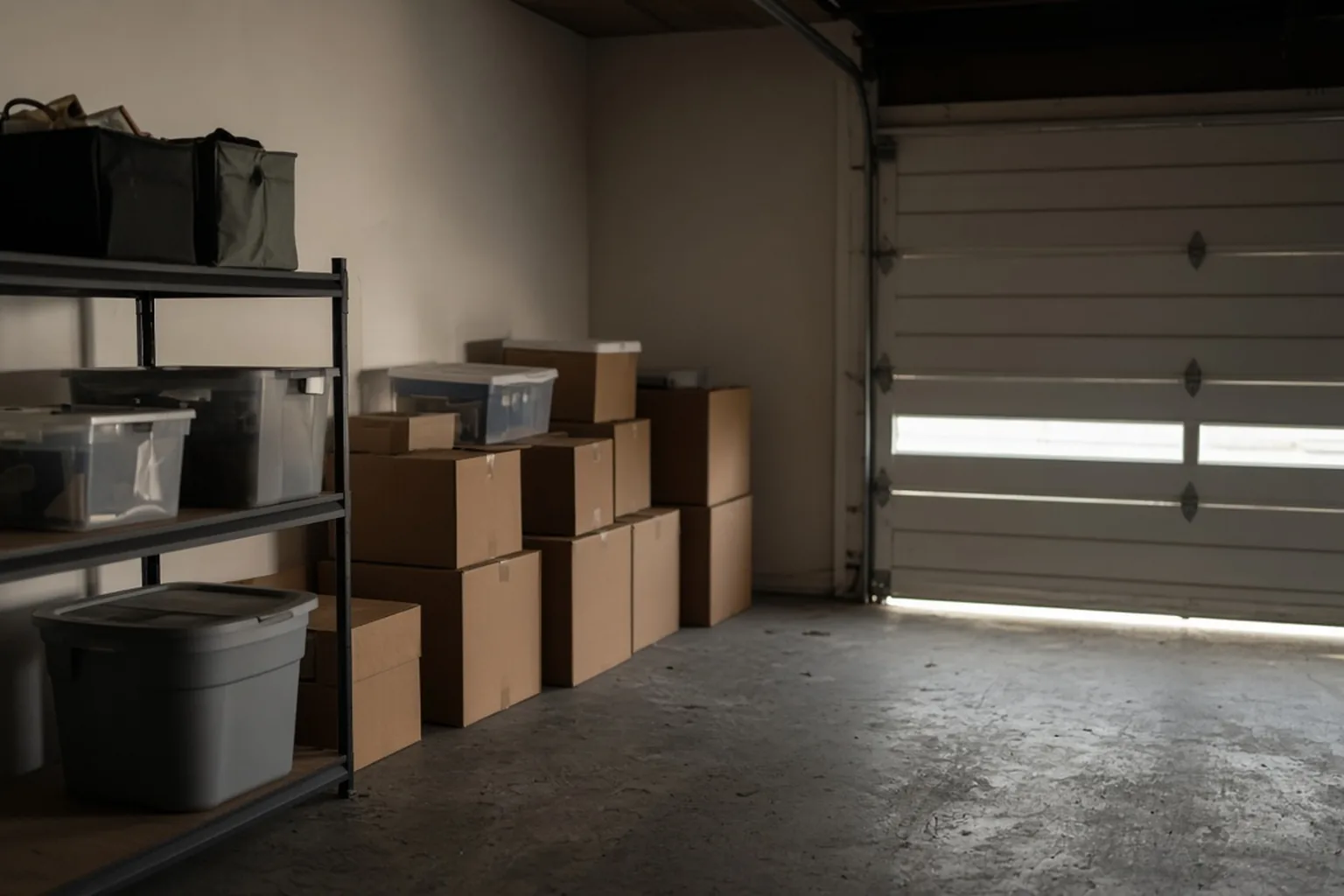 Cardboard boxes make easy nests and the gap under an overhead door makes an easy entrance. Plastic bins and a fresh door seal fix both.
Which rodents are getting into Ames homes?
Four rodents account for nearly every problem in Ames, and telling them apart changes how you handle it. The house mouse is gray-brown all over with a long, mostly hairless tail. It lives indoors full time and never needs to go outside, which is why some Ames houses have mice in July. Deer mice and white-footed mice look alike: brown backs, bright white bellies and big dark eyes. Iowa State describes both as seasonal movers. They nest outdoors through spring and summer, then come in once the food in fields and gardens dries up. These are the mice that fill a shed or a cabin with nests over one winter, and deer mice are the hantavirus carrier, so their nests call for extra care. Norway rats are much larger, with blunt noses and small ears. They burrow along foundations, under slabs and near feed storage, and one sighting usually means a burrow system nearby. If you are unsure which you have, keep a caught one in a sealed bag and ask the provider to identify it.
A month-by-month rodent calendar for Ames.
Rodent activity in Ames follows the thermometer more than the calendar, but the pattern is steady enough to plan around. September through November is the main entry window. Crops come out, garden seed runs low, and the first nights near freezing send native mice toward foundations. This is when the first scratching starts. December through March is the settled-in phase. With lows averaging about 12 degrees, mice that got inside stay put, and house mice keep breeding near furnaces and water heaters. Their cached corn and seed carries them to spring. April and May are spring-cleaning months, when people open sheds and garages and find a winter's worth of nests. Follow the CDC cleanup steps here rather than grabbing a broom. June through August is the quiet stretch. Native mice are back outside raising young, which makes summer the best time to walk the house, find gaps and seal them while nothing is trying to get in. Work done in July pays off in October.
 Fall is when rodents head indoors. Leaf piles against the foundation hide burrows and gaps, so clear them and walk the wall before the first cold snap.
Why stored feed and bird seed keep mice coming back.
It carries seed back to a nest inside a wall, a drawer or a pocket of insulation, and it keeps making the trip all winter. You can trap every mouse you see and still get new ones, because the food is still open for business. The fix costs very little. Move seed, corn, dog food and chicken feed into metal cans with fitted lids. Rake up spilled seed under feeders, or move the feeders away from the house for the season. Look for daylight under the garage door, because that gap is often the path between the feed and the kitchen. During an inspection, ask the provider to look for caches. A pile of kernels in a wall cavity shows exactly which direction the mice are traveling. Iowa State's guidance singles out one draw above the rest: mice cache corn kernels and bird seed indoors to last through Iowa winters. That one habit explains a lot of the frustration people describe. A mouse that finds a torn bag of sunflower seed in the garage does not just eat there.
What should the first provider visit cover?
Mice climb siding, downspouts and nearby trees, so a house with a tight foundation can still have mice coming in at the top. Inside, the provider should check the basement, under the kitchen sink, around the furnace and in the attic for droppings and travel paths. Then the plan should come in plain terms: how many openings, what material goes in each, how many traps and where, and how many return trips. Ask directly whether they use glue traps or lean on indoor poison. Given what Iowa State recommends, favor a plan built on snap traps and sealing. A useful first visit is mostly inspection, not a spray appointment. You want someone who walks the outside slowly and looks both low and high. Low means the sill plate where the house sits on the foundation, gaps around utility lines and the dryer vent, and the bottom seals on garage doors. Iowa State draws the line at about 1/4 inch: anything that size or bigger gets sealed. High means the roof edge, soffits and attic vents.
Renting near Iowa State: who handles the mice?
If you rent in Ames, near the Iowa State campus or anywhere else, a mouse problem often turns into a question of who pays as much as how to fix it. In most leases the structure belongs to the owner, which makes sealing gaps in the foundation, roof and walls the landlord's job. What tenants control is food storage and reporting. If you rent, note when and where you see droppings, take dated photos, and send them to the landlord in writing. Mice in shared walls travel between units, so one tenant trapping alone rarely ends it. If you own the building, treating one apartment while the others still have open food and gaps usually means the mice return. Ask the provider to inspect the whole building and quote the exclusion work once, not unit by unit. Turnover timing matters too. Spring move-outs often leave food in cupboards, and a unit that sits empty all summer can be full of nests by the time the fall semester starts. A quick check between tenants costs less than a full cleanup.
What affects the price
- How many entry points the inspection finds, since sealing is billed by time and material.
- Whether the garage, a detached shed or a barn is included along with the house.
- Roofline and attic vent work, which takes ladders and metal screening rather than a can of foam.
- The number of return visits to check and reset traps through the fall.
- Removal of droppings and soiled insulation, usually priced apart from trapping.
- Shared walls in duplexes and apartments, which widen the area that has to be covered.
📊
What's your biggest concern about rodents?
When to call for help
A professional also makes sense when a shed or cabin is full of nests you would rather not disturb yourself, or when you spot rat burrows along the foundation. Ask the company to walk the outside with you and point to every opening they plan to close. Bring in a provider when you are still catching mice after two weeks of steady trapping, because that almost always means an entry point you have not found. Call sooner if the noise is in the attic, since Iowa State notes mice climb and use roof areas and attic vents, and sealing up there is ladder work.
What you can do yourself
DIY works well for a handful of house mice in an Ames kitchen. Snap traps are cheap, the paired setup is easy to copy, and packed steel wool under a bead of foam will close the gaps around pipes under a sink. Plenty of people fix a small problem in one weekend. Where DIY falls short is finding every way in. A mouse needs only a gap about as wide as a pencil, and the openings that matter often sit at the sill plate, behind a deck ledger or up at the roofline. If mice keep turning up after you seal what you can see, paying for an inspection is the faster route. Skip the three things Iowa State steers people away from: glue traps, poison as a first move, and ultrasonic devices. A sensible split is to handle the trapping yourself and hire out the exclusion work.
Rodents in Ames
The city sits at 942 feet of elevation, and once winter lows slide toward 12 degrees, mice press against foundations looking for warmth. With a median home value near $265,000, paying for exclusion work costs far less than repairing chewed wiring or replacing soiled insulation. One local plus: the go-to mouse guidance for the state comes from Iowa State's own extension program, written with Iowa buildings in mind. Ames is a suburban city of about 67,000 people centered on Iowa State University, and that shapes the rodent picture in a few ways. The city dates to 1864, so it is worth knowing roughly when your own house was built: older framing and settled foundations tend to hold more of the 1/4-inch gaps mice use, though newer houses are not immune. Average humidity of 71 percent keeps basements and crawl spaces damp enough that mice can find water without leaving the lower floors.
Local research
Rodents in Ames, IA: what the public record shows
Before you compare quotes, it helps to know which rodents actually live in Iowa, when they are busiest around Ames, and what the state figures look like. Everything below links to the agency or university page it came from.
Rodent species recorded in Iowa
- House mouse (Mus musculus) — Enters at 1/4 inch; 5-10 litters per year; eats about 200 small meals a night.
- Norway rat (Rattus norvegicus) — Burrowing rat of basements, sewers and ground floors; tail shorter than head plus body.
- Deer mouse (Peromyscus maniculatus) — Primary U.S. hantavirus carrier; lives throughout Washington and the interior West.
When rodents are busiest around Ames
Deer and white-footed mice move into Iowa buildings as outdoor food runs out in fall.
Mice cache corn kernels and bird seed indoors to get through Iowa winters, so stored feed and seed are the main draw.
For context, nationally
- 1/4 inch (the width of a pencil) — Smallest gap a mouse can enter. CDC
- 890; 35% fatal; 94% west of the Mississippi — Hantavirus cases reported since 1993 (through 2023). CDC
Sources: Iowa State University Extension and Outreach, Natural Resources; CDC; Pest Notes: House Mouse; Pest Notes: Rats; Hantavirus. Figures are quoted as the source prints them. How we check our sources
Simple ways to keep rodents away
- Keep bird seed, deer corn and pet food in metal cans with tight lids, not the original bags.
- Pack steel wool hard into gaps around pipes and wires, then foam over it so mice cannot pull it loose.
- Look over attic vents and roof edges in late August, before the fall push starts.
- Replace a cracked or flattened garage door seal before the first frost.
- Stack firewood and pile leaves well away from the foundation so native mice cannot stage beside the house.
- Move bird feeders farther from the house in fall, since spilled seed feeds mice right at your wall.
- Set a pair of snap traps in the garage every September as an early warning.
- Use metal flashing or hardware cloth for openings too wide for steel wool, such as gaps under siding.
 Before you call, sketch where you have seen droppings or heard noise and measure any gaps you found. It makes the first visit faster and the quotes comparable.
Did you know?
Human plague still turns up in the United States, averaging about seven cases a year, nearly all in the Southwest and Far West, spread by fleas that ride on wild rodents.
About 35 percent of reported hantavirus cases in the United States have been fatal, which is why droppings get soaked in bleach rather than swept.
Puerto Rico logged 46 leptospirosis cases in the first 13 weeks of 2026, more than double the 21 reported across the rest of the country in the same span.
Questions people ask
When do mice start coming into houses in Ames?
That is when deer mice and white-footed mice, which raise young outdoors in spring and summer, run short of seed in fields and yards and look for shelter. House mice are different: they stay indoors year-round, so finding one in June does not mean the fall wave came early. Mice usually arrive in Ames homes between September and November.
Do deer mice in Iowa carry hantavirus?
The CDC's provisional count of 17 cases for 2025 listed none in Iowa, and most of the 890 cases since 1993 came from states much farther west. Nests in sheds and cabins still deserve a careful bleach cleanup instead of a broom. Deer mice are the main hantavirus carrier, and they do live in Iowa, but cases here are rare.
Does spray foam keep mice out by itself?
Bigger openings, such as gaps under siding or around a dryer vent, need metal flashing or hardware cloth. Check roof areas and attic vents as well, because mice are good climbers. No. Mice chew straight through foam, which is why Iowa State's guidance says to pack steel wool tightly into the gap first and then cover it with foam.
Why am I finding corn kernels hidden in my walls and drawers?
A stash usually means mice have a route between a food source, often a garage feed bin or a feeder, and a nest in the wall. Move the food into sealed metal containers and the house loses most of its pull. Mice in Iowa stockpile food for winter, and corn kernels and bird seed are favorites.
Do ultrasonic mouse repellers work in Ames homes?
A plug-in unit does nothing about the gap the mice used to get in. Your money goes further on steel wool, flashing and a good supply of snap traps. Iowa State's extension specialists, who work right in Ames, recommend against relying on ultrasonic devices, and they also advise skipping glue traps and poison as a first step.
Are rats a problem in Ames or is it mostly mice?
Rats turn up around grain storage, compost, chicken coops and outbuildings, where they dig burrows along foundations. They multiply fast: the University of California counts four to six litters a year for Norway rats, with 20 or more young weaned annually. Both can turn up. Iowa's species list for Ames-area homes includes Norway rats alongside three kinds of mice.
How do I clean up mouse droppings safely?
Then spray droppings and nest material with 1.5 cups of bleach per gallon of water, let it soak 5 minutes, and wipe it up with paper towels while wearing gloves. The CDC says never to sweep or vacuum droppings, because that puts particles in the air. Open windows and doors and leave the space for 30 minutes first.
How much does rodent control cost in Ames?
The number mostly depends on how many openings need sealing, whether the attic and garage are included, and how many trap checks are planned. Ask for sealing and trapping visits as separate line items so two quotes are easy to compare. No published price list exists for Ames, so expect a provider to quote after seeing the house.
Nearby cities
Related guides
Sources (6)
The facts in this article come from the public sources listed above. Every home is different, so ask the company you talk to about pricing and what’s included. Published by Rodent Exterminator · Updated October 11, 2026 · How we write these guides