The short version
Rodent control in West Des Moines, Iowa is mostly a fall job: seal gaps of 1/4 inch or more with packed steel wool and metal flashing, then set snap traps in pairs along walls. Iowa State Extension says native deer and white-footed mice move indoors as outdoor food runs out, and average winter lows near 14F mean whatever gets in stays until spring.
- Most West Des Moines mouse trouble starts September through November, when native mice lose their outdoor food.
- Iowa State treats 1/4 inch as the gap size worth sealing on homes and outbuildings.
- Pack steel wool before foam, because foam by itself gets chewed through.
- Paired snap traps beat glue boards, ultrasonic plug-ins and poison as a first move.
- Stored bird seed, grass seed and pet food are the biggest indoor draw for Iowa mice.
- Wet-clean droppings with a 1:9 bleach mix after airing the space for 30 minutes.
This guide is for West Des Moines homeowners and renters finding droppings, gnawed seed bags or scratching in the walls. It also suits landlords who hear about mice every fall, and office or retail managers in a city known for Jordan Creek Town Center and its corporate offices, where break rooms and storage closets can draw rodents just as kitchens do.
What to look for
Four rodents matter in Iowa, according to Iowa State Extension: the house mouse, the deer mouse, the white-footed mouse and the Norway rat. Each behaves a little differently, and that changes the fix. The house mouse is the one that never leaves. It nests in wall voids, cabinets and garage clutter and breeds indoors, so a house mouse problem in January is often one that began in September. Deer mice and white-footed mice are seasonal. They raise litters outside through a West Des Moines summer of 86F highs and roughly 35 inches of annual rain, which keeps lawns, gardens and seed heads productive. When that food runs out in fall, they go looking for shelter and stored food. Iowa State points out that mice cache corn kernels and bird seed indoors to get through winter, so a garage with open feed bags works like a pantry for them. Norway rats are heavier, burrow along foundations and need a bigger hole, though the CDC notes rats can gnaw a 1/4-inch opening wider. With 70% average humidity, summer plantings grow thick enough to hide burrows right against the house.
- 1Small dark droppings, about the size of a grain of rice, along garage walls or behind the stove.
- 2Little piles of corn kernels, bird seed or dog food tucked into drawers, boots or insulation.
- 3Shredded paper, fabric or insulation balled into a nest inside a storage box.
- 4Scratching or scurrying in walls or ceilings after dark, especially once nights turn cold.
- 5Gnaw marks on seed bags, cardboard boxes or the bottom corners of wooden doors.
- 6Greasy rub marks along baseboards where mice run the same route each night.
- 7Burrow openings near the foundation, under a deck or along a patio slab, which point to Norway rats.
- 8A musty, ammonia-like smell in a closed garage cabinet or storage room.
Why it’s worth acting soon
- A house mouse that gets in during fall can produce several litters before the snow melts.
- Gnawed wiring inside walls and garages creates a fire risk you cannot see.
- The CDC lists leptospirosis, salmonellosis and hantavirus among diseases rodents spread directly.
- Droppings in stored seed, pet food and pantry goods mean throwing those supplies away.
- Norway rat burrows can undermine patios, slabs and plantings along the foundation.
890Hantavirus cases reported in the U.S., 1993 to 2023CDC 94%Share of those hantavirus cases west of the MississippiCDC Treatment options and typical costs
Exclusion sealing
Quoted after inspection
A provider walks the foundation, siding, garage door, utility entries, roof edges and attic vents looking for openings of 1/4 inch or more, which is Iowa State's threshold. Small gaps get packed with steel wool and capped with foam, and larger openings get metal flashing or hardware cloth. Because mice climb, the roof check matters as much as the ground.
- Time
- Depends on how many openings are found
- Best for
- Homes that see mice every fall
Paired snap trapping
Quoted after inspection
Snap traps set in pairs along walls, with the bait ends facing opposite directions, in garages, kitchens, utility rooms and attics. This is the method Iowa State Extension recommends. Traps get checked and moved based on where captures happen until activity stops.
- Time
- Until captures stop
- Best for
- Mice already living indoors
Norway rat perimeter program
Quoted after inspection
Rats can forage 100 to 500 feet from the nest, so traps in tamper-resistant stations are spread across the property, and burrows along the foundation, deck or slab are located and closed. Ask whether the plan relies on traps first, since Iowa State advises against poison as an opening move.
- Time
- Until burrows go inactive; ask how many checks are included
- Best for
- Burrows or rat droppings outside
Droppings cleanup and sanitizing
Quoted after inspection
Garages, sheds, attics and storage areas are aired out, then droppings, nests and cached seed are soaked with diluted bleach, wiped up and bagged, following CDC steps. Contaminated insulation or stored goods may need to be removed. This fits spring, when winter nests are found.
- Time
- Depends on the size of the area
- Best for
- Heavy droppings in storage spaces
Prices are typical published ranges. Ask what’s included before you compare quotes.
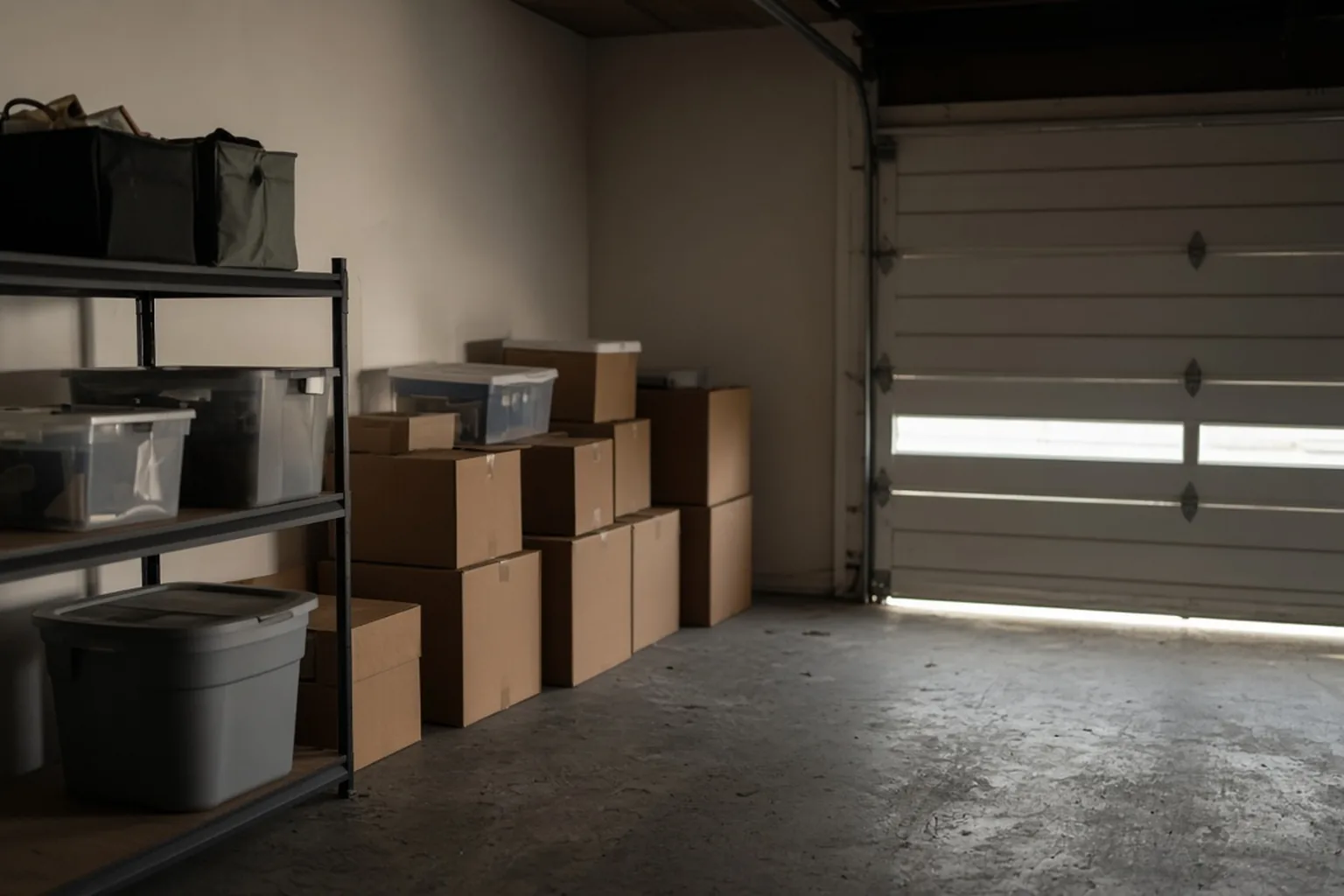 Cardboard boxes make easy nests and the gap under an overhead door makes an easy entrance. Plastic bins and a fresh door seal fix both.
Which rodents am I likely to find in a West Des Moines home?
They are outdoor animals for most of the year, raising young in fields, wood piles and landscaping through spring and summer. When fall cuts off their seed supply, they move into garages, sheds and houses, and Iowa State notes they stash corn and bird seed for the winter. The Norway rat rounds out Iowa's list. It is far heavier, digs burrows along foundations and slabs, and leaves droppings closer to the size of a raisin. Telling these four apart matters, because a deer mouse in the shed calls for careful wet cleanup, while a rat calls for a plan that covers the whole property. Start with the house mouse. Iowa State Extension describes it as the species that stays indoors year-round, and it is the one most West Des Moines homeowners end up trapping in kitchens, garages and wall voids. Once it finds food and nesting material, it has no reason to go back outside. The deer mouse and the white-footed mouse look much alike, with brown backs and clean white bellies.
A season-by-season rodent calendar for West Des Moines.
September through November is the main entry window. As outdoor food runs out, mice follow warmth and food smells toward foundations, garages and attic vents. This is when most people first hear scratching. December through February is the locked-in stretch. With average lows near 14F, mice that got inside stay put, nest in walls and garages, and live off the seed they cached. March and April are cleanup months. Open sheds and garages carefully, air them out, and wet-clean any droppings before you sweep or reorganize anything. Spring and summer belong to the native mice. With highs near 86F and about 35 inches of rain a year, West Des Moines yards produce plenty of seed and cover, so deer mice and white-footed mice raise their litters outside. House mice already indoors keep breeding no matter the season. Late August and early September are the time to act. The ground is still soft, the weather suits exterior sealing, and the native mice have not moved yet. Check garage door seals, pack gaps and shift seed and pet food into metal cans now.
 A good inspection starts outside at ground level: door thresholds, the joint between siding and foundation, and anywhere a pipe or cable enters.
How do you seal a house the way Iowa State recommends?
Iowa State recommends packing steel wool tightly into the gap before applying foam sealant, because foam on its own gets chewed out. Material choice is where many home repairs fall short. If a pencil slides in, the gap needs work. The CDC uses the same figure and compares it to the width of a pencil, which makes a handy test. Iowa State Extension sets the bar at about 1/4 inch: any opening that size or larger on a home or outbuilding counts as a mouse entry. A methodical walk around your house can start at the garage door, follow the foundation past gas, water, cable and dryer vent entries, and finish up top at the roof and vents. Look where the roofline meets the siding, along soffit edges, and at vent screens that have torn or pulled loose. Iowa State points out that mice climb, so roof areas and attic vents deserve the same attention as the foundation. Do not stop at ground level. For anything bigger than a small pipe gap, metal flashing or hardware cloth holds up far better.
What should a West Des Moines provider's inspection and quote include?
Second, which material goes on each gap, and does it match Iowa State's steel wool under foam and metal flashing for larger holes? Third, how are traps placed? Iowa State recommends snap traps in pairs along walls with bait ends facing opposite ways. Fourth, what is the poison policy? Iowa State advises against bait as a first response, and a quote built only around bait boxes skips the step that keeps mice out next year. Ask how many follow-up checks are included. A good first visit is mostly looking, not baiting. Expect the provider to walk the exterior, the garage, the attic if it can be reached, and the kitchen and utility areas, noting droppings, rub marks, gnawing and every gap of 1/4 inch or more. With a median home value near $325,000 in West Des Moines, sealing work is protecting a real investment, so ask for a written list of entry points before you approve anything. When you compare two quotes, line them up on four points. First, does the price include sealing, or only traps and bait?
Cleaning up mouse droppings in a garage or shed after winter.
Hantavirus is the reason for the extra care with deer mice. The CDC counted 890 U.S. cases from 1993 through 2023, 35% of them fatal, and 94% of them west of the Mississippi. Iowa falls on that side, and the deer mouse, the species tied to exposure in sheds and garages, appears on Iowa State's list for the state. The provisional national count for 2025 was 17 cases with none in Iowa, so the risk in West Des Moines is low. Wet cleanup keeps it that way. The CDC's cleanup method is simple, and the order of the steps matters. Open doors and windows and let the space air out for 30 minutes before you begin. Put on rubber or plastic gloves. Mix 1.5 cups of household bleach per gallon of water, about a 1:9 ratio, spray the droppings and nesting material until soaked, and wait 5 minutes. Wipe it up with paper towels, bag it, then wipe down the surrounding surfaces. Never sweep or vacuum droppings, which can push particles into the air.
What affects the price
- How many openings turn up at the foundation, garage door, roofline and attic vents.
- Whether roof-level sealing needs ladder work, since Iowa State warns that mice climb to reach vents.
- Detached sheds or outbuildings that need their own exclusion work.
- The number of trap checks needed once mice are already nesting inside.
- Cleanup of cached seed, nests and droppings in insulation or storage areas.
- Whether Norway rats are involved, which calls for a property-wide trap layout.
- Commercial space such as offices or retail units, which usually needs a recurring monitoring plan.
📊
What's your biggest concern about rodents?
When to call for help
Bring in a provider when your snap traps keep catching mice after a couple of weeks, when you hear activity in walls you cannot reach, or when you find burrows along the foundation that suggest Norway rats. Call sooner for chewed wiring, a dead-rodent smell or droppings in a food pantry. For West Des Moines homes, late August and September are the best months to schedule exclusion, before native mice start moving indoors and before frozen ground and 14F nights make exterior work harder. Ask the provider for a written list of every entry point they found and the material they plan to use on each, and whether follow-up trap checks are part of the price.
What you can do yourself
A pro earns the fee when openings are at the roofline or attic vents, when gaps hide behind siding or decks, or when mice come back every fall despite your work. Norway rats are also worth handing off, because their foraging range covers the whole lot and burrows need careful handling. Renters should report activity to the landlord instead of sealing exterior walls on their own, since exclusion work touches the structure. A lot of mouse work is reasonable to do yourself, and Iowa State's guidance is written with homeowners in mind. Buy snap traps rather than glue boards or ultrasonic plug-ins, and set them in pairs along walls with the bait ends pointing in opposite directions so a mouse running either way meets a trigger. For sealing, pack steel wool tightly into small gaps and finish with foam or caulk over it.
Rodents in West Des Moines
Iowa State Extension's advice applies directly here, from its 1/4-inch exclusion threshold to its preference for snap traps. The city was founded in 1893 and sits at about 958 feet of elevation, but the details that decide your risk are your own home's gaps, door seals and stored seed. Those swings set the local rodent calendar: native mice breed outdoors in warm months, then press toward buildings in fall. The climate is humid continental, with summers around 86F, 70% average humidity and roughly 35 inches of rain a year, and winters that bottom out near 14F on average. That mix of homes, offices and retail space means rodents can show up in kitchens and garages as easily as in break rooms and stockrooms. West Des Moines is a suburban city of about 69,000 people with a median home value near $325,000, known in the region as a corporate hub and for Jordan Creek Town Center.
Local research
Rodents in West Des Moines, IA: what the public record shows
Before you compare quotes, it helps to know which rodents actually live in Iowa, when they are busiest around West Des Moines, and what the state figures look like. Everything below links to the agency or university page it came from.
Rodent species recorded in Iowa
- House mouse (Mus musculus) — Enters at 1/4 inch; 5-10 litters per year; eats about 200 small meals a night.
- Norway rat (Rattus norvegicus) — Burrowing rat of basements, sewers and ground floors; tail shorter than head plus body.
- Deer mouse (Peromyscus maniculatus) — Primary U.S. hantavirus carrier; lives throughout Washington and the interior West.
When rodents are busiest around West Des Moines
Deer and white-footed mice move into Iowa buildings as outdoor food runs out in fall.
Mice cache corn kernels and bird seed indoors to get through Iowa winters, so stored feed and seed are the main draw.
For context, nationally
- 1/4 inch (the width of a pencil) — Smallest gap a mouse can enter. CDC
- 890; 35% fatal; 94% west of the Mississippi — Hantavirus cases reported since 1993 (through 2023). CDC
Sources: Iowa State University Extension and Outreach, Natural Resources; CDC; Pest Notes: House Mouse; Pest Notes: Rats; Hantavirus. Figures are quoted as the source prints them. How we check our sources
Simple ways to keep rodents away
- Move bird seed, grass seed and pet food into metal cans with tight lids before September.
- Check the garage door bottom seal each fall and replace it if you can see daylight underneath.
- Pack steel wool into pipe and wire penetrations, then cap it with foam or caulk.
- Cover attic and roof vents with metal screening, since Iowa State notes that mice climb.
- Keep mulch and dense plantings pulled back from the foundation through the humid summer.
- Clean up spilled seed under bird feeders, or move feeders well away from the house.
- Store garage and holiday items in lidded plastic bins instead of cardboard.
- Set a few snap traps in the garage in early fall as an early warning system.
 A good rodent quote lists the inspection, the number of trapping visits, each opening to be sealed and the material for it, and any cleanup.
Did you know?
Mice in Iowa stockpile corn kernels and bird seed indoors as a food supply to carry them through winter.
A single female Norway rat can wean 20 or more young in a year across 4 to 6 litters.
The U.S. averages about 7 human plague cases a year, spread by rodent fleas and concentrated in the Southwest and Far West.
Questions people ask
When do mice start coming into houses in West Des Moines?
For West Des Moines homes, winter lows averaging 14F keep them inside once they arrive, so activity often continues in walls and garages until spring. Iowa State Extension says deer mice and white-footed mice stay outside through spring and summer, then move into buildings when outdoor food runs out. Most entries happen from September through November.
Do ultrasonic mouse repellers work?
Put that money toward traps and sealing material instead, which deal with the mice you have now and the next ones trying to get in. Its recommended tool is the plain snap trap, set in pairs along walls. Iowa State Extension lists ultrasonic devices among the tools it advises against, along with glue traps.
Should I put poison out for mice in my garage?
Seal and trap first, and ask any provider to explain why bait is needed before using it. In a West Des Moines house closed up against January cold, a poisoned mouse often dies inside a wall where you cannot reach it, and the smell lingers. Iowa State advises against poison as an opening move. Not as your first step.
Is hantavirus a concern with mice in Iowa?
Deer mice carry the risk, so wet-clean their droppings rather than sweeping. The provisional 2025 national count of 17 included no Iowa case. cases from 1993 through 2023, and 94% were west of the Mississippi, the side Iowa sits on. The CDC counted 890 U.S. The risk is low, but it is real enough to clean carefully.
Why do mice in West Des Moines go after bird seed and corn?
Moving feed into metal cans removes most of the pull. A West Des Moines garage with an open seed bag hands them a winter supply and a reason to stay. Iowa State Extension notes that mice cache corn kernels and bird seed indoors to last through Iowa winters. Because those are the foods they stockpile.
Can I use expanding foam to keep mice out?
Any opening of 1/4 inch or more deserves attention. For larger openings around vents or the roofline, use metal flashing or hardware cloth. Pack steel wool tightly into the gap first, then foam over it to hold the wool in place. Iowa State says foam alone gets chewed through. Not on its own.
How can I tell if I have rats instead of mice?
Rats are a bigger job: UC IPM reports 4 to 6 litters a year per female, and they forage across the whole property. Norway rats leave much larger droppings and dig burrows along foundations, patios and under decks, while mice leave rice-sized pellets and slip through small gaps. Check the droppings and the entry points.
How do I clean mouse droppings without getting sick?
Never sweep or vacuum. Wipe it up with paper towels while wearing gloves, and bag it. Then soak the droppings with a bleach mix of 1.5 cups per gallon of water, roughly 1:9 per the CDC, and let it sit 5 minutes. Air the space out for 30 minutes with doors and windows open.
Nearby cities
Related guides
Sources (6)
The facts in this article come from the public sources listed above. Every home is different, so ask the company you talk to about pricing and what’s included. Published by Rodent Exterminator · Updated October 11, 2026 · How we write these guides