The short version
In Anaheim the winning approach is exclusion and trapping, because California bans most anticoagulant rodenticides in the majority of the state. UC IPM says to seal every opening wider than a quarter inch and to close door gaps under half an inch. Trapping removes what is already inside; the sealing keeps the next one out.
- State law puts most anticoagulant baits off limits, so trapping carries the load.
- Roof rats will travel more than 300 feet to a food source on your block.
- Only 13 inches of rain a year makes irrigation and pet bowls the main water draw.
- A rat gets under a door gap of half an inch; mice need a quarter.
- Rats stay active every month here, with a heavier push in fall.
It is also useful if you have pets or a bird feeder and are worried about poisoning something you did not intend to. Written for homeowners hearing movement in the attic, renters unsure what to report, and anyone who bought a bait block at a hardware store and wants to know if it was the right move. The advice covers single family homes, condos and small commercial buildings alike.
What to look for
Roof rats are the climbers, and they treat a mature ornamental tree, a fence top or a run of cable as a road to your roofline. Norway rats work the ground: burrows near foundations, hollow spots under concrete, drainage lines. House mice need almost nothing and are perfectly happy inside a wall. A Mediterranean climate is the reason none of this ever fully stops. With winter lows near 47F, there is no freeze to reset the population, and UC IPM notes that rats stay active year round and should be checked for periodically rather than only after a scare. The fall peak is real, but it is a peak on top of a baseline, not a season with a beginning and an end. Treat rodent proofing as maintenance, the way you treat gutters. Four rodents show up in California records: roof rats, Norway rats, house mice and deer mice. In a built up city at 157 feet of elevation, the first three do nearly all the damage.
- 1Droppings collecting in one spot on a garage shelf or inside a rarely opened cabinet.
- 2A greasy dark line along the top of a fence rail, a beam or a stucco ledge.
- 3Gnaw marks on irrigation tubing, drip emitters or the rubber seal of a garage door.
- 4Fruit on the ground with the flesh hollowed out and the skin left behind.
- 5Night noise that starts an hour after dark and moves horizontally across the ceiling.
- 6The dog or cat fixated on one baseboard, appliance or closet door.
- 7Insulation pulled into a loose pile in a corner of the attic.
Why it’s worth acting soon
- Chewed wire insulation in an attic creates a fire hazard that gets worse with every visit.
- Contaminated food surfaces expose your household to salmonellosis and other illnesses on the CDC rodent list.
- One nesting pair turns into a resident colony within a single warm season.
- Damaged drip irrigation wastes water and quietly feeds the animals doing the chewing.
- Rodent fleas and mites move into the living space once a nest is abandoned.
- Soiled attic insulation eventually has to be removed and replaced rather than cleaned.
Larger than 1/4 inch; rats pass under a 1/2 inch door gapOpening size that must be sealed against rodentsUC Statewide IPM Program Treatment options and typical costs
Rodent proofing the structure
Quoted after inspection
Every opening wider than a quarter inch gets closed with hardware cloth, galvanized sheet metal or mortar, and door gaps get metal edged sweeps because UC IPM notes a rat can pass under half an inch. Common targets are roof to wall junctions, attic vents, weep screeds, and the sleeves around gas, water and conduit runs.
- Time
- One to three days
- Best for
- Ending the problem rather than managing it
Trapping program
Quoted after inspection
Snap traps and multi catch stations set along walls, on rafters and in the garage do the removal. Because anticoagulant options are limited by state law, a serious provider here builds the whole plan around traps and checks them on a schedule. Ask how many traps go out in week one and how many return visits are included.
- Time
- Two to four weeks of scheduled checks
- Best for
- Active infestations of any species
Habitat and food source cleanup
Quoted after inspection
Ground fruit picked up, feeders removed or moved, dense vine cover thinned, trash bins latched, and tree limbs cut back from the roof. Roof rats travel over 300 feet for food according to UC IPM, so a fed yard three houses away still matters, but the yard you control comes first.
- Time
- Ongoing
- Best for
- Stopping the property from being reinfested
Attic remediation
Quoted after inspection
After the animals are out, contaminated insulation gets removed, the space is cleaned and disinfected, and new material goes in. This is separate work with its own price, and it is often the reason two quotes for the same house look nothing alike. Ask whether it is included or listed as an option.
- Time
- One to two days
- Best for
- Attics with heavy droppings or a lingering smell
Prices are typical published ranges. Ask what’s included before you compare quotes.
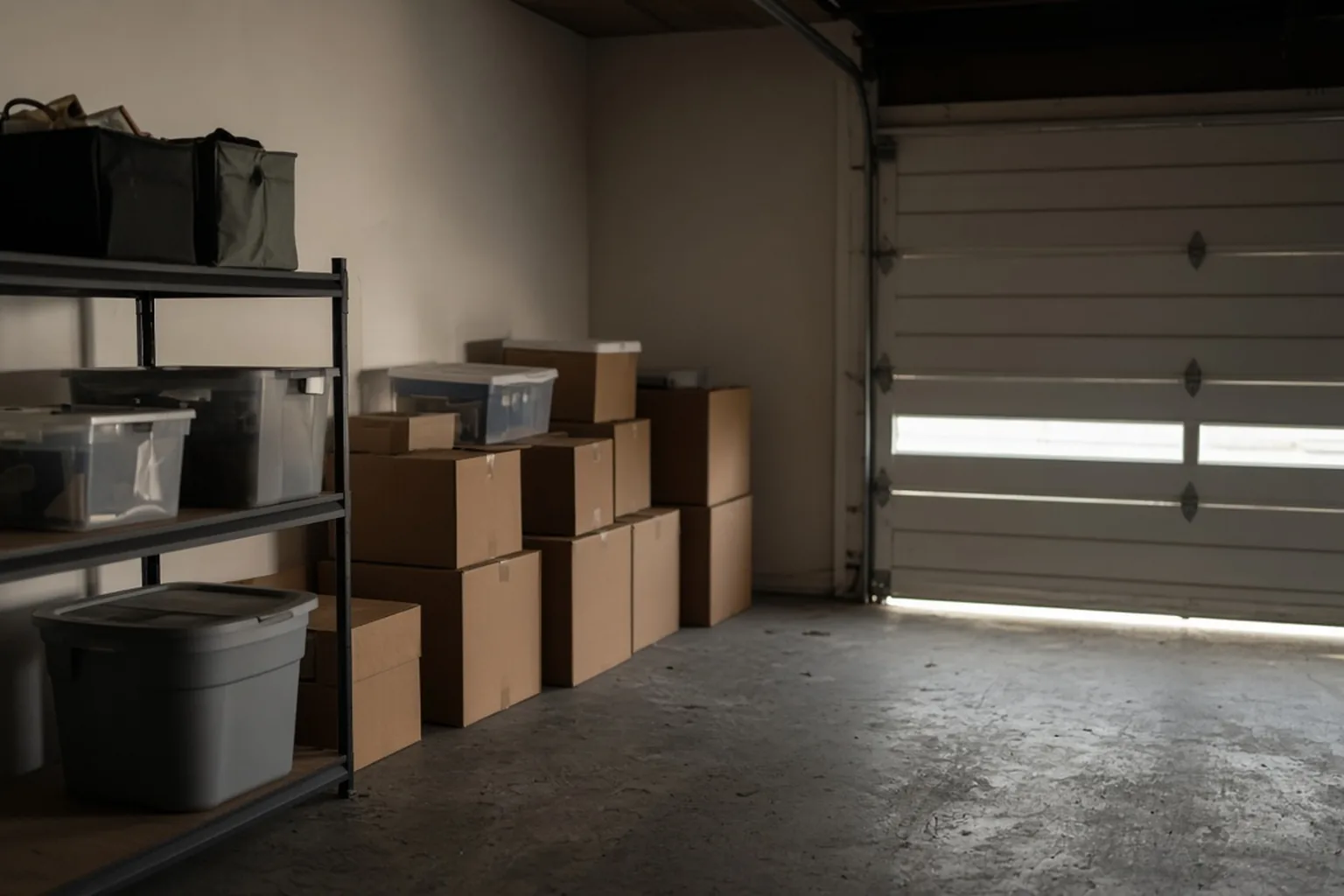 Cardboard boxes make easy nests and the gap under an overhead door makes an easy entrance. Plastic bins and a fresh door seal fix both.
How California's rodenticide rules change the whole plan.
Ask what products they intend to use, where, and how the plan gets smaller over time rather than repeating forever. If a provider in Anaheim leads with a monthly bait station route and treats sealing as an add on, they are selling maintenance of a problem rather than an end to it. It also changes how you read a proposal. Bait produces a guess and, in an attic, a dead animal in a place you cannot reach. Traps produce evidence, since you can count what came out and know when the building is empty. For you as a customer, that is an advantage. UC IPM is direct about the practical result: the work shifts toward trapping and exclusion. Bromethalin, cholecalciferol and zinc phosphide remain available, but they are not a substitute for a plan. Most uses of first and second generation anticoagulants are prohibited across most of the state, which takes brodifacoum, bromadiolone, difethialone, diphacinone, chlorophacinone and warfarin out of the toolbox. Start with what a company legally cannot reach for.
Where do roof rats actually get onto the house?
A roof rat is a strong climber that uses a tree limb, a fence top, a trellis, a downspout or a run of cable to reach the roof, then hunts the edge for an opening. Almost always from above, and almost always by way of something you planted or built. One that has both is a tenant. A rat that can reach the roof but cannot find a hole is an annoyance. Cut the bridges first by trimming canopy back from the roof, then screen and flash every opening on the edge. The fix follows the same path. That is why the noise moves sideways across a ceiling instead of scratching at a baseboard. Once inside, they stay high: attic, upper wall voids, sometimes a soffit run above a bedroom. The classic entries are the gap where a lower roof meets a wall, an unscreened attic or gable vent, a lifted tile edge, a rotted fascia corner, and the hole cut for a plumbing or exhaust stack that was never collared properly.
 Fall is when rodents head indoors. Leaf piles against the foundation hide burrows and gaps, so clear them and walk the wall before the first cold snap.
What a 13 inch rain year means for rodent behavior.
An average year brings about 13 inches of rain, with humidity around 68 percent and summer highs near 87F, so the animals in your neighborhood are not drinking from puddles for most of the year. Water is scarcer than food in this climate, and that reshapes where rodents live. Droppings and gnaw marks tend to show up there before they ever show up in the kitchen. Walk the irrigation lines and the equipment pad. It also tells you where to look first when you are hunting for evidence. Chewed drip tubing is worth noticing for the same reason: the damage is a symptom, and the leak that follows becomes the next attraction. Fixing a dripping valve or moving a water bowl indoors after dark takes minutes and removes a reason to stay. This gives you a lever most homeowners never use. They are drinking from drip irrigation, a leaking hose bib, an air conditioning condensate line, a pet bowl left out overnight, a pool edge or a bird bath.
What should the first two weeks of trapping look like?
A catch rate that stays level means either there is a hole nobody found or the food source outside is still running. A steep drop after week one and a flat zero in week two is the evidence that lets the crew close the final openings with confidence. The catch numbers are the whole point. Expect the first check within a few days, then a schedule. Traps set in the open middle of a room catch nothing, because rodents travel with a wall or beam against one side. A provider should set far more traps than feels reasonable, concentrated on the routes they identified during the inspection: along attic rafters, against garage walls, behind appliances, near the burrow openings outside. Heavy at the start and shrinking after. Two quotes in Anaheim can list the same sealing scope and differ entirely on this point, and the follow up is what converts sealing into a result. Ask before you sign how many visits the price covers and what happens after that.
Deer mice, hantavirus, and how much to worry.
California logged four provisional cases in 2025, the highest single state count in that column. The CDC has counted 890 cases nationwide since 1993, about 35 percent of them fatal, with 94 percent occurring west of the Mississippi. Deer mice are the hantavirus carriers, and they favor sheds, garages, cabins and outbuildings over occupied city homes. The honest answer is that risk here is low but not zero, and the fix is behavioral rather than expensive. So treat a dusty shed or a long closed garage with more care than the kitchen cabinet, wear gloves and a mask, and do not use a shop vacuum on droppings no matter how tempting it looks. Air the space out for half an hour, wet the material with diluted bleach, let it sit five minutes, and wipe rather than sweep. That is why the cleanup method is not optional. What matters for you is the exposure route: dried droppings and nesting material stirred into the air.
How do you read a rodent quote line by line?
A useful quote names the vent, the corner and the penetration. First, is there an itemized list of openings with locations, or a single line that says exclusion? Go through both proposals looking for four specifics rather than a total. If one refuses to itemize, that tells you something on its own. Get both providers to price the same scope, then compare. On a house near the local median value of $810,000, insulation removal and replacement is a real line item and it is the most common reason two bids look wildly apart. Fourth, is attic cleanup included or excluded? Third, is trapping in the price, with how many return visits, and what is the plan if activity continues after the final one? Foam and caulk on their own do not survive a determined rat, and a quote that does not name materials is hiding something. Galvanized hardware cloth, sheet metal, mortar and copper mesh last. Second, what goes into the holes?
What affects the price
- Length of roofline that has to be screened or rebuilt, which grows fast on a two story house.
- Whether tile roof edges need individual closures or a continuous product.
- Number of trap checks written into the agreement.
- Square footage of attic insulation removal and replacement, if any.
- Access difficulty in tight side yards or between closely spaced buildings.
- Whether landscaping work such as limb trimming is billed by the provider or left to you.
- Whether return visits for sealed openings are included, and for how long.
📊
What's your biggest concern about rodents?
When to call for help
Call also if you have set traps for two weeks with no drop in catches, if you find droppings in two separate areas of the house, or if you suspect the source is a shared wall in a condo or duplex. Because state rules limit which products a company may apply, ask directly what their plan uses and how they intend to verify the building is empty before they close the last hole. Bring someone in when the activity is in the attic or the wall cavity rather than in an open cabinet you can reach. Attic exclusion means working the entire roof edge, and missing one opening makes the rest of the money wasted.
What you can do yourself
Trapping a mouse in a kitchen is genuinely a homeowner job. Set snap traps flush against the wall with the trigger end toward the baseboard, put six of them out rather than two, and bait with something sticky. Pack copper mesh or steel wool into pipe collars and cover it with sealant. Latch the trash, get fallen fruit off the ground, and pull the bird feeder for a month. The roof is where amateurs lose. Tile edges, valley intersections, vent screens and fascia gaps are hard to inspect from a ladder and harder to close properly, and a partial seal simply moves the entry a few feet. A provider also brings the judgment to distinguish a roof rat problem from a mouse problem, which changes trap placement entirely. If you do one thing yourself in Anaheim, make it the yard.
Rodents in Anaheim
Only 13 inches of rain falls in an average year, so the dependable water in the neighborhood is irrigation, pet bowls, condensate lines and pool edges, and rodents orient around those instead of puddles. Median home value near $810,000 changes the math on repairs, since attic insulation replacement and roofline work on a house at that price is normal maintenance rather than an extravagance. Add a state rodenticide rule that limits the chemical shortcut and you get a market where the good providers compete on the quality of their sealing, which is the right thing to compare. Anaheim has grown from an 1857 settlement into a city of about 344,000 people packed at urban density, and density is a rodent multiplier: where yards, fences and rooflines sit close together, climbing rats get an uninterrupted path from block to block. Water is the other local lever.
Local research
Rodents in Anaheim, CA: what the public record shows
Before you compare quotes, it helps to know which rodents actually live in California, when they are busiest around Anaheim, and what the state figures look like. Everything below links to the agency or university page it came from.
Rodenticide restriction
Bromadiolone, brodifacoum, difethialone, diphacinone, chlorophacinone and warfarin cannot be applied in most areas; bromethalin, cholecalciferol and zinc phosphide remain.
UC IPMGap a rat can squeeze under a door
Roof rats travel 300+ feet for food.
UC IPMRodent species recorded in California
- House mouse (Mus musculus) — Enters at 1/4 inch; 5-10 litters per year; eats about 200 small meals a night.
- Norway rat (Rattus norvegicus) — Burrowing rat of basements, sewers and ground floors; tail shorter than head plus body.
- Roof rat (Rattus rattus) — Climber of attics and trees in warm and coastal regions; tail longer than head plus body.
- Deer mouse (Peromyscus maniculatus) — Primary U.S. hantavirus carrier; lives throughout Washington and the interior West.
When rodents are busiest around Anaheim
Rats active year-round; check periodically.
California's rodenticide law pushes work toward trapping and exclusion.
Rules that apply in California
For context, nationally
- 1/4 inch (the width of a pencil) — Smallest gap a mouse can enter. CDC
- 890; 35% fatal; 94% west of the Mississippi — Hantavirus cases reported since 1993 (through 2023). CDC
Sources: CDC National Notifiable Diseases Surveillance System; Pest Notes: Rats; CDC; Pest Notes: House Mouse; Hantavirus. Figures are quoted as the source prints them. How we check our sources
Simple ways to keep rodents away
- Trim tree canopy well back from the roof, and break up fence lines rodents use as runways.
- Screen attic vents, foundation vents and the gap behind the fascia with quarter inch galvanized mesh.
- Repair leaking drip emitters and hose bibs, since in a 13 inch rain year they are the reliable water.
- Pick up fallen fruit and nuts at least weekly.
- Keep pet food and water bowls indoors overnight.
- Add a metal edged sweep to the garage door and any exterior door with daylight under it.
- Thin ground covering vines and ivy that create continuous cover along a wall.
- Store garage items on shelving rather than in cardboard on the floor.
- Walk the roofline with binoculars each September before the fall peak.
 Shared basements and utility rooms are where rodent problems in rentals usually start. Landlords should walk them each fall and after every tenant turnover.
Did you know?
Roof rats will range more than 300 feet from the nest to reach a food source, which is why a neighbor's fruit tree can support the colony living in your attic.
A single Norway rat female raises four to six litters a year and can wean twenty or more offspring in that time.
Plague has never disappeared from the western United States, averaging about seven human cases a year, spread by fleas that live on wild rodents.
Questions people ask
Why will a company in Anaheim not just put out poison?
California prohibits most uses of first and second generation anticoagulants including brodifacoum, bromadiolone, difethialone, diphacinone, chlorophacinone and warfarin, leaving bromethalin, cholecalciferol and zinc phosphide. UC IPM points out this pushes work toward trapping and exclusion, which is a better long term answer anyway because it removes the animals rather than thinning them. Because most of it is off the table.
Can poison hurt my dog or a neighborhood hawk?
That is secondary poisoning. Where any bait is used at all, it belongs in a locked, anchored station outdoors and never loose in an attic or garage. Yes, and that risk is the reason for the state restrictions. A rodent that eats an anticoagulant stays alive and sluggish for days, so the cat, dog, owl or hawk that catches it takes in the dose too.
How big does a gap have to be before rodents use it?
The CDC uses the same quarter inch figure for mice, comparing it to the width of a pencil. Since rats gnaw a small hole until it fits, the practical rule is to close everything at the quarter inch line with metal or mesh. UC IPM says seal anything larger than a quarter inch, and notes a rat can squeeze under a door gap of half an inch.
Is there a rodent season here or is it all year?
Anaheim winter lows average 47F, which never kills back the outdoor population the way a hard freeze does, so UC IPM advises checking for rats periodically rather than waiting for a season. What changes in autumn is volume: a year of breeding compresses into competition for shelter, and buildings get tested harder. It runs all year with a fall peak.
Should I be worried about hantavirus in Anaheim?
California reported four provisional hantavirus cases in 2025, the highest count of any state that year, and the CDC has recorded 890 cases nationally since 1993 with 94 percent west of the Mississippi. That is a reason to clean droppings the safe way, not to panic. It is a low but real concern tied mostly to deer mice in rural sheds and cabins rather than city homes.
What is the safe way to clean up a garage full of droppings?
Then wet everything with a bleach solution of roughly 1.5 cups per gallon of water, wait five minutes, and wipe it up with paper towels while wearing gloves. The CDC is specific that sweeping and vacuuming are the wrong tools, since both aerosolize whatever is in the dust. Open it up and leave for 30 minutes before you touch anything.
Rats keep coming from the neighbor's yard. Is sealing pointless?
Close the building envelope, latch the bins, pull the feeders, and clear ground fruit. The pressure outside stays; the harboring inside stops. No, sealing is exactly what helps. Roof rats forage more than 300 feet from the nest, so you cannot control where they live, but you can control whether they get inside your walls and whether your property feeds them.
Does my HOA or landlord handle this in a condo?
Report activity in writing with dates and photos. Rodents travel through shared chases and attic spaces, so one unit treated alone rarely holds. In an Anaheim condo or apartment, the usual split puts the building envelope and shared areas on the association or owner, and sanitation inside the unit on the person living there, though your CC&Rs or lease has the final word.
Nearby cities
Related guides
Sources (6)
The facts in this article come from the public sources listed above. Every home is different, so ask the company you talk to about pricing and what’s included. Published by Rodent Exterminator · Updated October 11, 2026 · How we write these guides