The short version
Rodent control in Bloomington, MN is mostly a house mouse job that starts each fall, when cold nights drive mice into walls, garages and basements for the winter. The fix is sealing every gap a pencil fits into, trapping along walls, and cleaning droppings wet. Deer mice, the hantavirus carrier, matter more at cabins and outbuildings than inside homes in town.
- House mice are the indoor rodent in Minnesota; deer mice matter at cabins and sheds.
- Seal before October: if a pencil fits in a gap, a mouse fits too.
- Minnesota counts only 2 hantavirus cases likely acquired in the state since 1999.
- The state treats mouse droppings as an asthma trigger, so clean them wet.
- Winter lows near 8F keep mice indoors until spring, so trapping often runs into March.
Bloomington homeowners hearing scratching in the walls once the furnace kicks on, families with someone who has asthma, renters finding droppings in a kitchen drawer, and anyone about to open a cabin or shed after a winter shut. If you store a car, boat or camper in the garage over the cold months, this is for you as well.
What to look for
Minnesota's state notes put it plainly: the house mouse is the structural problem, and the deer mouse is the cabin and outbuilding problem. Norway rats are on the state list too, but inside a Bloomington home the mouse is what you will most often trap. House mice are small, gray-brown and closely tied to people. They nest in insulation, behind appliances, inside wall cavities and in garage clutter. The Minnesota Department of Health tells residents to look for black or brown droppings about the size of a grain of rice. Deer mice are a bit larger, with white bellies and feet, and they favor sheds, detached garages and seasonal buildings. The climate sets the timing. Summers reach about 83F, and roughly 31 inches of rain a year keeps seeds and insects plentiful outdoors. Then winter arrives with average lows near 8F, and mice cannot ride that out in the open. They move into heated space from September through November and stay put until the thaw.
- 1Black or brown droppings the size of a grain of rice in drawers, under sinks or along basement walls.
- 2Scratching inside walls or ceilings at night, often starting the first weeks the furnace runs.
- 3Shredded insulation, paper towel or fabric tucked behind the water heater or in a storage bin.
- 4Chewed holes in cereal boxes, bird seed bags or grass seed stored in the garage.
- 5A stale, musky smell in a closed cabinet or a corner of the unfinished basement.
- 6Tiny tracks in garage dust, or in fresh snow leading to a gap along the foundation.
- 7Nest material or droppings under the hood of a car parked in the garage all winter.
Why it’s worth acting soon
- House mice can breed 5 to 10 times a year, and a heated house removes the winter pause.
- The Minnesota Department of Health lists mouse droppings and urine as an indoor asthma trigger.
- Chewed wiring in walls, attics and parked cars can cause shorts and fires.
- Nesting mice flatten and soil insulation, which costs you during a long heating season.
- Waiting until spring leaves a whole winter of droppings to clean from basements and garages.
1/4 inchSmallest gap a mouse can squeeze throughCDC 51%Midwestern homeowners who reported ever encountering rodents (NPMA/Harris Poll survey of U.S. adults, September 2022; lifetime, not an annual infestation rate)NPMA / Harris Poll Treatment options and typical costs
Fall exclusion
Quoted after inspection
Sealing gaps at the foundation, sill plate, utility lines, dryer vent and garage door before cold weather sets in. Steel wool or copper mesh goes into the gaps and is covered with sealant, vents get hardware cloth, and doors get new sweeps. Done in September or early October, it keeps most of the fall migration outside.
- Time
- Depends on how many gaps the inspection turns up
- Best for
- Homes that get mice every fall
Winter snap trapping
Quoted after inspection
Traps set along walls, behind appliances and in the basement and garage, checked regularly until no fresh droppings appear. House mice are curious, so traps often catch within days. Expect several weeks of checks, since mice that slipped in before sealing keep turning up.
- Time
- Until no fresh droppings appear; ask how many checks are included
- Best for
- Mice already in the walls or basement
Exterior bait stations for Norway rats
Quoted after inspection
Locked stations placed outdoors by a licensed applicator, used mainly when Norway rats are burrowing along the foundation or under a deck. They do not replace sealing and are a poor choice inside the house, where poisoned rodents can die in walls.
- Time
- Ongoing, on the schedule written into the service plan
- Best for
- Rat burrows on the property
Cleanup and allergen reduction
Quoted after inspection
Wet cleanup of droppings and nest material, removal of soiled insulation, and disinfecting surfaces using the CDC method. In a household where someone has asthma, this step matters as much as removing the mice.
- Time
- Depends on how much material is soiled
- Best for
- Homes with asthma or heavy basement activity
Prices are typical published ranges. Ask what’s included before you compare quotes.
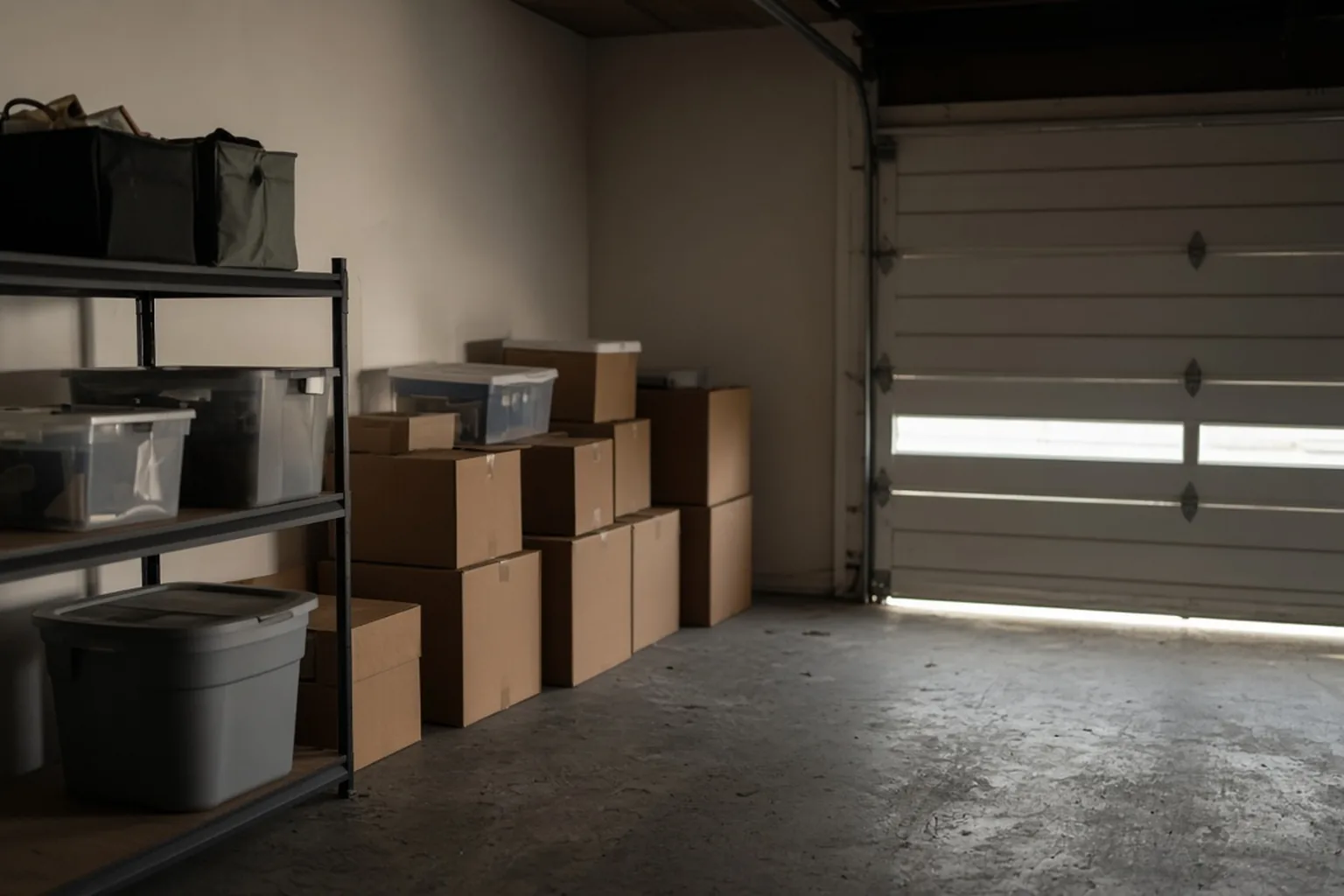 Cardboard boxes make easy nests and the gap under an overhead door makes an easy entrance. Plastic bins and a fresh door seal fix both.
Why do mice move into Bloomington homes every fall?
Seal in late August or September, set traps the moment you see droppings, and keep checking through March, because mice that got in before the gaps were closed will keep turning up. Work with that calendar. House mice can produce 5 to 10 litters a year, and a warm basement removes the seasonal brake, so a single mouse heard in October can turn into a real population by February. Once inside, they keep breeding. Minnesota's seasonal notes describe the result well: mice in walls and garages all winter. Mice follow the foundation, find a gap at the sill plate or around a pipe, and settle into insulation, wall cavities, basement storage and attached garages. The shift usually starts in September and peaks in October and November. A house offers both. Average lows bottom out near 8F, and mice that spent summer in gardens, window wells and brush piles need heat and steady food. Mice move into Bloomington homes in fall because the winter here is too cold to survive outside without shelter.
House mouse or deer mouse: does it change the risk?
A deer mouse nest in a shed or cabin is another story, and that cleanup deserves the full CDC method: air it out, soak with bleach, wipe, bag, and never sweep. For a Bloomington household, the practical point is that a kitchen mouse is a sanitation and allergy problem, not a hantavirus emergency. Deer mice are more likely in cabins, sheds, detached garages and buildings near fields or woods. House mice live alongside people in town. Deer mice have a brown back, a bright white belly and white feet, and a tail that is sharply dark above and pale below. House mice are a fairly even gray-brown, with a scaly tail about the same color top and bottom. You can usually tell them apart at a glance. The deer mouse does, and it is behind the handful of cases on record here: 2 likely acquired in the state since 1999. The state health department says plainly that the house mouse does not carry hantavirus. In Minnesota it does.
 This is what a proper seal looks like: metal mesh fastened with screws and sealed at the edges. Foam or caulk on its own gets chewed through.
Mice, droppings and asthma: why indoor cleanup matters.
Then close the entry points, or the allergen load builds right back up as new mice arrive. Bag the waste and wash nearby surfaces. Air out the space for 30 minutes if you can, spray droppings and nest areas with 1.5 cups of bleach per gallon of water, wait 5 minutes, and wipe up with paper towels. Keep cleanup wet. People with asthma, children especially, may react before anyone actually sees a mouse. If mice are nesting near the furnace, along the basement rim joist or behind a return vent, their allergens travel with that air. In a Bloomington winter the furnace runs for months, pushing air through basements and ducts. Droppings, urine and dander dry out and break into fine particles, which get stirred up by sweeping, vacuuming and moving air. The Minnesota Department of Health treats mice and rats as an indoor asthma trigger, and for most households that is the main health cost of a winter mouse problem.
Opening a cabin or shed after winter: deer mouse cleanup.
Before closing up in fall, seal gaps, store food in metal or glass, and set a few traps so next spring's job is smaller. The same routine applies to a shed or detached garage back in Bloomington. hantavirus cases since 1993 were fatal, so a careful hour is worth it. Minnesota's case count is small, but the CDC reports that about 35 percent of U.S. Wash bedding and fabric on hot. Bag everything, then mop floors and wipe counters with the same mix. Spray droppings, nests and urine stains with a 1:9 bleach solution and let it soak 5 minutes before wiping. Put on rubber or plastic gloves. Open every door and window and step away for 30 minutes. Do not walk in and start sweeping. If you own or rent a cabin, the first day back is when exposure is most likely. They spend winter in closed buildings, and by spring there can be droppings in drawers, on mattresses and inside stored bedding. Minnesota's notes place deer mice squarely in rural cabins and outbuildings.
What a winter rodent visit looks like in a Bloomington home.
A good provider will tell you which openings are temporary patches until spring. Ask what can be sealed now and what should wait for warmer weather, since some exterior sealants and mortar do not cure well in deep cold. You should leave with a written list of entry points, a trapping plan with dates for follow-up checks, and a note on any insulation that needs cleanup. The inspector is reading droppings, gnawed edges, nests and rub marks to map how mice are moving through the house. Inside, expect a look at the basement rim joist, the space behind the furnace and water heater, under sinks and throughout the attached garage. Fresh snow can help, since tracks show where mice are coming and going. The inspector should walk the foundation looking for gaps at the sill plate, around utility lines and at the corners of the garage door, and check vents and the seams where siding meets the foundation. A useful first visit in a Bloomington home starts outside, even in January.
What affects the price
- Timing, since sealing in early fall usually means less trapping later in the winter.
- Unfinished basements with long runs of exposed sill plate take more time to seal.
- Attached garages with worn door seals often need new bottom seals and sweeps.
- Snow and frozen ground can limit some exterior work after December.
- The number of trap checks included through the winter months.
- Insulation cleanup in an attic or along basement rim joists, normally priced separately.
📊
What's your biggest concern about rodents?
When to call for help
Bring someone in if you are still catching mice after a few weeks of trapping, which usually means the entry points are still open. Call sooner if someone in the house has asthma, or if you find signs of Norway rats such as burrows along the foundation, since rats are warier and harder to trap. A provider is also worth it for a cabin or outbuilding packed with deer mouse droppings. In Bloomington the smartest time to call is September, before mice settle into the walls for the season.
What you can do yourself
Plenty of homeowners handle a fall mouse or two on their own, and that is reasonable. Snap traps with a bit of peanut butter, set at a right angle to the wall along mouse routes, work well. The Minnesota Department of Health's rule of thumb makes sealing simpler: if a pencil fits in an opening, a mouse can use it. Steel wool plus caulk handles small gaps, and a new garage door sweep fixes a lot. A pro helps most with the openings you cannot see. Gaps at the sill plate, behind siding, around the dryer vent and along the top of the foundation are easy to miss, and in a Bloomington winter mice will test every one. Help also makes sense when cleanup is heavy or when Norway rats show up. Skip loose poison indoors. Mice that eat it often die inside walls, and the smell lingers.
Rodents in Bloomington
Bloomington is a suburban city of about 90,000 at 827 feet, founded in 1858 and known for the Mall of America and MSP Airport. Its rodent pattern is set mostly by the continental climate. Average humidity near 70 percent and about 31 inches of rain support plenty of rodents outdoors in summer, then a hard winter forces them to pick shelter. Every house, whatever its age, gets tested by mice each fall. With a median home value near $340,000, chewed wiring or soiled insulation along a basement rim joist is a real repair. The good news is on the disease side: Minnesota's health department notes that rodents in the state are far less likely to carry hantavirus than those farther west.
Local research
Rodents in Bloomington, MN: what the public record shows
Before you compare quotes, it helps to know which rodents actually live in Minnesota, when they are busiest around Bloomington, and what the state figures look like. Everything below links to the agency or university page it came from.
Hantavirus cases likely acquired in Minnesota since 1999
Plus one resident infected in the western US; Minnesota rodents are far less likely to carry the virus.
Minnesota Department of HealthWhich mouse carries hantavirus here
Minnesota Department of Health states plainly that the house mouse does not carry hantavirus.
Minnesota Department of HealthRodent species recorded in Minnesota
- House mouse (Mus musculus) — Enters at 1/4 inch; 5-10 litters per year; eats about 200 small meals a night.
- Norway rat (Rattus norvegicus) — Burrowing rat of basements, sewers and ground floors; tail shorter than head plus body.
- Deer mouse (Peromyscus maniculatus) — Primary U.S. hantavirus carrier; lives throughout Washington and the interior West.
When rodents are busiest around Bloomington
Fall entry; winter infestations. Upper Midwest and Northeast: mice in walls and garages all winter.
Based on Bloomington’s humid continental climate profile.
In Minnesota the house mouse is the structural problem; the deer mouse is the rural cabin and outbuilding problem.
For context, nationally
- 1/4 inch (the width of a pencil) — Smallest gap a mouse can enter. CDC
- 890; 35% fatal; 94% west of the Mississippi — Hantavirus cases reported since 1993 (through 2023). CDC
Sources: Minnesota Department of Health; CDC; Pest Notes: House Mouse; Pest Notes: Rats; Hantavirus. Figures are quoted as the source prints them. How we check our sources
Simple ways to keep rodents away
- Walk the foundation in September and close any gap a pencil slides into.
- Replace a worn garage door bottom seal and add a sweep to the service door.
- Keep bird seed, grass seed and pet food in metal or heavy plastic bins with lids.
- Stack firewood off the ground and away from the house through the winter.
- After a fresh snowfall, follow any small tracks along the foundation to find the gap.
- Seal around pipes under sinks and where utilities enter the basement.
- Fit proper guards on dryer and exhaust vents rather than window screen.
- Store garage clutter in sealed plastic bins instead of cardboard boxes over winter.
 After sealing, a few monitors or unset traps left along the walls tell you whether anything is still getting in before you hear it again.
Did you know?
The Minnesota Department of Health uses a pencil as its sealing gauge: if one slides into a gap, a mouse can get through it.
House mice can go their whole lives without drinking, getting the moisture they need from the food they eat.
Some diseases tied to rodents, including plague, Lyme disease and murine typhus, reach people indirectly through fleas and ticks that fed on rodents.
Questions people ask
Do house mice in Bloomington carry hantavirus?
No. The Minnesota Department of Health states that the common house mouse does not carry hantavirus. The deer mouse does, and it turns up more in cabins, sheds and outbuildings than inside Bloomington homes. House mouse droppings are still worth cleaning carefully, since they trigger asthma and can carry other germs, so wet them first.
When do mice come inside in Minnesota?
Mostly from September through November. As nights cool toward Bloomington's average winter low of about 8F, mice leave yards and gardens for basements, attached garages and wall cavities. Once inside they stay all winter and keep breeding. Sealing gaps in late summer or early fall is the best way to keep that migration outside.
How many hantavirus cases has Minnesota had?
Very few. The state health department counts 2 cases likely acquired in Minnesota since 1999, plus one resident infected in the western U.S. Rodents here are far less likely to carry the virus than western deer mice. The CDC cleanup method is still the right habit for any droppings you find.
Can mouse droppings make asthma worse?
Yes. The Minnesota Department of Health lists mice and rats as an indoor asthma trigger and suggests looking for black or brown droppings about the size of a grain of rice. Proteins in droppings and urine become airborne when disturbed, so spray the area with a bleach solution and wipe it up instead of sweeping or vacuuming.
How small a hole can a mouse get through?
If a pencil fits in the opening, a mouse fits, by the Minnesota Department of Health's rule, and the CDC puts the size at about a quarter inch. In a Bloomington basement, check the sill plate, gaps around pipes and wires, and the dryer vent, then pack the openings with steel wool and seal over it.
Are there rats in Bloomington, MN?
Norway rats are on Minnesota's species list, so they do occur, but they show up in homes far less often than house mice. Look for burrows along foundations or under decks and droppings much larger than a mouse's, with blunt ends. Rats avoid unfamiliar objects, so traps can sit untouched for days.
Why are mice getting into my car in the garage?
A car parked in an attached garage is shelter during a long Minnesota winter, and the engine compartment offers warmth and nesting room. Mice chew wiring and stuff air filter housings with nest material. Set traps along garage walls, keep seed and pet food out of the garage, and check under the hood if the car sits for weeks.
Nearby cities
Related guides
Sources (6)
The facts in this article come from the public sources listed above. Every home is different, so ask the company you talk to about pricing and what’s included. Published by Rodent Exterminator · Updated October 11, 2026 · How we write these guides