The short version
Rodent control in Brownsville, Texas means removing roof rats and Norway rats and treating for their fleas in the same window, because Texas DSHS ties rats and fleas to flea-borne typhus, long concentrated in South Texas and the Rio Grande Valley. Seal roofline and foundation gaps, trap or station-bait the rats outdoors, then treat pets and nesting areas for fleas.
- Texas reported over 8,600 flea-borne typhus cases from 2008 through 2025, per Texas DSHS.
- About 72 percent of those Texas typhus patients ended up in the hospital.
- With 52F winter lows, Brownsville rats breed and travel in every month.
- Roof rats rule Gulf Coast attics, while Norway rats burrow under slabs and sheds.
- Treat pets and nesting areas for fleas whenever rats are removed.
This page is for Brownsville homeowners hearing scratching overhead, renters who found droppings under the sink, and landlords managing units across town. It also matters to anyone with dogs or cats, since pets pick up rat fleas easily, and to small business owners who store food or supplies and cannot afford gnawed stock.
What to look for
Four rodents turn up in Texas homes, and in Brownsville the roof rat usually leads. It climbs trees, fences, and utility lines, slips into attics through soffit gaps and roof vents, and nests in insulation that feels unbearably hot to us. The Norway rat is its ground-level partner, burrowing under slabs, sheds, and debris piles and entering beside plumbing. House mice take over kitchens and pantries, and deer mice mostly stick to rural outbuildings. What sets Brownsville apart is the flea. Texas DSHS reports that rats and their fleas are the natural reservoir for flea-borne typhus, with more than 8,600 Texas cases from 2008 through 2025 and South Texas a long-standing hotspot. When rats die or move out, their fleas hunt for a new host, and that can be you or your dog. A 52F average winter low means no true cold season to knock populations back, so breeding runs all year, with an extra push into homes in fall.
- 1Running or gnawing in the attic or ceiling during the first hours after dark.
- 2Dark, greasy smudges on roof edges, beams, or pipes where rats squeeze through the same gap each night.
- 3Flea bites around your ankles, or pets suddenly scratching when they were fine last month.
- 4Spindle-shaped droppings scattered in attic insulation or along the tops of walls.
- 5Hollowed-out citrus or other fruit, still on the tree or lying underneath it.
- 6Burrow openings under concrete slabs, sheds, or stacked lumber in the yard.
Why it’s worth acting soon
- Rat fleas can carry flea-borne typhus, and Texas DSHS says roughly 72 percent of reported cases needed hospital care.
- Mild winters let roof rat colonies keep growing instead of shrinking back each year.
- Attic nests ruin insulation and leave droppings on ductwork that feeds air into living space.
- Chewed AC lines and wiring in a hot attic can knock out cooling in the middle of summer.
- Removing rats without treating for fleas leaves hungry fleas searching for people and pets.
Treatment options and typical costs
Rat removal paired with flea treatment
Quoted after inspection
Trapping or baiting rats alongside flea control for pets, the yard, and the places rats nested. Because Texas DSHS names rats and their fleas as the natural reservoir for flea-borne typhus, flea work belongs in the plan. Ask the provider how flea treatment is timed against rat removal, and check pet products with your veterinarian.
- Time
- Two to four weeks
- Best for
- Any rat problem in a home with people or pets
Attic and roofline exclusion
Quoted after inspection
Sealing roof vents, soffit and fascia gaps, AC line penetrations, and roof-to-wall joints with metal mesh, hardware cloth, or flashing, then cutting back branches. In Brownsville this mostly targets roof rats, which can return to the same attic within days if a single gap stays open. Ask for a written list of every point sealed.
- Time
- One or two visits
- Best for
- Roof rats in attics
Snap traps and enclosed traps
Quoted after inspection
Traps set on rafters, along top plates, and on rat runways, checked often enough that nothing decays in a hot attic. Trapping lets the provider confirm when activity has stopped, and it avoids poisoned rats dying where nobody can reach them. Ask how often traps are checked and who removes the catch.
- Time
- One to three weeks of checks
- Best for
- Attic and indoor activity
Exterior bait stations
Quoted after inspection
Locked stations placed around the foundation, sheds, and fence lines to pressure Norway rats and roof rats outdoors. Bait works slowly and rats can die in hidden spots, so stations belong outside, after sealing is done. Ask which product is used and how pets and wildlife are kept away from it.
- Time
- Ongoing service
- Best for
- Heavy pressure from yards and outbuildings
Prices are typical published ranges. Ask what’s included before you compare quotes.
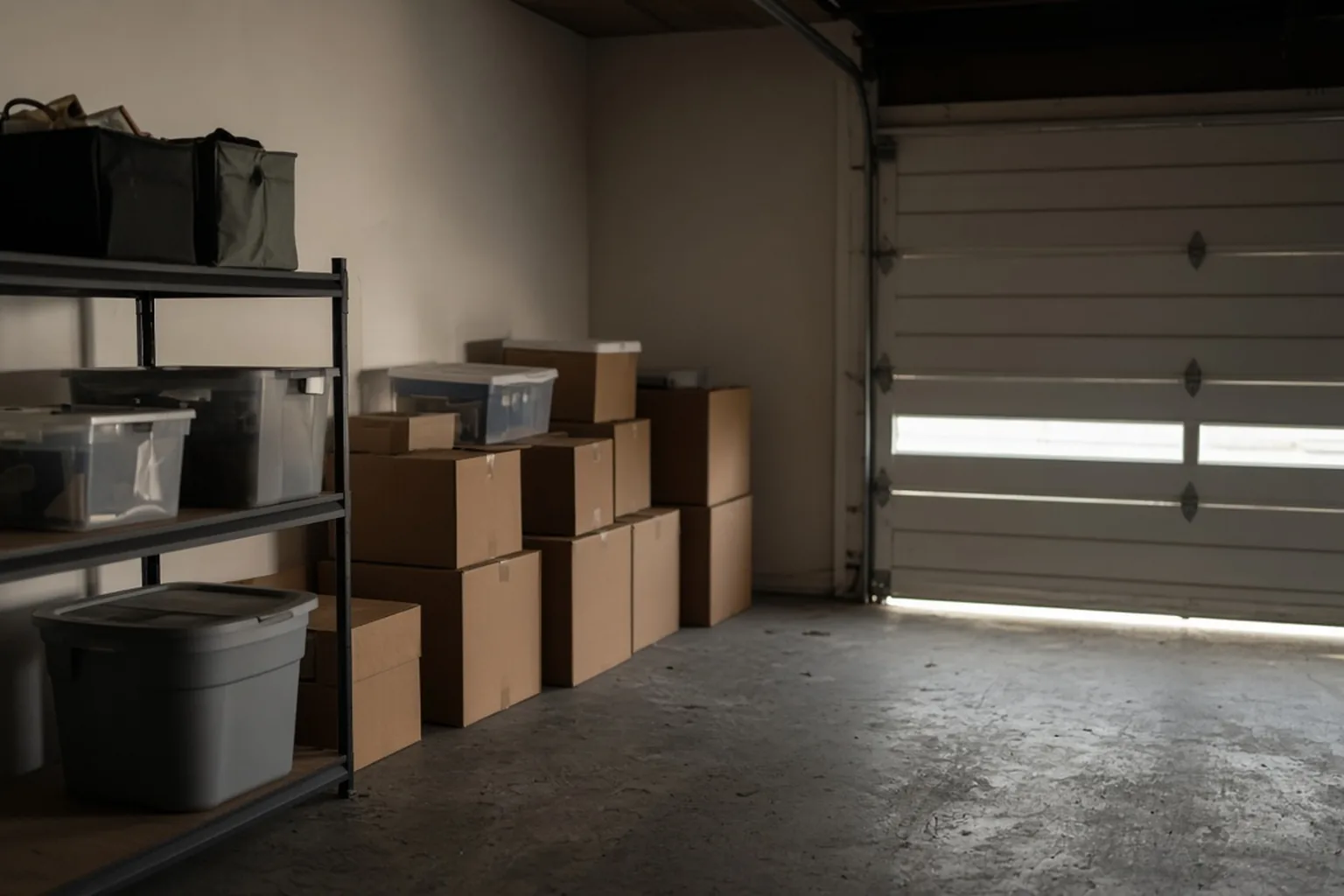 Cardboard boxes make easy nests and the gap under an overhead door makes an easy entrance. Plastic bins and a fresh door seal fix both.
Why should a Brownsville rat job include flea control?
Texas DSHS reports that rats and their fleas are the natural reservoir for flea-borne typhus, also called murine typhus, and that Texas logs more cases than any other state. The trend is heading the wrong way. Texas DSHS counted a low of 135 cases in 2010 and a peak of 1,110 in 2025. Over the full 2008 to 2025 period, about 72 percent of patients were hospitalized and 17 died. South Texas, from Nueces County through the Rio Grande Valley, has long been a center of those cases, and Brownsville sits at the bottom of that region. The practical lesson is timing. When rats are removed, their fleas need a new host, and the nearest one may be your dog, your cat, or you. A sound plan treats pets with vet-approved flea products, treats the nesting areas, and handles rat removal in the same window. Ask any provider how they deal with fleas before you agree to a rat job. Because in South Texas the fleas riding on rats are a health issue on their own.
Roof rats in a city that never really gets cold.
In colder cities, winter kills off weak rodents and slows breeding. Here, roof rats keep raising young straight through December and January. University of California pest notes put roof rats at three to five litters a year, with up to eight young in each. In a mild climate with steady food from fruit trees, pet bowls, and garbage, a colony that moves into an attic in October can be several times larger by spring. Summer does not slow them much either. With highs around 96F, attics turn brutally hot, so roof rats may nest along the cooler edges, inside wall voids, or above garage ceilings, then forage at night when temperatures drop. That is why noise often starts right after sunset. The fix is making the roof unusable rather than trying to outlast the colony. Seal vents and soffit gaps, cut back branches, and check again after storms, since one loose vent screen can let a new group move in. Brownsville's average winter low of 52F is the biggest reason rat problems here feel endless.
 A good inspection starts outside at ground level: door thresholds, the joint between siding and foundation, and anywhere a pipe or cable enters.
What a first rodent visit in Brownsville should cover.
Outside, the provider should walk the full roofline, looking at roof vents, soffits, fascia boards, and the places where AC lines, cables, and plumbing pass through walls. They should note any branches or fences that give roof rats a bridge to the roof, plus burrows under slabs, sheds, and debris piles that point to Norway rats. Inside, expect a look into the attic for droppings, runways through the insulation, and nests, then under sinks and behind appliances for mouse activity. Fresh droppings tell them which species is present and how active the problem is. Before work starts, ask for a written plan covering which openings will be sealed and with what, where traps or stations will go, how flea treatment fits in, and how many follow-up checks are included. If pets live in the house, ask how the plan protects them, and loop in your veterinarian on flea products. A thorough first visit starts outside and works in, and in Brownsville it should include a flea check, not just a rat count.
Rats in a Brownsville rental: what tenants and landlords should do.
Tenants should report activity in writing with dates, photos of droppings or damage, and any flea bites. Keep food sealed and trash taken out so housekeeping cannot be blamed for the problem. Check your lease for language about pest control. Landlords have the stronger reason to move fast. Roof rats travel along shared attics and rooflines, so a duplex or small complex in Brownsville is often dealing with one colony, not several. Treating one unit while the neighbor's attic stays open just moves the rats around. Sealing a roofline is a building repair, not something a tenant can do. Since Texas DSHS links rats and fleas to flea-borne typhus, documenting flea treatment matters too. A provider can leave a written report of what was found, what was sealed, and what was treated, which protects both sides if the problem returns. Rat problems in rentals tend to stall on the question of who handles it, and the faster that is settled, the better for everyone in the building.
When does a rodent problem need action right away?
A rat bite or scratch needs medical attention. Wash it well and call a doctor, since the CDC lists rat-bite fever among diseases rodents spread directly. A fever after flea bites in a house with rats is worth a doctor visit, and mention the rats and fleas when you go. That detail helps a clinician consider flea-borne typhus, which Texas DSHS tracks closely in South Texas. Rats inside living space, not just the attic, mean the colony is large or a major gap is open. In a Brownsville home with babies, older adults, or anyone with a weak immune system, move quickly on trapping, sealing, and cleanup. Chewed wiring, a burning smell, or flickering lights near rat activity can mean an electrical hazard. Have an electrician look before assuming it is only a rodent issue. Everything else, such as a few droppings in the garage, can wait for a scheduled visit. Most rodent problems are urgent rather than emergencies, but a few situations should move to the top of your list.
What affects the price
- Whether flea treatment is part of the job or billed as a separate service.
- Attic size and access, since South Texas heat limits how long anyone can work up there.
- How many roofline gaps and AC or utility penetrations need sealing.
- The number of sheds, carports, or storage rooms that also need inspection.
- Insulation removal and replacement when nesting and droppings are heavy.
- Monthly station service compared with a one-time removal and sealing job.
📊
What's your biggest concern about rodents?
When to call for help
Attic work in South Texas heat is also hard on homeowners: the space can be dangerously hot for much of the year, and finding roof rat entry points means checking the roofline from a ladder. Bring in a provider as well if droppings cover insulation or ductwork, if you smell a dead rat somewhere you cannot reach, or if you rent out property and need the work documented. Call when you have rats rather than a single mouse, and call sooner if anyone in the house is getting flea bites. Rat control and flea control go together here, and doing one without the other leaves a gap.
What you can do yourself
A house mouse in the pantry is a fair DIY project. Snap traps baited with peanut butter and set along walls will usually catch it within a few nights, and sealing the gap under the sink or behind the stove keeps the next one out. Rats are a harder call in Brownsville for two reasons. First, roof rats live in attics, and attics here get extremely hot, so reaching the right spots and checking traps daily is tough and risky. Second, rats bring fleas, and Texas DSHS ties rats and their fleas to flea-borne typhus. A provider can pair trapping with flea treatment, seal the roofline, and time the work so fleas do not end up on your family. If you handle rats yourself, wear gloves, use traps rather than loose poison, and treat pets for fleas at the same time with your vet's advice.
Rodents in Brownsville
With a median home value near $155,000, sealing an attic and treating for fleas is small next to replacing insulation and ductwork, and it protects everyone living under that roof. Texas DSHS lists South Texas from Nueces County to the Rio Grande Valley as a long-standing concentration area for flea-borne typhus, which puts Brownsville in the zone where rat control is a health measure. At 33 feet of elevation, with about 27 inches of rain a year and humidity averaging 74 percent, the city is warm and muggy but not especially wet, so rats gather wherever water is reliable: irrigation, drains, and leaky outdoor fixtures. Its rodent picture comes down to heat and location. Brownsville is an urban border city of about 190,000 people at the southern tip of Texas, founded in 1848 and now also known for the SpaceX launch site.
Local research
Rodents in Brownsville, TX: what the public record shows
Before you compare quotes, it helps to know which rodents actually live in Texas, when they are busiest around Brownsville, and what the state figures look like. Everything below links to the agency or university page it came from.
Flea-borne (murine) typhus cases reported in Texas, 2008-2025
Texas reports more flea-borne typhus than any other state; rats and their fleas are the natural reservoir.
Texas Department of State Health ServicesRodent species recorded in Texas
- House mouse (Mus musculus) — Enters at 1/4 inch; 5-10 litters per year; eats about 200 small meals a night.
- Norway rat (Rattus norvegicus) — Burrowing rat of basements, sewers and ground floors; tail shorter than head plus body.
- Roof rat (Rattus rattus) — Climber of attics and trees in warm and coastal regions; tail longer than head plus body.
- Deer mouse (Peromyscus maniculatus) — Primary U.S. hantavirus carrier; lives throughout Washington and the interior West.
When rodents are busiest around Brownsville
Year-round, fall surge. Roof rats dominate Florida, Texas and Gulf Coast attics.
Based on Brownsville’s humid subtropical climate profile.
Rat control in Texas is a flea-borne typhus issue as much as a structural one, so flea treatment goes with rodent removal.
For context, nationally
- 1/4 inch (the width of a pencil) — Smallest gap a mouse can enter. CDC
- 890; 35% fatal; 94% west of the Mississippi — Hantavirus cases reported since 1993 (through 2023). CDC
Sources: Texas Department of State Health Services; CDC; Pest Notes: House Mouse; Pest Notes: Rats; Hantavirus. Figures are quoted as the source prints them. How we check our sources
Simple ways to keep rodents away
- Keep dogs and cats on flea prevention all year, since rats and their fleas never take a season off here.
- Trim tree limbs and shrubs so nothing touches the roof or eaves.
- Pick up fallen citrus and other fruit every day while trees are dropping.
- Cover attic and roof vents with hardware cloth and check the screens after heavy storms.
- Seal gaps where AC lines and plumbing pass through walls using metal mesh and sealant.
- Keep pet food and bird seed in sealed metal or heavy plastic containers.
- Clear lumber, old tires, and debris piles that give Norway rats a place to burrow.
 Before you call, sketch where you have seen droppings or heard noise and measure any gaps you found. It makes the first visit faster and the quotes comparable.
Did you know?
Twenty or more weaned pups a year is typical output for one female Norway rat, spread over four to six litters.
Provisional national data through week 17 of 2026 counted 17 hantavirus cases for 2025, with California reporting the most at four.
Plague still appears in the United States at an average of about seven human cases a year, mostly in northern New Mexico, northern Arizona, and southern Colorado.
Questions people ask
Is flea-borne typhus a real risk in Brownsville?
Rats and their fleas are the reservoir, so Brownsville households should pair rat removal with flea control for pets and the home. Texas DSHS counts more than 8,600 Texas cases from 2008 through 2025, with South Texas and the Rio Grande Valley a long-standing hotspot. Yes, and it is the main health reason to take rats seriously here.
Do rats slow down during Brownsville winters?
Fall still brings a surge into homes as rodents look for shelter and food, but active roof rats can turn up in attics in any month. With average winter lows around 52F, Brownsville never gets cold enough to thin rat populations, so breeding continues all year. Not much.
Why do I need flea treatment if the problem is rats?
Texas DSHS ties those fleas to flea-borne typhus, so treating nesting areas and pets around the same time as rat removal closes that gap. When rats are trapped or poisoned, their fleas leave the body and look for another warm host, including people, dogs, and cats. Because rat fleas outlast the rats.
What kind of rats live in South Texas attics?
Norway rats live here too but usually stay at ground level, under slabs and sheds and in crawlspaces. They reach the roof using trees, fences, and utility lines, then slip in through vents and soffit gaps. Mostly roof rats, the slender climbing species that dominates attics along the Texas Gulf Coast.
Should I worry about hantavirus in Texas?
Deer mice do live in Texas, so if you are clearing out a closed-up shed or ranch building, air it out first and wet the droppings with bleach solution before wiping. cases west of the Mississippi in deer mouse country. Texas DSHS reports that hantavirus cases are rare in the state, and the CDC places most U.S.
How do I clean rat droppings out of a Brownsville attic?
In a Brownsville attic, work early in the morning before the heat builds, and never sweep or vacuum dry droppings. The CDC advises ventilating for 30 minutes, then soaking droppings and nests with 1.5 cups of bleach per gallon of water for five minutes before wiping up with paper towels. Air the space out first.
How much of my yard does rat control need to cover?
Placement should follow fence lines, sheds, and the foundation, and on Brownsville blocks where lots sit close together, comparing notes with neighbors helps. Rats forage roughly 100 to 500 feet from the nest, so one bait station by the back door rarely does much. More than most people expect.
Nearby cities
Related guides
Sources (6)
The facts in this article come from the public sources listed above. Every home is different, so ask the company you talk to about pricing and what’s included. Published by Rodent Exterminator · Updated October 11, 2026 · How we write these guides