The short version
Rodent control in Corpus Christi works best as a three-part job: seal every opening a quarter inch or larger, trap the rats and mice already inside, and deal with fleas at the same time. Fleas matter on this coast because Texas DSHS names South Texas, from Nueces County to the Rio Grande Valley, as the core of the state's flea-borne typhus activity, and rats carry those fleas.
- Rats stay active all year here because winter lows only average about 47F.
- Roof rats favor attics and trees, while Norway rats burrow at ground level.
- Texas DSHS reported 1,110 flea-borne typhus cases in 2025, and rats carry the fleas.
- Ask for flea control to be part of any rat removal plan.
- Close gaps with metal or mortar, since rats gnaw straight through foam.
Use this page if you live in Corpus Christi and hear noises in the attic, find droppings in the garage, or watch a rat run a fence line at dusk. It is written for owners, renters and landlords alike, and for anyone whose dogs or cats spend time outdoors, since flea exposure is part of the local rodent story.
What to look for
Texas state records list four rodents of concern: the roof rat, the Norway rat, the house mouse and the deer mouse. In a coastal city the roof rat tends to be the headliner. It is a climber that nests in attics, wall tops, dense vines and tall shrubs, and it reaches the roof by running along utility lines, fences and overhanging branches. The Norway rat is heavier and stays low, burrowing under slabs, sheds and debris piles. House mice slip into kitchens and garages through small gaps, and deer mice keep mostly to sheds and outbuildings. The Corpus Christi climate removes the brake that colder cities rely on. Winter lows average about 47F, so outdoor populations never crash and breeding runs through most of the year, with a modest bump in fall. UC Statewide IPM puts roof rats at three to five litters a year of up to eight young each, and without a winter die-off those litters stack up. Health is the other local factor. Rats here carry the fleas that spread flea-borne typhus, which turns a structural nuisance into a medical one.
- 1Scurrying or gnawing above the ceiling between dusk and dawn, often near the eaves.
- 2Slender droppings with pointed ends in the attic, on garage rafters or on top of the water heater.
- 3Dark grease smears where rats squeeze past a soffit gap, roof vent or pipe entry.
- 4Fallen fruit or pet food left out overnight with tooth marks on what remains.
- 5Chewed irrigation lines, AC condensate tubing or garden hoses where rats went looking for water.
- 6Burrow openings under a slab edge, concrete steps or a stack of stored lumber.
- 7A sudden flea problem on pets or indoors, which can point to rodents nesting close by.
Why it’s worth acting soon
- With no cold season to thin them, a few rats in a Corpus Christi attic keep multiplying month after month.
- Rat fleas spread flea-borne typhus, and Texas DSHS reports about 72 percent of cases end up hospitalized.
- Gnawed wiring or AC lines in a hot attic can mean an electrical fault or a dead air conditioner in August.
- Urine and nesting ruin attic insulation, a real cost when summer highs average 94F.
- Norway rat burrows can undercut slabs, walkways and patio edges over time.
Treatment options and typical costs
Roofline and attic exclusion
Quoted after inspection
Closing the openings roof rats use: gaps at the soffit and fascia, roof and gable vents, plumbing stacks, AC line entries and the corners where the garage door meets the jamb. Durable work uses hardware cloth, metal flashing and mortar rather than foam. Ask the provider to photograph each sealed spot so you can see exactly what was closed.
- Time
- One to three days
- Best for
- Rats or mice heard in the attic or walls
Attic and garage trapping
Quoted after inspection
Rat-size snap traps or enclosed traps set on beams, along walls and beside the openings rats travel, then checked on a fixed schedule until catches stop. Trapping keeps animals from dying inside a wall in a hot attic, and the catch log is your proof of whether the sealing actually worked.
- Time
- Two to four weeks
- Best for
- Rats or mice already living inside the structure
Flea control alongside rodent removal
Quoted after inspection
Rat control in Texas is tied to flea-borne typhus, so treating fleas belongs in the plan. Once rats are trapped out, the fleas in their nests look for a new host, and pets and people are the nearest choices. Ask whether nest areas get flea treatment and whether that work is included or quoted on its own line.
- Time
- Usually during the first one or two visits
- Best for
- Any confirmed rat activity, especially in homes with pets
Exterior Norway rat control
Quoted after inspection
Locked bait stations or traps placed along fences, sheds and burrow sites, paired with clearing the debris and dense ground cover that shelters rats. This fits properties beside drainage channels, open lots or commercial areas where outdoor pressure stays high. Ask which product is used and where stations will sit relative to pets and children.
- Time
- Monthly service, often for several months
- Best for
- Burrowing rats in the yard or under outbuildings
Prices are typical published ranges. Ask what’s included before you compare quotes.
 Clutter gives mice cover. Keeping stored fabric in lidded bins and off the floor takes away the nesting spots they like best.
Why rat control in Corpus Christi is also flea control.
In Corpus Christi they are a public health problem too, because rats carry the fleas that spread flea-borne typhus. Texas DSHS reports more than 8,600 cases statewide from 2008 through 2025, and it names South Texas from Nueces County to the Rio Grande Valley as the long-standing center of that activity. The trend has run in one direction. The state logged 135 cases in its low year of 2010 and 1,110 in 2025. About 72 percent of patients over that span were hospitalized, and 17 died. That changes how rat removal should be planned. When rats are trapped out of an attic, the fleas living in their nests stay behind and go looking for a new host, and the closest warm bodies are usually pets and people. A plan that removes rats without addressing fleas can briefly raise your exposure. When you talk to providers, ask how they handle fleas in nest areas, whether they can time the work with your pets' flea treatment, and whether that step appears in the written quote. Most cities treat rats as a property problem.
Roof rats, Norway rats or mice: who is making the noise?
UC Statewide IPM notes that Norway rats raise four to six litters a year and wean 20 or more young, while roof rats have three to five litters of up to eight. Where winter lows average 47F, all three can stay busy every month. Roof rat droppings are slender with pointed ends, Norway rat droppings are thicker with blunt ends, and mouse droppings are far smaller, closer to a grain of rice. Droppings help confirm it. Light, quick scratching inside cabinets or behind the stove is more often house mice. Thumping or gnawing low in a wall, under the floor or near the garage slab points toward Norway rats, which nest in burrows and enter at ground level. Steady scurrying along the top of a wall or across the ceiling at night usually means roof rats, the climbers that reach attics from tree limbs, fences and power lines. Start with where the sound comes from. Knowing which species you have tells a provider whether the work belongs at the roofline, the foundation or both.
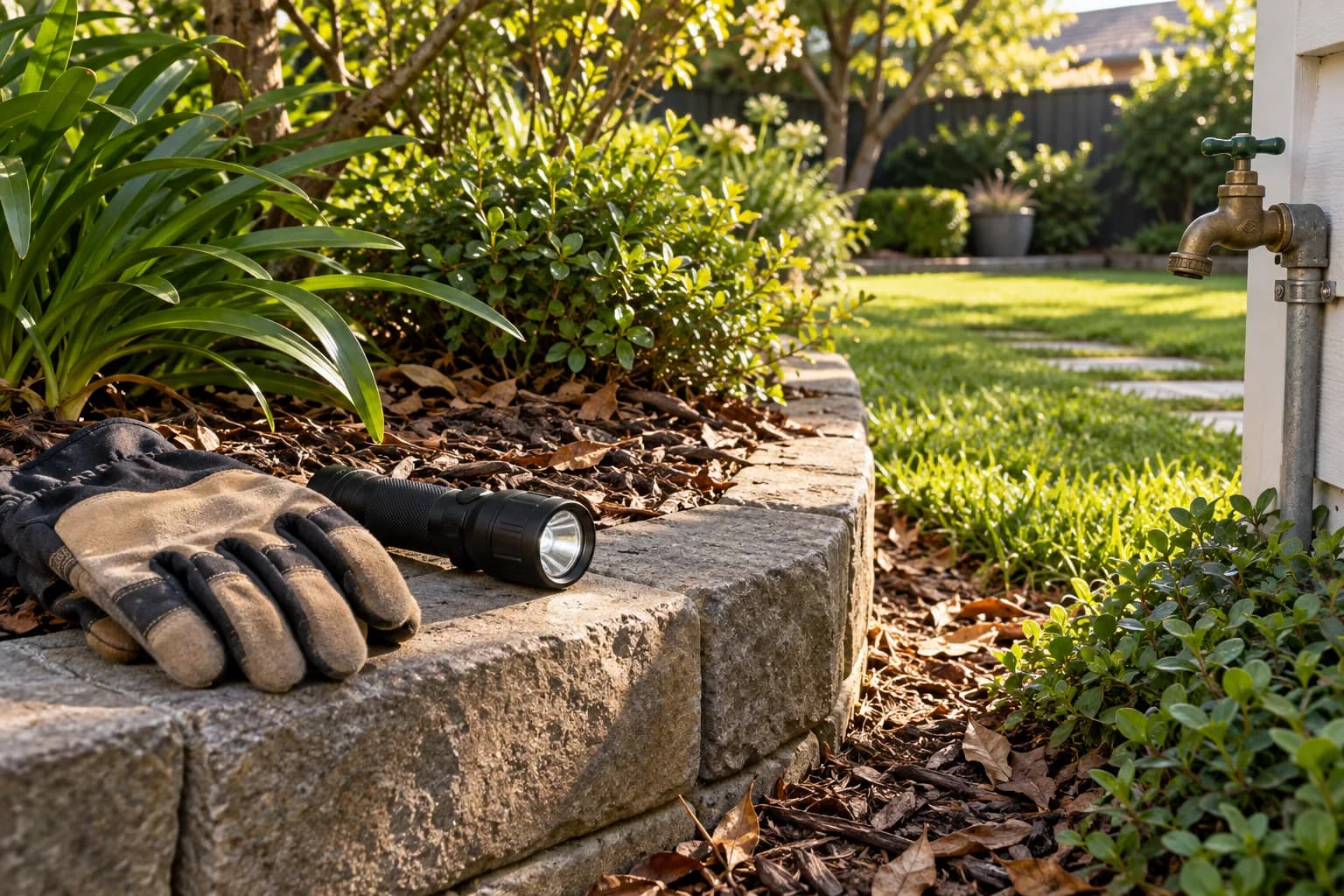 Dense shrubs against the house and a dripping hose bib give rodents cover and water. Trimming back and fixing drips makes the yard less inviting.
What happens to rats when Corpus Christi floods or a storm blows through?
At roughly 7 feet above sea level, Corpus Christi sits low, and a heavy rain or storm surge can flood the burrows Norway rats dig under slabs, sheds and debris piles. When that happens, the rats head for the nearest dry, sheltered space, which is often a garage, a crawl area or a gap at the base of an exterior wall. Roof rats already live off the ground, but storms create openings for them as well. Wind can peel soffits loose, lift vent screens and push branches into fresh contact with the roofline, and each of those opens a new route into the attic. After any significant storm, walk the house in daylight. Check soffits, fascia, vent screens, garage door seals and the base of every wall for new gaps, and look for fresh burrows along fences and slabs. If rats were already an issue before the weather hit, this is a good time to ask a provider for a follow up inspection instead of waiting for the noises to come back. Low ground changes how rats behave.
What should the first visit cover in a Corpus Christi home?
Expect the inspector to walk the outside first, looking at limbs and vines near the roof, utility lines, fences that rats use as highways, and burrows along slabs and sheds. On the house itself, they should check soffits, fascia, roof and gable vents, plumbing stacks, AC line entries, dryer vents and garage door seals. Inside, the attic is the main event. A careful inspector looks for droppings, runways through insulation, gnawed wiring and nests near the eaves, then moves on to the garage, the water heater closet and the cabinets under each sink. Across Corpus Christi, two extra questions belong in that visit. First, ask whether they see signs of fleas around nest sites, given the area's typhus history. Second, ask how attic heat affects their trap schedule, since a missed carcass in a summer attic becomes an odor problem fast. You should leave with a written list of entry points, a trapping plan and a separate price for each part. A useful first visit takes time and covers the whole property, from the yard to the ridge.
How do you compare two quotes for rat work on the coast?
The lower price only counts as cheaper if it covers the same ground. Bait stations, trapping and debris clearing each carry different costs and different risks for pets. Fifth, what is the plan for outdoor Norway rats, if you have them? Pulling soiled insulation out of a hot attic is hard, unpleasant work, and some quotes skip it entirely or price it later. Fourth, who handles cleanup? In a part of Texas where flea-borne typhus clusters, a rat quote that never mentions fleas is leaving something out. Third, is flea control part of the plan? Second, how many trap checks are included, and what happens if rats are still turning up after the last one? Foam alone does not. Metal, mesh and mortar hold up. First, does each one name the specific openings to be sealed and the materials, or does it simply say exclusion? Two quotes can look alike and describe very different jobs, so put them side by side and check five things. Ask each provider to fill any gaps in writing before you choose.
What affects the price
- Roof pitch and attic access, since sealing a steep or two story roofline takes more time and equipment.
- The count of AC, plumbing and vent penetrations that need metal or mesh.
- Whether flea treatment is built in or added as a separate charge.
- How much attic insulation is soiled and has to be pulled out and replaced.
- Trees and vines touching the roof that must be cut back to remove rat highways.
- Outdoor Norway rat pressure that calls for exterior stations and ongoing monthly visits.
📊
What's your biggest concern about rodents?
When to call for help
Call a provider once you confirm rats rather than mice, and do not count on a winter that never really arrives to slow things down. Across Corpus Christi, rat activity in an attic builds steadily, and every month adds droppings to clean and insulation to replace. Bring in help right away if anyone in the home has been bitten, if pets suddenly have fleas alongside rodent signs, or if you find gnawing on wiring or AC lines. Ask each company how they handle fleas, how they reach the roofline, and how many trap checks the price covers.
What you can do yourself
A sensible split: you manage the yard and food sources, and a provider seals the roofline and runs the attic trapping. Add the typhus factor, and handling soiled insulation and nests is a job many people would rather hand off. Attics in this climate also get dangerously hot by midday, which turns long trapping sessions up there into a safety question. Sealing a roofline means working on ladders around soffits, vents and fascia, and missing one gap keeps the rats coming back. The line shifts when roof rats move into the attic. A single mouse in the kitchen with an obvious gap under the door is a weekend fix. Trimming branches back from the roof, picking up fallen fruit and pet food each evening, fixing leaky hoses and condensate drains, and setting snap traps in the garage are all reasonable jobs to take on yourself. A lot of this is homeowner work in a coastal house.
Rodents in Corpus Christi
With a median home value around 210,000 dollars, sealing and cleanup protect both the house and the people living in it. Most important, Texas DSHS identifies South Texas from Nueces County to the Rio Grande Valley as the long-standing core of flea-borne typhus in the state. Annual rainfall is a modest 32 inches, so in dry stretches the most dependable water around is often a leaky hose, a pool edge or an AC drip line. The city lies only about 7 feet above sea level, which means a heavy rain or storm surge can flood ground level burrows and push Norway rats toward drier shelter in garages and wall bases. Today the city has about 316,000 residents living at urban density, so neighboring yards, alleys and rooflines sit close enough for rats to share. Corpus Christi was founded in 1839 and is known for its port and naval air station, and waterfront, warehouse and shipping activity is the kind of setting Norway rats have long followed.
Local research
Rodents in Corpus Christi, TX: what the public record shows
Before you compare quotes, it helps to know which rodents actually live in Texas, when they are busiest around Corpus Christi, and what the state figures look like. Everything below links to the agency or university page it came from.
Flea-borne (murine) typhus cases reported in Texas, 2008-2025
Texas reports more flea-borne typhus than any other state; rats and their fleas are the natural reservoir.
Texas Department of State Health ServicesRodent species recorded in Texas
- House mouse (Mus musculus) — Enters at 1/4 inch; 5-10 litters per year; eats about 200 small meals a night.
- Norway rat (Rattus norvegicus) — Burrowing rat of basements, sewers and ground floors; tail shorter than head plus body.
- Roof rat (Rattus rattus) — Climber of attics and trees in warm and coastal regions; tail longer than head plus body.
- Deer mouse (Peromyscus maniculatus) — Primary U.S. hantavirus carrier; lives throughout Washington and the interior West.
When rodents are busiest around Corpus Christi
Year-round; fall peak. Pacific Northwest: roof and Norway rats plus deer mice statewide in Washington.
Based on Corpus Christi’s humid subtropical climate profile.
Rat control in Texas is a flea-borne typhus issue as much as a structural one, so flea treatment goes with rodent removal.
For context, nationally
- 1/4 inch (the width of a pencil) — Smallest gap a mouse can enter. CDC
- 890; 35% fatal; 94% west of the Mississippi — Hantavirus cases reported since 1993 (through 2023). CDC
Sources: Texas Department of State Health Services; CDC; Pest Notes: House Mouse; Pest Notes: Rats; Hantavirus. Figures are quoted as the source prints them. How we check our sources
Simple ways to keep rodents away
- Cut tree limbs and vines back so nothing hangs within reach of the roof or touches the walls.
- Screen roof vents, gable vents and soffit gaps with quarter inch hardware cloth.
- Pack metal mesh around AC lines and plumbing where they enter the house, then seal over it.
- Pick up fallen fruit, pet food and birdseed every evening, since roof rats forage at night.
- Repair dripping hose bibs, irrigation leaks and condensate lines that hand rats free water.
- Store lumber, firewood and fishing or boat gear on racks off the ground and away from walls.
- Keep dogs and cats on a flea preventive, which limits typhus exposure if rats are nearby.
- Use trash bins with tight lids and park them away from the house wall.
 In a multi-unit building, mice move between apartments through shared walls and pipe chases, so treating one unit rarely solves it. Ask for a building-wide plan.
Did you know?
Texas reports more flea-borne typhus than any other state, and rats with their fleas are the disease's natural reservoir.
Flea-borne typhus has spread beyond South Texas and is now also found in Dallas-Fort Worth, Greater Houston, Bexar and Travis counties.
The CDC counts tularemia and lymphocytic choriomeningitis among the diseases rodents can pass directly to people.
Questions people ask
Do rats in Corpus Christi go away in the winter?
Activity may pick up in fall as rats hunt for sheltered nest sites, but the attic noises you hear in February usually come from the same colony that was there in July. Corpus Christi winter lows average about 47F, which is not cold enough to knock back outdoor rat populations or stop breeding. No.
What is flea-borne typhus and why do rats matter?
About 72 percent of Texas cases are hospitalized, so removing rats and treating fleas together is worth the effort. Texas DSHS counted 1,110 cases in 2025 and names South Texas, from Nueces County down to the Rio Grande Valley, as a center of activity. It is a bacterial illness spread by fleas living on rats and other animals.
Is it a roof rat or a Norway rat in my attic?
Knowing which one tells a provider where to seal and trap. Norway rats are bulkier, burrow at ground level and rarely reach an attic unless a wall void gives them a route. Roof rats are slimmer, with tails longer than their bodies, and they leave pointed droppings. If the noise is overhead and the animal climbs, it is almost always a roof rat.
How small a gap do rats and mice need?
On a coastal home, check soffits, roof vents, AC line entries and garage door corners first. That is why sealing should use hardware cloth, sheet metal or mortar. Rats start with somewhat larger openings but gnaw at the edges until a small one fits. A pencil-width hole, a quarter inch by the CDC's measure, is enough for a house mouse.
Should I treat my pets for fleas if I have rats?
Keep pets on a flea preventive your vet recommends during and after rat control, and ask the provider whether nest areas get treated too. When rats are trapped or leave, their fleas look for new hosts, and dogs, cats and people are the closest options. Yes, and in Corpus Christi it is one of the simplest protective steps you can take.
How do I clean up rat droppings safely?
Skip the broom and the vacuum, which lift dried particles into the air. The CDC says to let it sit five minutes, wipe up with paper towels and bag everything. Ventilate the space for 30 minutes before you start, then put on gloves and soak the droppings with a bleach solution of about 1.5 cups per gallon of water.
Is hantavirus a concern on the Texas coast?
Deer mice are the carrier, so use the wet bleach cleanup method in sheds, barns or closed cabins anyway, since the precaution is easy and the illness is serious. Texas DSHS describes reported hantavirus cases in the state as rare, and the CDC's provisional national count for 2025 listed none in Texas. It is uncommon.
Nearby cities
Related guides
Sources (6)
The facts in this article come from the public sources listed above. Every home is different, so ask the company you talk to about pricing and what’s included. Published by Rodent Exterminator · Updated October 11, 2026 · How we write these guides