The short version
Rodent control in Dothan, Alabama, follows the order Alabama Extension recommends: seal the house first, cut off food and shelter second, and use traps or bait third. Dothan's mild winters, with lows near 39F, let roof rats and Norway rats stay active year-round, so sealing gaps of 1/2 inch for rats and 1/4 inch for mice matters in every season.
- Dothan has three problem rodents: roof rats up high, Norway rats down low, house mice indoors.
- Alabama Extension says one unchecked rat pair can become more than 640 rats in a year.
- Rats get through 1/2-inch holes and climb pipes up to 3 inches across.
- Anticoagulant bait takes 4 or 5 days to work, so dead rodents can turn up in walls.
- Pest control firms in Alabama need a state Household Pest Control license.
This is for Dothan homeowners hearing noises in the attic, renters finding droppings in a kitchen drawer, and anyone with a shed, barn, or garage where feed, seed, or stored food has started disappearing. If you've already put out bait and now smell something in the wall, the sections on bait timing will help.
What to look for
House mice produce five to ten litters a year, according to Alabama Extension, with five or six young born about 20 days after mating. A couple of mice in September can be a household problem by Thanksgiving. Alabama Extension's guide to rats and mice around the home names three rodents, and Dothan houses can see all of them. Norway rats live low, under buildings and slabs and along stream banks. Roof rats live high, in trees, vine-covered fences, and attics, and get indoors from the roof and along utility lines. House mice settle into kitchens, cabinets, and wall voids. Dothan's climate keeps all three busy. Summer highs average 92F and winter lows only drop to about 39F, so there's no hard freeze long enough to slow outdoor rats much. The city gets about 54 inches of rain a year and averages 73% humidity, which keeps vegetation thick and water easy to find. Roof rats in particular do well with that much cover around a house. The real issue is speed.
- 1Scurrying or gnawing above the ceiling at night, a classic roof rat sign.
- 2Droppings in a pantry, drawer, or along the top of a cabinet.
- 3Chewed bags of peanuts, pet food, or bird seed in the garage or shed.
- 4Burrow openings under the slab edge, a shed, or a woodpile.
- 5Greasy marks on pipes, wires, or beams where rats travel.
- 6A rat running along a power line, fence top, or tree limb near the house at dusk.
- 7A sudden dead-animal odor from a wall several days after bait was set out.
Why it’s worth acting soon
- Alabama Extension's math is blunt: one pair left alone can top 640 rats in a year.
- Mice breed five to ten times a year, so a few become dozens fast.
- Rats chew wiring in attics, which can start fires and knock out power.
- CDC lists leptospirosis and salmonellosis among illnesses rodents spread directly.
- Waiting until numbers are high often means bait, and bait means dead rodents in walls.
Treatment options and typical costs
Exclusion and rodent-proofing
Quoted after inspection
Sealing every hole a rat or mouse can use, including gaps as small as 1/2 inch for rats and 1/4 inch for mice, plus pipe penetrations rats climb along. Alabama Extension puts exclusion first in its control order because nothing else lasts without it.
- Time
- Depends on how many openings need sealing
- Best for
- Every home with rodent activity
Trapping inside the house
Quoted after inspection
Snap traps or enclosed trap boxes set in attics, along walls, and behind appliances. Trapping indoors avoids the odor problem that comes when baited rodents die inside walls, and it gives a clear count of how many animals are being removed.
- Time
- Until catches stop, with regular checks
- Best for
- Rodents already inside the living space
Exterior bait stations
Quoted after inspection
Locked bait stations along the outside of the house for rat populations that live in the yard. Alabama Extension notes anticoagulant bait takes about 4 or 5 days to kill after the first feeding, so results aren't instant. Ask where stations will go and how they're secured from pets.
- Time
- Ongoing, serviced on a schedule
- Best for
- Norway rats burrowing outdoors
Sanitation and yard cleanup
Quoted after inspection
Removing food, water, and cover: sealing feed and seed, cutting vines off fences and walls, trimming limbs away from the roof, and clearing debris piles. Alabama Extension makes sanitation the second step in rodent control, and in a 54-inch-rain climate, overgrowth returns quickly.
- Time
- One cleanup, then seasonal upkeep
- Best for
- Yards with vines, trees, and sheds
Prices are typical published ranges. Ask what’s included before you compare quotes.
 Under the sink is the first place to check: the hole where the pipe passes through the cabinet back is often cut much bigger than the pipe.
Why roof rats stay busy in Dothan attics all year.
Without the outdoor work, new rats replace trapped ones within weeks. Traps on attic rafters handle the rats already inside. Cut limbs back from the roof, pull vines off fences and walls, and have soffits, gable vents, and roof returns checked and sealed. The fix starts outside. The noise usually starts around dusk. Once inside, roof rats nest in insulation, travel along rafters and ductwork, and chew whatever is in the way, including wiring. Every limb touching a roof and every vine climbing a fence is a potential route in. Summers average 92F, and with about 54 inches of rain a year, vines and tree canopy grow thick and fast. Winter lows average around 39F, mild enough that roof rats can nest in trees and attics through winter without much trouble. Dothan's weather gives them little reason to slow down. Alabama Extension describes them living in trees, vine-covered fences, and attics, and entering houses from the roof and along utility lines. Roof rats are the rodent most Dothan homeowners hear before they see.
What happens after rodent bait goes down in a Dothan home?
A clear answer is a good sign. If a quote for your home relies mostly on bait, ask where the stations will sit, whether any bait goes in the attic, and what the provider does if a carcass ends up in a wall. Sealing entry points before baiting also helps, since rodents that eat outside are less likely to die inside. Many providers keep bait outdoors in locked stations along the foundation and use snap traps or trap boxes indoors. There are ways to reduce the risk. In a Dothan house where summer highs average 92F and humidity sits around 73%, odor follows quickly. A rat that feeds at a station on Monday may crawl into a wall void or under the attic insulation before it dies on Friday. That delay causes most of the complaints people have about bait. Alabama Extension explains that anticoagulant bait kills about 4 or 5 days after a rodent first eats it, and dead rodents may turn up inside walls days after treatment. Bait doesn't work overnight.
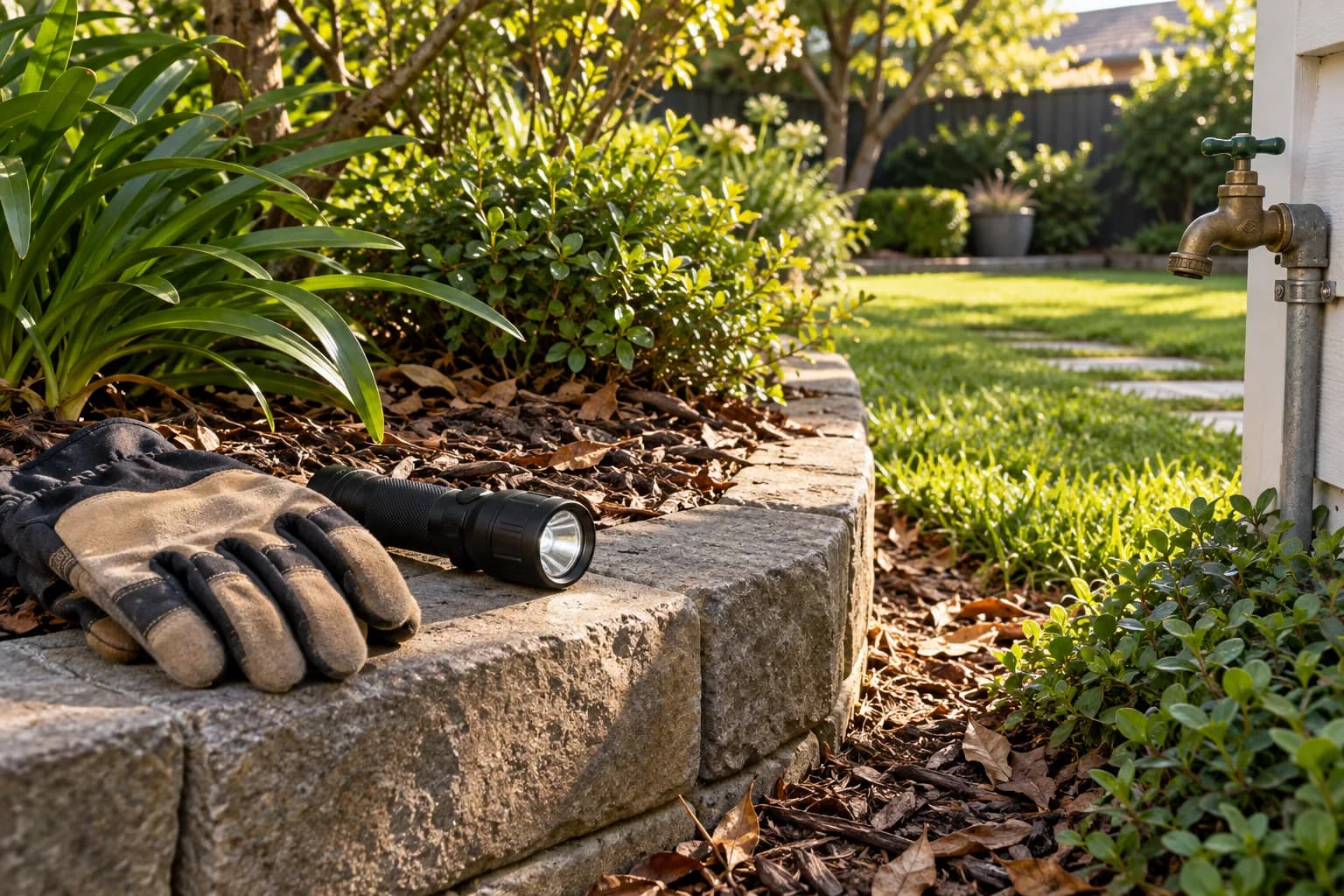 Dense shrubs against the house and a dripping hose bib give rodents cover and water. Trimming back and fixing drips makes the yard less inviting.
How fast can a few rodents become an infestation in Dothan?
Trapping without sealing only removes animals from a population that can replace them faster than you can catch them. It also explains why sealing matters so much. The same goes for one rat seen on a fence at dusk: where there's one, there's a nest nearby. A single mouse in the pantry in October is worth acting on that week, not after the holidays. What this means for you is timing. The 54 inches of annual rain and thick summer growth mean food and cover are rarely in short supply. Winter lows near 39F let outdoor rats keep breeding, and mice inside a warm house breed every month. In Dothan it barely does. In colder places, winter puts a brake on that math. House mice keep pace: five to ten litters a year, each of five or six young, born about 20 days after mating. Alabama Extension states that one rat pair left unchecked can turn into more than 640 rats in a single year. Faster than most people expect.
How to check that a Dothan pest company is licensed in Alabama.
Bait stations around the foundation, burrow treatments, and any bait in an attic should be placed by someone trained in how those products work and how to keep them away from pets and children. Licensing matters most when rodenticides are involved. Will the person coming to your house be applying bait under that license? Who is the certified operator? Is the company licensed by the state for household pest control? For a Dothan homeowner, that translates into a few easy questions. The certified operator behind the license passes a 100-question exam, which costs $75 to take, according to Alabama Extension's applicator permit information. A firm needs an annual Structural Professional Services license, which costs $175 for the main office. Alabama licenses pest control firms through the Alabama Department of Agriculture and Industries, and rodent work falls under Household Pest Control. A provider who's properly licensed will have it ready. It's reasonable to ask for the license information in writing along with the quote.
Rodent-proofing a Dothan house: slabs, pipes, and rooflines.
Use materials rodents can't chew. The top zone belongs to roof rats: soffits, gable vents, roof returns, and anywhere a limb or utility line meets the house. Alabama Extension points out that rats crawl along pipes up to 3 inches in diameter, so every place a pipe, conduit, or AC line enters the wall needs sealing, not just the foundation. The middle zone is plumbing and utilities. Burrows under a shed or deck are a sign rats are already close. Check the slab edge, the gap under garage doors, and the spaces around pipes where they leave the ground. Alabama Extension notes they live under buildings and slabs and along stream banks. Ground level is Norway rat territory. Sealing a Dothan home means covering three zones, because each rodent uses a different one. Size matters too: rats have entered through holes as small as 1/2 inch, and mice need only 1/4 inch. Steel wool packed into small gaps and covered with sealant, hardware cloth over vents, and metal flashing on larger openings all hold up.
What affects the price
- How many openings need sealing at the roofline, soffits, and pipe penetrations.
- Whether roof rats are in the attic, which adds ladder and crawl work.
- The amount of vine and tree trimming needed before sealing can hold.
- Outbuildings like sheds and barns where feed or seed is stored.
- Number of return visits to check traps or service bait stations.
- Odor removal or dead-rodent retrieval from walls after baiting.
📊
What's your biggest concern about rodents?
When to call for help
Call a licensed provider if you hear activity overhead, see rats outdoors in daylight, or find burrows under the slab or a shed. Those are signs of an established colony, not a stray. It's also time when you've trapped for a couple of weeks and the catch isn't falling, or when you can't figure out how they're getting in, since roof rats in Dothan often enter at roof level along utility lines. If you already used bait and now smell decay inside a wall, a provider can help locate and remove the carcass.
What you can do yourself
In a house that reaches 92F in summer, the smell is hard to ignore. A provider can steer outdoor bait to locked stations and handle indoor work with traps instead. House mice in a kitchen are a good DIY project in Dothan. Snap traps along the wall behind the stove, plus steel wool and sealant around the plumbing under the sink, will often clear a small problem. Rats are harder. Roof rats come in at the roofline, which means ladder work around soffits, gable vents, and utility lines. Norway rats burrow under slabs and outbuildings. Both breed fast enough in this climate that partial efforts get outpaced. Alabama Extension's warning that a single pair can become 640-plus rats in a year is a good reason not to spend a whole season experimenting. Bait is where many DIY efforts go wrong. Anticoagulant bait takes 4 or 5 days to kill, and animals often die out of reach inside walls or ceilings.
Rodents in Dothan
The city sits at 322 feet in a humid subtropical climate with summer highs around 92F, winter lows near 39F, average humidity of 73%, and roughly 54 inches of rain a year. That wet, warm pattern grows thick vines and trees that roof rats use to reach roofs, and it gives Norway rats soft soil for burrows. With a median home value near $170,000, rodent damage to wiring, insulation, and ductwork is a meaningful share of what a house is worth, which makes early sealing a good investment rather than an extra. Dothan is a suburban city of about 72,000 people, founded in 1885 and known as the Peanut Capital of the World. That nickname has a practical side for rodent control: nuts, seed, and feed are exactly what rats and mice look for, so storage in garages and sheds deserves attention.
Local research
Rodents in Dothan, AL: what the public record shows
Before you compare quotes, it helps to know which rodents actually live in Alabama, when they are busiest around Dothan, and what the state figures look like. Everything below links to the agency or university page it came from.
Hole size a rat has entered through
Rats also crawl along pipes up to 3 inches in diameter, so seal pipe penetrations as well as foundation gaps.
Alabama Cooperative Extension SystemRodent species recorded in Alabama
- House mouse (Mus musculus) — Enters at 1/4 inch; 5-10 litters per year; eats about 200 small meals a night.
- Norway rat (Rattus norvegicus) — Burrowing rat of basements, sewers and ground floors; tail shorter than head plus body.
- Roof rat (Rattus rattus) — Climber of attics and trees in warm and coastal regions; tail longer than head plus body.
When rodents are busiest around Dothan
Year-round, fall surge. Roof rats dominate Florida, Texas and Gulf Coast attics.
Based on Dothan’s humid subtropical climate profile.
Alabama Extension treats the Norway rat (under buildings and slabs, stream banks), roof rat (trees, vine-covered fences, attics, entering from roofs and utility lines) and house mouse as the three commensal rodents; control is exclusion, sanitation, then chemical control.
Rules that apply in Alabama
For context, nationally
- 1/4 inch (the width of a pencil) — Smallest gap a mouse can enter. CDC
- 890; 35% fatal; 94% west of the Mississippi — Hantavirus cases reported since 1993 (through 2023). CDC
Sources: Alabama Cooperative Extension System; CDC; Pest Notes: House Mouse; Pest Notes: Rats. Figures are quoted as the source prints them. How we check our sources
Simple ways to keep rodents away
- Cut vines off fences, walls, and trees near the house, since roof rats use them as ladders.
- Trim tree limbs back several feet from the roofline.
- Seal pipe penetrations as well as foundation gaps, because rats climb pipes up to 3 inches wide.
- Store peanuts, feed, seed, and pet food in metal or heavy plastic bins with tight lids.
- Keep firewood, lumber, and debris piles off the ground and away from the slab.
- Fix dripping outdoor faucets and standing water near the foundation.
- Check soffit vents and gable screens each spring for chewing or tears.
 A good rodent quote lists the inspection, the number of trapping visits, each opening to be sealed and the material for it, and any cleanup.
Did you know?
A house mouse litter of five or six young is born about 20 days after mating.
Rats can crawl along the outside of pipes up to 3 inches in diameter, which is how many reach upper floors and attics.
About 35% of reported U.S. hantavirus cases since 1993 have been fatal.
Questions people ask
Are rats active year-round in Dothan?
Roof rats in attics and Norway rats under slabs keep breeding through winter, though indoor activity usually picks up in fall as nights cool. Plan on sealing and monitoring all year rather than only in one season. Yes. With winter lows averaging about 39F, Dothan rarely gets cold enough for long enough to slow rats down.
Why does my house smell days after rodent bait was put out?
In Dothan's heat, odor builds fast. Trapping indoors and keeping bait in outdoor stations helps avoid this. Anticoagulant bait doesn't kill right away. Alabama Extension says death comes about 4 or 5 days after a rodent first eats it, so the animal may crawl into a wall or ceiling before dying.
How small a hole can a rat fit through?
Alabama Extension reports rats entering through holes as small as 1/2 inch, and mice need only about 1/4 inch, according to CDC. Rats also climb along pipes up to 3 inches in diameter, so on Dothan homes, seal around plumbing and AC lines where they enter the walls, not just gaps at ground level.
Does Alabama require pest control companies to be licensed?
The certified operator also passes a 100-question exam. Ask any Dothan provider for their license information before they put out bait. Yes. A household pest control firm in Alabama needs a license from the Alabama Department of Agriculture and Industries, and the annual license for a main office costs $175.
Do stored peanuts and feed attract rats and mice?
Nuts, seed, grain, and pet food are dense, easy calories, and an open sack in a garage or shed is one of the most reliable rodent magnets around a Dothan home. Move them into metal or heavy plastic bins with tight lids, and sweep up spills so there's nothing left on the floor. They do.
Is hantavirus a risk in Alabama?
hantavirus cases from 1993 through 2023 west of the Mississippi, and Alabama wasn't on CDC's provisional 2025 list. Still, any rodent droppings should be cleaned wet: ventilate 30 minutes, soak with 1.5 cups of bleach per gallon for 5 minutes, and never sweep. It's rare. CDC places 94% of the 890 U.S.
How fast do mice multiply in a house?
Alabama Extension puts house mice at five to ten litters a year, with five or six young born about 20 days after mating. In a warm Dothan house with food in the pantry, a pair that slips in during October can have produced several litters before spring arrives. Very fast.
Nearby cities
Related guides
Sources (6)
The facts in this article come from the public sources listed above. Every home is different, so ask the company you talk to about pricing and what’s included. Published by Rodent Exterminator · Updated October 11, 2026 · How we write these guides