The short version
Rodent control in East Orange, New Jersey means dealing with Norway rats outside and house mice inside, with the heaviest push indoors from September through November as nights fall toward a 24F winter average. In a dense city beside Newark, sealing gaps, fixing trash storage and coordinating with neighbors or building owners matters as much as trapping. Use a state-licensed applicator for any pesticide work.
- Norway rats and house mice are the two rodents New Jersey data lists for homes here.
- September to November is when both species move indoors in East Orange.
- In multi-family buildings, treat shared walls and trash areas as one problem.
- New Jersey requires 40 hours of on-the-job training per category before commercial licensing.
- Seal gaps a quarter inch or wider with steel wool, hardware cloth or metal.
This page is for East Orange homeowners, renters and landlords dealing with mice in an apartment, rats in a yard, or droppings in a basement or storage room. It also helps building superintendents and small-business owners who need to know what a provider should do and how to check credentials before signing anything.
What to look for
New Jersey data lists two structural rodents, and East Orange has plenty of both. Norway rats are the big, brown ground dwellers. They dig burrows along foundations, under stoops and walkways, in yards and beside trash collection areas, and they enter buildings at ground level through foundation cracks, gaps around pipes and doors left open. House mice are smaller and live inside: in wall voids, kitchen cabinets, behind stoves and in stored belongings. The temperate climate sets the calendar. Summers top out near 85F, and rats do well outdoors on trash and food scraps. As fall cools toward the 24F winter average, both species look for shelter, and September through November brings the most new indoor activity. About 48 inches of rain a year keeps soil soft for burrowing. Urban density does the rest: buildings share walls, trash areas serve many households, and a colony that loses one food source simply shifts next door.
- 1Burrow holes in yard soil, under stoops or beside walkways, often with packed dirt at the opening.
- 2Large, blunt-ended droppings near trash cans, in a basement or along a building's back wall.
- 3Small, rice-sized droppings in kitchen drawers, under the sink or behind the stove.
- 4Gnawed holes in the bottom edges of plastic trash cans or recycling bins.
- 5Noises in walls or ceilings at night, especially in fall and winter.
- 6Dark rub marks along the base of walls or around pipes where rodents pass repeatedly.
- 7Torn garbage bags left out overnight with scraps scattered by morning.
Why it’s worth acting soon
- UC IPM reports a Norway rat female can raise 4 to 6 litters a year, so colonies grow quickly.
- In shared buildings, a problem in one unit spreads to the units around it through walls and pipes.
- Rats and mice contaminate food and counters, and the CDC links them to leptospirosis and salmonellosis.
- Chewed wiring in walls and basements can start fires.
- Burrows under walkways and stoops can undermine concrete and steps over time.
Treatment options and typical costs
Building inspection and sealing
Quoted after inspection
A full inspection of the foundation, basement, utility entries, doors and vents, followed by sealing with steel wool, hardware cloth, mortar and metal flashing. In brick and block buildings, mortar gaps and pipe openings are common entry points. Sealing is what keeps fall arrivals from returning each year.
- Time
- Depends on the building and the number of gaps
- Best for
- Any building with repeat activity
Indoor trapping
Quoted after inspection
Snap traps or enclosed traps placed along walls in kitchens, basements and storage rooms, then checked and moved based on captures. For rats, traps are often baited unset for a few days first. Traps let you confirm progress without leaving poisoned rodents in the walls.
- Time
- Until captures stop
- Best for
- Mice and rats already indoors
Burrow and yard treatment
Quoted after inspection
Rat burrows in yards, under stoops and along walkways are located and treated, and locked bait or trap stations may go around the perimeter. In New Jersey, applying pesticides for hire requires a state commercial applicator license, so confirm the technician's credentials before work starts.
- Time
- Until burrows go inactive, then periodic checks
- Best for
- Norway rats living outdoors
Multi-unit building program
Quoted after inspection
Inspection and treatment of all connected units, basements, common areas and trash rooms at once, with scheduled follow-ups. Treating a single apartment usually just pushes mice next door, so this is the approach that actually clears a building.
- Time
- Several visits, then routine service; get the schedule in writing
- Best for
- Apartment buildings, two-family and three-family homes
Prices are typical published ranges. Ask what’s included before you compare quotes.
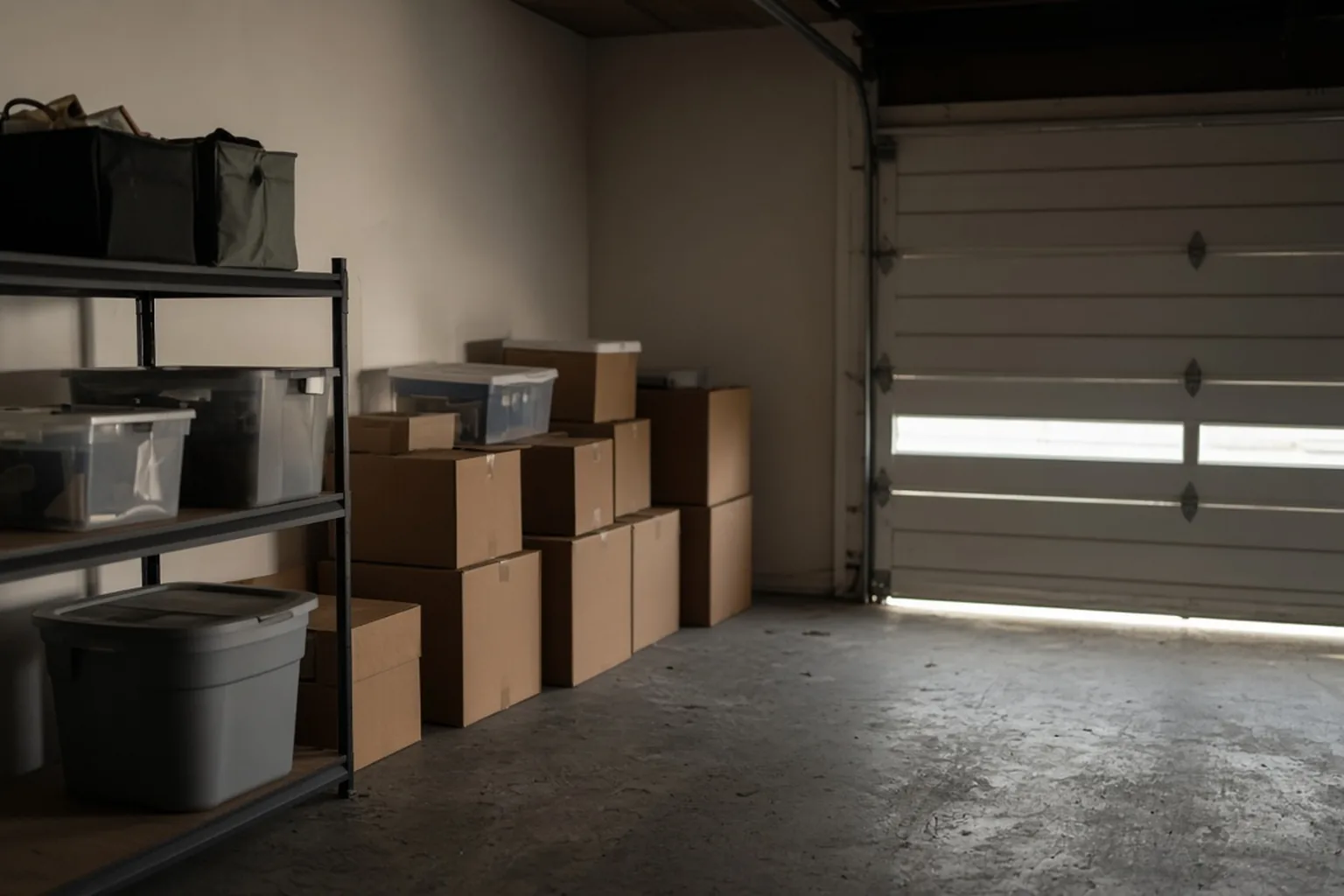 Cardboard boxes make easy nests and the gap under an overhead door makes an easy entrance. Plastic bins and a fresh door seal fix both.
Norway rats in a dense city: where they live and how they get in.
The urban setting makes this harder to control. When a colony loses one food source, it shifts to the next yard or building. When one property traps, rats from a neighboring burrow can move into the empty space. That is why rat control in East Orange works best as a block-level effort. Fix your trash storage, seal your foundation and basement openings, and talk with neighbors or the building owner about doing the same. A provider can map burrows across adjoining yards if neighbors agree to coordinate. Norway rats in East Orange live mostly outdoors, in burrows dug into yard soil, under stoops and walkways, along foundations and next to trash collection areas. They come out at night to feed, usually on garbage, pet food and scraps, then return to the burrow. They get inside at ground level. Cracked foundations, gaps where pipes enter basements, worn door bottoms and unscreened basement windows are the usual routes. Once in, they nest in basements, storage rooms and wall voids near food.
September to November: the fall entry window.
September through November is peak entry. Expect droppings in kitchen drawers, noise in walls at night and gnawing on stored items. Trap actively and keep sealing any new gaps you find. December through February, rodents that got in are breeding indoors. March through May, rats expand outdoor burrows again as the ground softens. Summer, with highs near 85F, keeps rats busy outside around trash. Use those months to fix trash storage so the next fall starts with fewer rats nearby. For East Orange homes, fall is when rodent problems move from the yard to the kitchen. As average lows slide toward the 24F winter mark, house mice and Norway rats look for warm, sheltered spots, and buildings are the obvious choice. Late August and early September are the time to prepare. Walk the building and seal gaps around pipes, under doors and in the foundation. Replace worn door sweeps and screen basement windows. Set a few traps in the basement as an early warning.
 A metal vent cover with a working flap keeps mice out all winter. Plastic flaps crack in the cold and get chewed open.
Apartments and multi-family buildings: who handles what.
Ask whether neighboring units and the basement will be inspected too. If you own or manage a building, a building-wide plan saves money over time. Have the provider inspect every unit, the basement and the trash area, seal shared entry points, and schedule follow-up visits. Keep records of reports and service dates. Fixing the trash area, with tight lids, regular pickup and no overflow, often does more than any amount of indoor trapping. In a multi-family building, a rodent problem is almost never confined to one unit. Mice travel through shared walls, pipe chases and ceilings, and rats move through basements and common trash areas. Treating one apartment while ignoring the rest usually just moves the problem around. If you rent in East Orange, report what you see to the landlord or superintendent in writing, with dates, photos and locations. Keep food in sealed containers, take trash out regularly, and do not set out poison yourself, especially with kids or pets in the home.
How to check a New Jersey pest control license.
In practice, ask the East Orange provider you are considering for the license number and category, and the name of the certified applicator responsible for your job. A reputable company will share this readily. Also ask what products they plan to use, where they will place them, and how they will protect children, pets and wildlife. A license is not proof of good work, but a company that cannot show one is a clear warning sign. New Jersey licenses pesticide applicators through the NJDEP Pesticide Control Program, which has certified applicators since 1975. Rodent work falls under category 7A, General and Household Pest Control, and you have every right to ask about it before a company sets out any bait. According to Rutgers, new commercial applicators must complete 40 hours of on-the-job training in each category before licensing, pass a core exam and a category exam, and then earn 8 core and 16 category recertification credits every five years. The commercial license itself must be renewed every year.
Fixing the trash problem that feeds rats.
If you compost, use a closed bin with a solid or screened bottom and keep meat and cooked food out of it. For buildings, the trash area deserves real attention. Overflowing dumpsters, bags piled beside full cans, and spilled food around collection points feed rats every night. Ask the owner or manager to add capacity, increase pickups or enclose the area. For East Orange homes, where buildings sit close together, one well-kept trash area helps the whole block. Combine it with sealed foundations and cleared debris, and rats have far less reason to stay. Trash is the single biggest reason Norway rats stay in a neighborhood. A colony with steady access to garbage, food scraps and pet food will rebuild after almost any amount of trapping. Start with containers. Use metal or heavy plastic cans with tight-fitting lids, and replace any that have holes chewed in the bottom or lids that no longer close. Keep cans on pavement, not bare soil, so rats cannot burrow underneath. Put trash out the morning of pickup instead of the night before.
What affects the price
- The number of units, floors and shared spaces included in the inspection.
- The condition of foundations, stoops and walkways where rats burrow.
- How many entry points need sealing and which materials each one needs.
- Whether outdoor burrow treatment and trash area fixes are part of the job.
- How many follow-up visits run through the fall and winter season.
- Cleanup of droppings, nests and contaminated storage.
📊
What's your biggest concern about rodents?
When to call for help
Call a provider when you see rats, find burrows in the yard or along the building, or keep catching mice after a few weeks of your own trapping. If you live in a multi-family building in East Orange, contact the landlord or superintendent first and ask for a professional inspection, since sealing one apartment rarely fixes a building-wide problem. Get help fast if you find droppings in food areas, chewed wiring or a dead-animal smell. Before any pesticide goes down, confirm the company holds a New Jersey commercial applicator license in the household pest category.
What you can do yourself
For a mouse or two in a single-family house or your own apartment, DIY makes sense. Put out several snap traps along walls where you find droppings, trigger end toward the baseboard, and seal small gaps under sinks and around pipes with steel wool and caulk. Keep food in hard containers. Rats and building-wide problems are another story. Norway rats here often live in burrows that run under walkways, stoops and neighboring yards, so controlling them means working across the whole area, fixing trash storage, and sometimes placing locked bait stations. In New Jersey, applying pesticides for hire requires a state license and ongoing continuing education. If you rent, structural repairs and work on shared property usually fall to the owner under most leases, so report the problem in writing and ask for a licensed company.
Rodents in East Orange
With a median home value near $310,000, sealing is worth doing properly once, and clear communication between tenants, owners and neighbors is often what decides whether a rodent problem ends or keeps coming back. Urban density is the biggest local factor: wherever households share walls, trash areas and yards, rodents move easily between buildings. For rodents, that means a long outdoor season for Norway rats through summer, a clear move indoors in fall, and soil soft enough to burrow in most of the year. The temperate climate brings summer highs near 85F, average humidity around 64% and roughly 48 inches of rain a year. It was founded in 1863 and is known for its VA hospital. East Orange is an urban city of about 70,000 people, bordering Newark and sitting around 164 feet above sea level.
Local research
Rodents in East Orange, NJ: what the public record shows
Before you compare quotes, it helps to know which rodents actually live in New Jersey, when they are busiest around East Orange, and what the state figures look like. Everything below links to the agency or university page it came from.
Hantavirus in New Jersey
The state health department still lists rodent infestation in and around the home as the primary exposure risk.
New Jersey Department of HealthRodent species recorded in New Jersey
- House mouse (Mus musculus) — Enters at 1/4 inch; 5-10 litters per year; eats about 200 small meals a night.
- Norway rat (Rattus norvegicus) — Burrowing rat of basements, sewers and ground floors; tail shorter than head plus body.
When rodents are busiest around East Orange
Fall entry (Sept-Nov). Norway rats and house mice move indoors as temperatures drop.
Based on East Orange’s humid subtropical climate profile.
New Jersey's commercial pesticide program began in 1975 under the NJDEP Bureau of Licensing and Registrations; applicants pass a Core exam then add categories such as 7A.
Rules that apply in New Jersey
For context, nationally
- 1/4 inch (the width of a pencil) — Smallest gap a mouse can enter. CDC
- 890; 35% fatal; 94% west of the Mississippi — Hantavirus cases reported since 1993 (through 2023). CDC
Sources: New Jersey Department of Health; Rutgers Pest Management Office, Rutgers, The State University of New Jersey; CDC; Pest Notes: House Mouse; Pest Notes: Rats. Figures are quoted as the source prints them. How we check our sources
Simple ways to keep rodents away
- Use metal or heavy plastic trash cans with tight lids, and never leave bags on the curb overnight.
- Seal gaps around pipes and utility lines with steel wool and caulk before September.
- Install door sweeps on exterior and basement doors.
- Patch foundation cracks and gaps under stoops with mortar or hardware cloth.
- Clear yards of piled wood, old furniture and debris that give rats cover.
- Store pet food and birdseed in sealed containers, and feed pets indoors.
- Report overflowing dumpsters or building trash areas to the owner or manager right away.
- Screen basement windows and vents with 1/4-inch hardware cloth.
 A good rodent quote lists the inspection, the number of trapping visits, each opening to be sealed and the material for it, and any cleanup.
Did you know?
A New Jersey commercial pesticide applicator license is valid for only one year and must be renewed.
Leptospirosis spreads through the urine of infected animals, and the CDC counts rodents among its carriers.
More than nine in ten U.S. hantavirus cases reported since 1993 occurred west of the Mississippi River.
Questions people ask
When do rodents move indoors in East Orange?
Sealing gaps in late summer and setting traps early in fall catches the first arrivals before they nest and breed. Norway rats and house mice both look for warmth and food then. Most indoor activity starts between September and November, as nights cool toward East Orange's 24F average winter low.
How do I check that a pest company is licensed in New Jersey?
Any East Orange provider applying pesticides should show you this without hesitation. Rutgers notes new commercial applicators need 40 hours of on-the-job training per category. Rodent work falls under category 7A, General and Household Pest Control. Ask for the company's New Jersey pesticide applicator license and category.
Who pays for rodent control in an East Orange apartment?
In East Orange apartment buildings, mice move through shared walls and pipes, so report activity in writing with dates and photos, and ask that neighboring units be inspected at the same time. Owners usually handle structural repairs, sealing and building-wide treatment, while tenants keep food stored and trash out. Start with your lease.
Why do rats keep coming back to my yard?
On dense East Orange blocks, the source may be a neighbor's yard or a building trash area, so fix your own storage, then talk to neighbors or the property owner. A Norway rat colony that can reach trash cans, dumpsters, pet food or debris piles will rebuild after trapping. Usually because food and shelter are still nearby.
Should I worry about hantavirus in New Jersey?
The New Jersey Department of Health keeps a hantavirus information page, and its cleanup advice fits any droppings: ventilate first, soak with diluted bleach, then wipe up instead of sweeping. hantavirus cases since 1993 occurred west of the Mississippi. The CDC reports that 94% of U.S. The risk is low.
What size hole can a mouse get through?
Pack small gaps with steel wool and caulk, and use hardware cloth or metal for anything bigger. In brick and block buildings, look at mortar gaps, openings around radiator and water pipes, and the space under doors. The CDC says a quarter inch, and rats can chew small holes larger.
Can rats come over from Newark?
That is why fixing trash storage on your property and coordinating with neighbors works better than treating one yard on its own. East Orange borders Newark, and connected neighborhoods let Norway rats move between yards, buildings and trash areas on both sides. Rats do not follow city lines.
How long does it take to clear rats from a yard?
Ask the provider how they will confirm the burrows are inactive before they close them. Burrows have to be found and treated, and food sources removed, or new rats move in. Norway rats avoid new objects at first, so traps or stations may sit untouched for days. Longer than most people hope.
Nearby cities
Related guides
Sources (6)
The facts in this article come from the public sources listed above. Every home is different, so ask the company you talk to about pricing and what’s included. Published by Rodent Exterminator · Updated October 11, 2026 · How we write these guides