The short version
Rodent control in Edmond, Oklahoma usually means stopping house mice and Norway rats from moving indoors between September and November, when nights head toward a 28F winter low. Close openings with 1/4-inch hardware cloth, place traps within the short range these animals actually travel, and confirm any company baiting your property holds an ODAFF category 7a license.
- Edmond's rodent push comes in fall, after 94F summers give way to freezing nights.
- Mice rarely roam beyond 10 to 20 feet of the nest, so traps go close to the activity.
- Rats cover about 100 feet, which makes the whole yard part of the job.
- Oklahoma State recommends 24-gauge, 1/4-inch hardware cloth to stop both rats and mice.
- Pesticide work for hire in Oklahoma requires an ODAFF license; general pest work is category 7a.
Use this page if you own a house in Edmond and just found droppings in the garage, rent near the University of Central Oklahoma and hear scratching in the walls, manage rental property, or run a shop or restaurant where a single mouse sighting is a problem. It also helps anyone comparing quotes who wants to know what a thorough job includes.
What to look for
Three rodents account for most of what Oklahoma State university extension sees in structures across the state: the Norway rat, the roof rat and the house mouse. In a suburb like Edmond, expect the Norway rat and house mouse most often, with roof rats appearing where trees and fences give them a way up. What makes them hard to stop is speed. OSU Extension reports rat litters averaging 6 to 8 young, with as many as 10 to 12 litters a year, a gestation of about 23 days, and young that mature in roughly two months. Mice keep a similar pace in a smaller space. The weather sets the schedule. Summers run hot, with highs around 94F, and winters bring lows near 28F. That swing creates a clear fall migration from September through November, when rodents that fed outdoors all summer move into garages, attics and wall voids. About 35 inches of rain a year and 65% average humidity keep yards green enough to feed them until the cold drives them inside.
- 1Black droppings near the garage door, the water heater, or bags of grass seed and birdseed stored nearby.
- 2Gnawed notches along the bottom seal of the garage door or in door weatherstripping.
- 3Rustling in the attic or walls during the first cold nights of October.
- 4Burrows with smooth, packed entrances along slab edges, fence lines, or under sheds.
- 5Shredded insulation, paper towels, or dryer lint packed into a corner as nest material.
- 6Dark grease marks along baseboards where mice follow the same short path every night.
- 7Pet food that disappears faster than it should, with crumbs scattered around the bowl or bag.
Why it’s worth acting soon
- OSU Extension says rats can produce up to 12 litters a year, so every week of delay multiplies the work.
- Rodents chew wiring in attics, garages and even the cars parked in them, causing costly or dangerous failures.
- Droppings and urine spread germs the CDC links to salmonellosis, leptospirosis and other illnesses.
- Nests flatten attic insulation, which you need through both 94F summers and freezing winters.
- A colony that settles in over winter is far harder to remove in spring than a few scouts in October.
Treatment options and typical costs
Exclusion with hardware cloth and metal
Quoted after inspection
OSU Extension recommends 24-gauge hardware cloth with 1/4-inch openings to keep out both rats and mice; heavier 1/2-inch mesh stops rats only. A good exclusion job uses it on vents and crawl space openings, then adds sheet metal, sealant and door sweeps wherever else animals can enter.
- Time
- Depends on how many openings the inspection finds
- Best for
- Any home with fall entry or recurring activity
Trapping inside the home range
Quoted after inspection
Because mice stay within 10 to 20 feet of their nest and rats within about 100 feet, traps go where activity is concentrated, set close together for mice. Expect the provider to move traps after each visit based on catches and fresh droppings.
- Time
- Until catches stop; ask how many checks are included
- Best for
- Mice or rats already inside the house or garage
Exterior bait stations
Quoted after inspection
Locked stations spaced about 25 to 50 feet apart for rats and much closer for mice, following OSU guidance. Anticoagulant baits can take 7 to 21 days to work. In Oklahoma, whoever places them for hire should hold an ODAFF license in category 7a.
- Time
- 7 to 21 days for anticoagulants, per OSU, often ongoing
- Best for
- Norway rats burrowing along fences, sheds or slabs
Cleanup and sanitation
Quoted after inspection
Removing droppings, nests and soiled insulation after the animals are gone, using the CDC routine of airing the space for 30 minutes and soaking with a 1:9 bleach mix before wiping. Some providers also bag and replace attic insulation; others refer that out.
- Time
- Depends on how much material is soiled
- Best for
- Garages, attics and sheds with heavy droppings
Prices are typical published ranges. Ask what’s included before you compare quotes.
 Rats can travel plumbing, so a sink or floor drain with a missing strainer is worth fixing; a tight strainer or grate keeps them out.
How far do Edmond rats and mice really travel?
Oklahoma State university extension gives a home range of about 10 to 20 feet for house mice and about 100 feet for rats, and says rodents spend roughly 80% of their time inside that range. A mouse living behind your Edmond refrigerator may never visit the garage at all. For mice, that means traps belong close to the evidence. OSU's placement guidance puts mouse bait stations no more than 10 feet apart, and the same logic applies to traps: several set near droppings and along walls beat one trap in the middle of the kitchen floor. Rats are a different story. A 100-foot range on a typical suburban lot covers the house, the backyard, the shed and part of the neighbor's yard. OSU spaces rat stations 25 to 50 feet apart, and a provider working a rat problem should be checking fence lines, woodpiles and sheds as well as the house. If a quote only covers the inside, ask why. Less than you might think, and that is good news for trapping.
Checking an Oklahoma pesticide license before anyone baits your yard.
Rodent and general household pest work falls under category 7a, which ODAFF describes as treatment within a structure and immediately next to it, no more than three feet away. That matters because rodenticides are among the more hazardous products used around homes. Bait stations should be locked, anchored and placed where children and pets cannot reach them. Ask the provider for the license number and confirm the category before work begins. A legitimate company will share it without fuss. You can also ask how the provider chooses between bait and traps. In an Edmond home with small children or outdoor cats, some households prefer traps inside and locked stations outside only. Others skip bait entirely and rely on exclusion and trapping, which takes more visits but leaves no poison on the property. A provider who explains those tradeoffs plainly, instead of pushing one approach, is usually a good sign. Anyone applying pesticides for hire in Oklahoma is licensed through the Oklahoma Department of Agriculture, Food and Forestry.
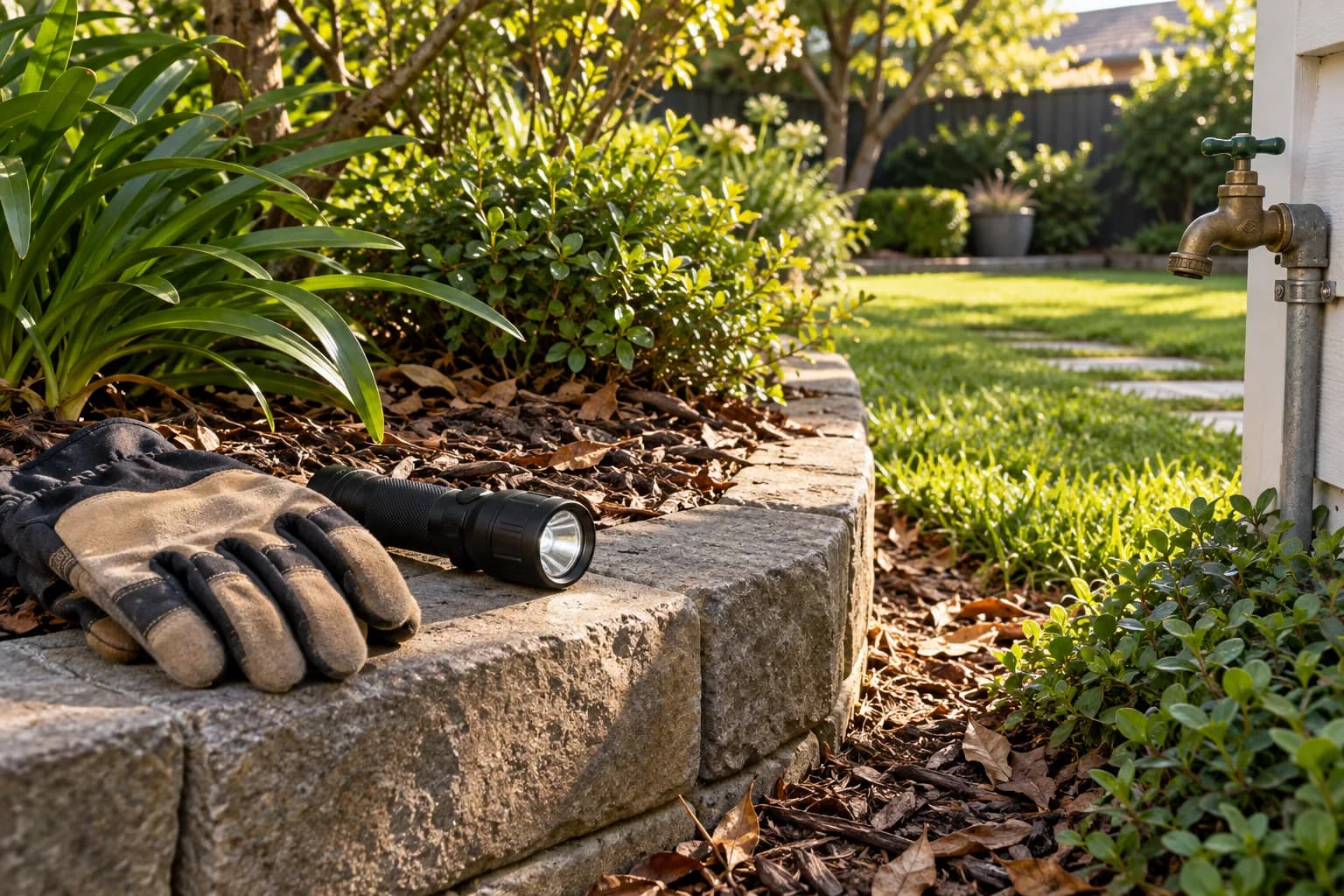 Dense shrubs against the house and a dripping hose bib give rodents cover and water. Trimming back and fixing drips makes the yard less inviting.
Why does fall bring rodents into Edmond homes?
Edmond's summers peak around 94F, and rodents spend those months outdoors feeding on seeds, garden produce, pet food and garbage. When nights slide toward freezing, with winter lows averaging 28F, that outdoor life gets hard quickly. From September through November, house mice and Norway rats start probing foundations, garage doors and utility openings for warmth. They follow heat and smells: the dryer vent, the gap around the gas line, the corner of a garage door that no longer seals. Once inside, they settle into insulation, wall voids and stored boxes and start breeding. That is why late summer is the best time to act. Walk the outside of the house in August with a flashlight and a pencil. Anywhere the pencil fits, a mouse fits. Close those openings before the first cold front and there will be far less to trap. If you wait until you hear scratching in October, plan on sealing and trapping at the same time. The short answer is the temperature swing.
Choosing the right mesh and materials for sealing.
Oklahoma State university extension recommends 24-gauge hardware cloth with 1/4-inch openings when you need to stop both rats and mice. Heavier 19-gauge mesh with 1/2-inch openings stops rats but lets mice slip through, so it is the wrong pick for most houses. Use the hardware cloth over foundation vents, crawl space openings and gable vents, fastened with screws or staples into solid framing. For small gaps around pipes and cables, pack steel wool or copper mesh tightly and seal over it. Door sweeps and garage door seals handle the bottom edges. Expanding foam on its own is not enough, because rodents chew straight through it. Height matters too. OSU notes that rats can jump about 36 inches straight up, so openings a few feet off the ground still count. Across Edmond, where hot summers and hard freezes crack caulk and warp weatherstripping, recheck seals every fall. A good exclusion quote names the material for each opening, not just a total. Material choice decides whether a seal lasts.
How fast can an Edmond rodent problem grow?
Oklahoma State university extension describes rat litters averaging 6 to 8 young, with as many as 10 to 12 litters a year for one female. Gestation runs about 23 days, and the young are ready to breed at around two months old. Even if real-world numbers come in lower, the curve is steep. House mice keep a similar pace in a much smaller space. A pair that slips into an Edmond garage in October can produce several litters before spring, and the young stay inside that same 10- to 20-foot range, so the population piles up exactly where you least want it. That pace is why timing matters more than products. Trapping a few animals in October while sealing the gaps they used is a small job. Waiting until March, after a winter of indoor breeding, turns it into a longer project with more cleanup. Count droppings and catches each week. If the numbers are not falling after two weeks, either a gap is still open or the traps are in the wrong places. Faster than most people expect.
What affects the price
- How many openings need hardware cloth, metal or door sweeps, and how hard they are to reach.
- Whether rats are involved, since their 100-foot range means traps and stations across the yard.
- The number of follow-up visits, which matters because anticoagulant bait can take up to three weeks.
- Attached garages, sheds and outbuildings that need sealing along with the house.
- Attic cleanup and insulation replacement if rodents nested there through a winter.
- Ongoing exterior bait station service compared with a one-time exclusion and trapping job.
📊
What's your biggest concern about rodents?
When to call for help
Call a pro when traps are not keeping up, when you find rat-sized droppings or burrows, or when you cannot work out how the animals are getting in. Across Edmond, the fall push from September through November means new animals keep arriving, so one missed opening undoes a lot of trapping. Also call when droppings show up in a kitchen or food business, when wiring is chewed, or when a strong odor suggests a dead rodent in a wall. Before anyone applies bait or pesticide, ask to see their Oklahoma Department of Agriculture, Food and Forestry license.
What you can do yourself
A few house mice in a garage or kitchen are well within DIY range. Because mice rarely travel more than 10 to 20 feet from the nest, a handful of snap traps set tight against walls near the droppings usually does the job within a week or two. Seal the small gaps you find with steel wool and caulk, and keep birdseed and pet food in metal bins. Rats change the math. Their home range of about 100 feet means the nest may sit under a neighbor's shed or along a fence line, and they are cautious around new objects. Effective rat work often pairs exterior bait stations, which take 7 to 21 days to show results with anticoagulants, with sealing and trapping inside. A licensed provider also knows which products are allowed where and how to keep them away from pets and kids. If you are unsure what you have, one inspection visit can settle it before you buy supplies.
Rodents in Edmond
With a median home value near $295,000, an Edmond house has plenty to protect, and sealing gaps early generally costs less than repairing chewed wiring or replacing soiled insulation later. Rainfall of about 35 inches keeps the ground soft enough for Norway rat burrows, while dry spells pull rodents toward leaky hoses and pet water bowls. That range is the main reason rodent pressure peaks in fall instead of staying flat all year. At 1,204 feet with a humid subtropical climate, the city swings from summer highs near 94F to winter lows around 28F. Yards, fence lines, sheds and attached garages give mice and rats plenty of cover, while near the University of Central Oklahoma, any building with shared walls can pass a problem from one unit to the next. Edmond grew from an 1889 founding into an Oklahoma City suburb of about 97,000 people, and its rodent picture reflects that suburban layout.
Local research
Rodents in Edmond, OK: what the public record shows
Before you compare quotes, it helps to know which rodents actually live in Oklahoma, when they are busiest around Edmond, and what the state figures look like. Everything below links to the agency or university page it came from.
Rodent species recorded in Oklahoma
- House mouse (Mus musculus) — Enters at 1/4 inch; 5-10 litters per year; eats about 200 small meals a night.
- Norway rat (Rattus norvegicus) — Burrowing rat of basements, sewers and ground floors; tail shorter than head plus body.
- Roof rat (Rattus rattus) — Climber of attics and trees in warm and coastal regions; tail longer than head plus body.
When rodents are busiest around Edmond
Fall entry (Sept-Nov). Norway rats and house mice move indoors as temperatures drop.
Based on Edmond’s humid subtropical climate profile.
OSU Extension names the Norway rat, roof rat and house mouse as the most frequently identified rodents in Oklahoma poultry houses.
Rules that apply in Oklahoma
For context, nationally
- 1/4 inch (the width of a pencil) — Smallest gap a mouse can enter. CDC
- 890; 35% fatal; 94% west of the Mississippi — Hantavirus cases reported since 1993 (through 2023). CDC
Sources: Oklahoma Cooperative Extension Service, Oklahoma State University; CDC; Pest Notes: House Mouse; Pest Notes: Rats. Figures are quoted as the source prints them. How we check our sources
Simple ways to keep rodents away
- In late August, close gaps around pipes, cables and vents with 24-gauge, 1/4-inch hardware cloth or packed steel wool.
- Replace worn garage door bottom seals, which take a beating from hot summers and freezing winters.
- Keep grass seed, birdseed and pet food in metal or heavy plastic bins with snug lids.
- Stack firewood and lumber off the ground and away from the house so rats cannot nest close in.
- Keep shrubs trimmed back from the foundation so burrows and gaps stay visible.
- Fix leaky outdoor faucets and drip lines, since water draws rodents during dry summer stretches.
- Clear clutter from garages and sheds so nesting spots are easy to spot and check.
 A good rodent quote lists the inspection, the number of trapping visits, each opening to be sealed and the material for it, and any cleanup.
Did you know?
By Oklahoma State university extension's math, one pair of rats could leave 15,000 descendants in a single year if every offspring survived and bred.
Rats can drop about 50 feet without being hurt, according to OSU Extension's rodent fact sheet.
Oklahoma charges pesticide businesses $100 per license category, with the annual total capped at $500.
Questions people ask
When do mice usually come inside in Edmond?
Edmond homeowners who seal gaps in August generally have far fewer animals to deal with once fall arrives. After a summer with highs in the mid-90s, the first nights that drop toward freezing send house mice and Norway rats looking for warm garages and wall voids. Most often from September through November.
How far from the nest do rats and mice travel?
That is why mouse traps go close together and rat control has to cover the whole yard. Oklahoma State university extension puts a mouse's home range at about 10 to 20 feet and a rat's at about 100 feet, with most rodents spending around 80% of their time inside that range. Not far.
Does a rodent control company in Oklahoma need a license?
If a company serving Edmond plans to place bait or apply any pesticide, ask for its license number and category. The Oklahoma Department of Agriculture, Food and Forestry licenses pesticide applicators, and general pest work falls under category 7a, covering treatment inside and within three feet of a structure. Yes.
What size hardware cloth keeps mice out?
The CDC uses the same quarter-inch measure, roughly the width of a pencil, as the smallest gap a mouse can use. Oklahoma State notes that heavier 19-gauge mesh with 1/2-inch openings stops rats but lets mice through. Use 24-gauge hardware cloth with 1/4-inch by 1/4-inch openings.
How long does rat bait take to work?
Around Edmond homes, bait stations belong outdoors, locked, and placed by someone licensed for category 7a work. That delay is normal, and it is why bait plans include several follow-up checks. Anticoagulant baits can take 7 to 21 days to succeed, according to Oklahoma State university extension.
Is hantavirus a concern in Oklahoma?
Before cleaning droppings out of an Edmond shed, air it out for 30 minutes and wet everything with bleach. Exposure usually happens in closed sheds, cabins and garages. hantavirus cases since 1993 occurred west of the Mississippi, which includes Oklahoma. The CDC reports that 94% of the 890 U.S. It is uncommon but worth respecting.
Are mice a problem in apartments near UCO?
Treating one apartment rarely solves it; the building usually needs to be inspected as a whole. Renters near the University of Central Oklahoma should report droppings to the landlord quickly and keep food in sealed containers. They can be, because mice move between units through shared walls and pipe chases.
Nearby cities
Related guides
Sources (6)
The facts in this article come from the public sources listed above. Every home is different, so ask the company you talk to about pricing and what’s included. Published by Rodent Exterminator · Updated October 11, 2026 · How we write these guides