The short version
Rodent control in Norman, OK works best as a sealing job first and a trapping job second. Norway rats, roof rats and house mice all turn up in Oklahoma, and they push indoors from September through November as nights head toward 28F. Close gaps down to 1/4 inch with 24-gauge hardware cloth, then set traps or stations at the spacing OSU Extension recommends.
- Fall, roughly September through November, is when Norman rodents move from yards into walls and attics.
- OSU Extension spaces mouse stations 10 feet apart at most and rat stations 25 to 50 feet.
- Hardware cloth with 1/4 by 1/4 inch openings in 24 gauge stops both rats and mice.
- Anticoagulant baits can take 7 to 21 days, so a single visit rarely finishes the job.
- Oklahoma licenses general pest applicators under ODAFF category 7a, so ask to see it.
This guide is for Norman homeowners hearing noises overhead, renters who found droppings in a kitchen drawer and want to know what to ask the landlord, and owners of rental houses who need a plan that holds up through fall. It also helps anyone comparing two rodent exterminator quotes and trying to tell which one covers the whole property rather than just the kitchen.
What to look for
The rodent you are hearing depends on where the noise is. Roof rats climb, so they show up in attics, soffits and the upper parts of walls. Norway rats are heavier ground dwellers that burrow along foundations, under slabs and beside sheds, then work into crawlspaces, garages and lower walls. House mice live almost anywhere food is close, often inside cabinets, appliances and wall voids. Norman's weather moves all three on a predictable schedule. Summers average a 93F high, which sends rodents hunting for water at dripping hose bibs, pet bowls and AC condensate lines. About 38 inches of rain a year keeps grass and shrubs thick enough to hide runways. Then winter lows near 28F drive the move indoors, peaking September through November. Speed is the other problem. OSU Extension says rats mature at about two months, carry young for 23 days, and have 6 to 8 pups per litter, so a few rats spotted in August can be a working colony by the time the heat comes on.
- 1Quick, light scratching in the attic or upper walls after dark, typical of roof rats.
- 2Droppings the size of rice grains in drawers and under the sink, which points to house mice.
- 3Larger capsule-shaped droppings along the garage wall or at the crawlspace entrance.
- 4Fresh burrow holes with loose soil beside the foundation, patio slab or shed.
- 5Greasy rub marks along baseboards or where pipes come through a wall.
- 6Chewed corners on pet food bags, birdseed sacks or cereal boxes.
- 7A dog or cat fixated on one spot at the base of the stove or a closet wall.
Why it’s worth acting soon
- Each month of delay adds litters, and the job grows from a few traps to a full exclusion.
- Roof rats chew attic wiring, which turns a pest problem into an electrical one.
- Nests packed into insulation can mean pulling and replacing it, not just cleaning it.
- Urine and droppings on counters and in stored food spread germs to the household.
- Mice that settle into walls in October keep breeding indoors until spring.
43%Southern homeowners reporting a rodent encounter at some point, 2022 NPMA/Harris Poll of U.S. adultsNPMA and The Harris Poll Treatment options and typical costs
Inspection and exclusion
Quoted after inspection
A provider walks the house from foundation to roofline and closes openings with 24-gauge hardware cloth in 1/4 by 1/4 inch mesh, which OSU Extension says keeps out both rats and mice. Coarser 19-gauge mesh with half-inch openings stops rats only, so ask which one goes on your vents and crawlspace openings.
- Time
- Depends on how many openings turn up
- Best for
- Any home with repeat fall activity
Indoor snap trapping
Quoted after inspection
Traps go along walls where droppings and rub marks show regular travel. For mice the spacing is tight, because a house mouse rarely ranges more than 10 to 20 feet from its nest. Rats need fewer, larger traps set across their runways, often left unset for a few days so the rats get used to them.
- Time
- Regular checks until catches stop
- Best for
- House mice in kitchens and small rat problems
Exterior bait stations
Quoted after inspection
Locked, anchored stations sit outside along the foundation, fence and garage, placed 25 to 50 feet apart for rats. Because anticoagulant bait works slowly, the plan should include return visits to refill stations and to confirm feeding has stopped before anything is pulled.
- Time
- Bait may need 7 to 21 days, per OSU
- Best for
- Norway rats burrowing in the yard
Cleanup and sanitizing
Quoted after inspection
Once activity ends, droppings and nests are removed by the CDC wet method: air the space out, soak everything with diluted bleach, then wipe and bag it. Ask whether removing soiled attic insulation is part of the price or a separate line item.
- Time
- After activity ends
- Best for
- Attics, garages and crawlspaces with heavy droppings
Prices are typical published ranges. Ask what’s included before you compare quotes.
 Roof rats and mice love attic insulation. Tunnels through the fluff, flattened runways and droppings along the eaves are the signs to look for.
Which rodent is in my Norman attic, wall or garage?
Roof rats call for roofline sealing and branch trimming, Norway rats for foundation work and exterior stations, and mice for close-set traps indoors plus attention to every pencil-sized gap. Knowing the species sets the plan. Droppings help confirm which one you have: mouse droppings are small, about like rice, while rat droppings are noticeably bigger and blunter. Those three are the rodents Oklahoma State university extension identifies most often in the state's poultry houses, and they are the same three that get into houses. House mice can turn up anywhere but favor kitchens, pantries and the warm spaces under appliances. Ground-level activity, such as burrows beside the slab, chewed garage storage or droppings near the crawlspace door, fits the Norway rat, a heavier animal that would rather dig than climb. Around Norman, noise above the ceiling at night usually points to roof rats, slim and agile climbers that reach the roof along tree limbs, fences and utility lines. Location narrows it down quickly.
A rodent calendar for Norman, from August heat to winter walls.
The practical schedule: book an exclusion inspection in August, keep traps working through fall, and do a cleanup and recheck in early spring. When warm weather returns, outdoor populations rebuild, and about 38 inches of yearly rain keeps grass and shrubs thick enough to hide runways and burrow openings. Roof rats settled in an attic have no reason to leave at all. Through the cold months, the rodents that got in stay in, nesting in insulation and breeding where it is warm. This is when most people first hear scratching. As nights slide toward the 28F winter average, Norway rats and house mice move out of yards, fields and storage areas into garages, crawlspaces and wall voids. September through November is the main entry window. Outdoor numbers peak late in the warm season after months of breeding. Summer highs average 93F, and heat is when rodents chase water: dripping spigots, sprinkler leaks, pet bowls and condensate lines become regular stops. Rodent pressure in Norman tracks the temperature.
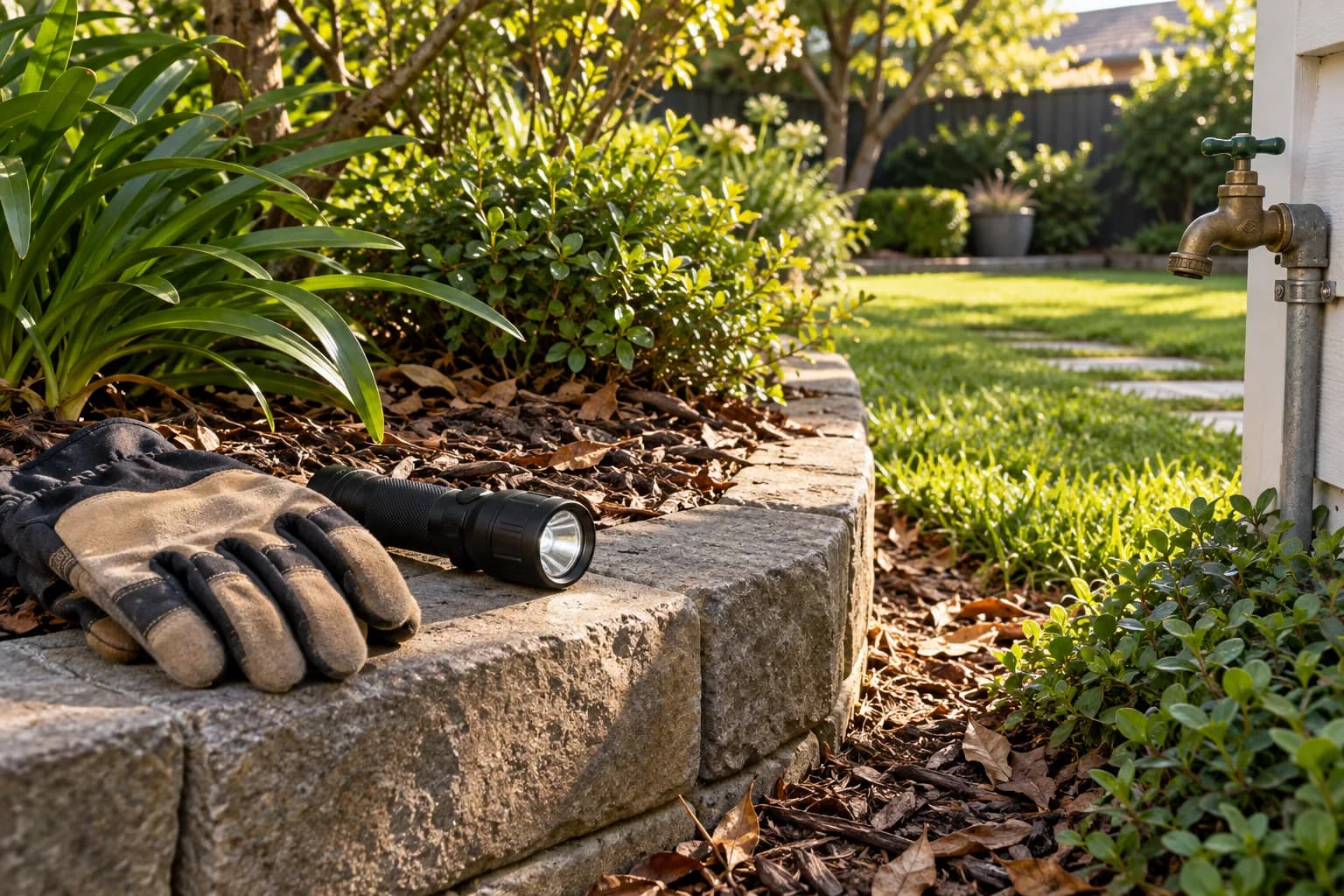 Dense shrubs against the house and a dripping hose bib give rodents cover and water. Trimming back and fixing drips makes the yard less inviting.
How far apart should traps and bait stations go?
A quote that names one number for the whole house without a layout is worth questioning. Ask each provider how many stations or traps they plan, where each will sit, and how many return trips are in the price. Placement is the easiest thing to check when you compare quotes. For Norway rats burrowing outside, a ring of stations along the foundation, fence and garage covers the ground they actually travel. For a Norman kitchen with mice, that can mean a trap every few feet along the walls where droppings appear, not a lone trap under the sink. OSU's guidance is to space mouse stations no more than 10 feet apart and rat stations 25 to 50 feet apart. A trap 15 feet from a mouse nest may never get a visit. Oklahoma State university extension says house mice live within a home range of about 10 to 20 feet, while rats cover roughly 100 feet, and most rodents spend around 80 percent of their time inside that range. Closer than most people set them.
Checking a provider's Oklahoma license before baiting starts.
That question matters most if dogs, cats or small children use the yard. Ask what products they use and whether every station is locked and anchored. If a provider plans to bait farther out, around a barn or along a back fence, they should be able to explain which category covers that work. Before a Norman company places stations along your foundation, ask for its business license and confirm the person doing the work is certified in 7a. The useful part for you is simple. Business license fees run $100 per category with a $500 yearly cap, so a company doing several kinds of work may hold more than one category. ODAFF defines that category as work inside a structure or immediately next to it, no more than three feet out. General pest control, which includes rodent baiting in and around homes, falls under category 7a. In Oklahoma, the Department of Agriculture, Food and Forestry licenses the businesses and people who apply pesticides for hire.
Cleaning up after rodents without stirring up the dust.
Ask whether removal and replacement are included in the quote or added later. Heavy contamination, especially nests packed into attic insulation, is a reasonable job to hand off. Cases are rare, but a closed Norman garage or storage shed that held rodents all winter is exactly where care pays off. The CDC has recorded 890 cases nationwide since 1993, 94 percent of them west of the Mississippi, and Oklahoma falls on that side of the river. Brooms and vacuums lift dried droppings into the air, and breathing that dust is how hantavirus reaches people. The reason is the dust. Bag the waste and wash gloved hands before taking the gloves off. Then mix 1.5 cups of bleach per gallon of water, a 1-to-9 ratio, spray droppings and nesting material until soaked, and wait 5 minutes before wiping up with paper towels. The CDC's method starts with opening doors and windows and letting the space air out for 30 minutes. Wet it, never sweep it.
What affects the price
- How many openings the inspection finds, since each needs mesh, flashing or sealant.
- Whether rats are in the attic, the crawlspace or both.
- The number of exterior stations and the return trips needed to service them.
- Attic insulation that has to come out after heavy nesting.
- Sheds, detached garages and fence lines that fall inside a rat's roughly 100-foot range.
- A one-time job versus an ongoing monitoring plan through each fall.
📊
What's your biggest concern about rodents?
When to call for help
Call a provider when you hear activity in the attic, find droppings in more than one room, or trap mice for two weeks and keep catching new ones. Rats are a stronger signal than mice: one rat in a Norman garage usually means a burrow or nest somewhere on the lot, and a colony rather than a loner. Move faster if you smell something dead inside a wall, find gnawed wiring, or see fresh burrows against the crawlspace. If a pet may have eaten bait, call your vet first and the provider second. The best time to book sealing work is August, before the September push begins and while openings are easy to spot.
What you can do yourself
You can still do the habitat work yourself: trim shrubs off the siding, fix dripping faucets and store feed in metal. A provider earns the fee by finding entry points you would miss and by staying on the job until feeding stops. Roof rats in an attic also mean ladder work at the soffits and roofline. Their range covers your whole yard and probably part of the neighbor's, bait has to sit in locked stations for one to three weeks, and the sealing standard is exact: 24-gauge hardware cloth at 1/4 inch mesh, not window screen and not spray foam. Rats are a different job. Clean up with the CDC bleach method rather than a broom. Snap traps baited with a little peanut butter, set every few feet along the wall where droppings appear, plus steel wool and sealant pressed into the gap around the sink pipes, often settle it. A couple of mice in the kitchen is a fair DIY job.
Rodents in Norman
And with a median home value near $240,000 in the city data we compiled, sealing a house properly is a small expense next to rewiring an attic or replacing chewed ductwork and insulation. Average humidity around 65 percent keeps soil workable for Norway rat burrows much of the year. If you own one of the older houses in town, expect more of the openings rodents like, such as settled foundations, loose siding and old utility holes. Norman dates to 1889. The city holds about 129,000 people at urban density, so a rat colony behind one fence line can draw food from several neighboring yards at once, and fixing your own lot works best alongside neighbors. Norman is best known for the University of Oklahoma and its weather research, and rodent pressure here follows the forecast as closely as anything: the first real cold front of fall reliably sends mice looking for a way in.
Local research
Rodents in Norman, OK: what the public record shows
Before you compare quotes, it helps to know which rodents actually live in Oklahoma, when they are busiest around Norman, and what the state figures look like. Everything below links to the agency or university page it came from.
Rodent species recorded in Oklahoma
- House mouse (Mus musculus) — Enters at 1/4 inch; 5-10 litters per year; eats about 200 small meals a night.
- Norway rat (Rattus norvegicus) — Burrowing rat of basements, sewers and ground floors; tail shorter than head plus body.
- Roof rat (Rattus rattus) — Climber of attics and trees in warm and coastal regions; tail longer than head plus body.
When rodents are busiest around Norman
Fall entry (Sept-Nov). Norway rats and house mice move indoors as temperatures drop.
Based on Norman’s humid subtropical climate profile.
OSU Extension names the Norway rat, roof rat and house mouse as the most frequently identified rodents in Oklahoma poultry houses.
Rules that apply in Oklahoma
For context, nationally
- 1/4 inch (the width of a pencil) — Smallest gap a mouse can enter. CDC
- 890; 35% fatal; 94% west of the Mississippi — Hantavirus cases reported since 1993 (through 2023). CDC
Sources: Oklahoma Cooperative Extension Service, Oklahoma State University; CDC; Pest Notes: House Mouse; Pest Notes: Rats. Figures are quoted as the source prints them. How we check our sources
Simple ways to keep rodents away
- Cut tree limbs back several feet from the roof so roof rats lose their bridge.
- Cover foundation vents and crawlspace openings with 24-gauge, 1/4 inch hardware cloth.
- Fix dripping spigots and condensate puddles that give rodents water through hot Norman summers.
- Bring pet bowls in at night and keep kibble and birdseed in metal cans.
- Fit the garage door with a tight bottom seal and close the gaps at each corner.
- Stack firewood on a rack, off the ground and away from the walls.
- Keep ground cover trimmed short along the foundation so runways stay visible.
- Walk the house every August looking for new gaps before fall entry starts.
 After sealing, a few monitors or unset traps left along the walls tell you whether anything is still getting in before you hear it again.
Did you know?
Rats can jump about 36 inches straight up and survive a 50-foot drop unharmed, according to Oklahoma State university extension.
OSU Extension estimates a single pair of rats can produce 15,000 descendants in one year.
The U.S. averages about 7 human plague cases a year, mostly in the Southwest and far West, carried by rodent fleas.
Questions people ask
Are roof rats a problem in Norman, Oklahoma?
Trimming branches back from the roof removes their easiest route in. Around Norman, roof rats usually give themselves away in attics and upper walls because they travel by trees, fences and utility lines. OSU Extension names the roof rat, Norway rat and house mouse as the rodents found most often in Oklahoma poultry houses, and the same three cause trouble in homes. Yes.
When do mice start coming inside in Norman?
Sealing in late summer beats trapping in December, because every gap you close in August is one less nest in the walls all winter. As Norman's nights drop toward the average winter low of 28F, house mice and Norway rats leave yards and fields for garages, crawlspaces and walls. Expect the push from September through November.
How long does rat bait take to work?
Ask how often stations will be checked and refilled. A plan that drops off bait once and never returns is unlikely to finish the colony. OSU Extension says anticoagulant baits may need 7 to 21 days to succeed, because rats have to feed over several days before the bait takes effect. Longer than most people expect.
What size gap can a mouse fit through?
Half-inch mesh only stops rats. That is why OSU Extension points to 24-gauge hardware cloth with 1/4 by 1/4 inch openings for vents and gaps on a Norman house. About 1/4 inch, roughly the width of a pencil, according to the CDC, and rats can gnaw a hole that size into a bigger one.
Does a rodent exterminator need a license in Oklahoma?
Before anyone places bait around your Norman home, ask for the business license and the applicator's certification. The Oklahoma Department of Agriculture, Food and Forestry licenses commercial pesticide applicators, and general pest work falls under category 7a, which covers treatment inside a structure and within three feet of it. Yes.
What diseases can rodents spread in Norman homes?
For a Norman household the everyday risk is contaminated food and surfaces, which is why sealed containers and wet cleaning matter. Others, such as murine typhus and Lyme disease, travel through fleas and ticks that ride on rodents. The CDC lists several that rodents spread directly, including leptospirosis, salmonellosis, rat-bite fever, tularemia, hantavirus and lymphocytic choriomeningitis.
How much does rodent control cost in Norman?
Ask for inspection, exclusion and follow-up visits itemized in writing. Companies serving Norman generally quote after a walkthrough, because the bill depends on how many entry points need sealing, whether rats are in the attic or under the slab, and how many station visits it takes. There is no single price, and this site does not set one.
Nearby cities
Related guides
Sources (6)
The facts in this article come from the public sources listed above. Every home is different, so ask the company you talk to about pricing and what’s included. Published by Rodent Exterminator · Updated October 11, 2026 · How we write these guides