The short version
Rodent control in Hartford, CT works when sealing and trapping match how far each rodent travels. Connecticut DEEP says house mice stay within 10 to 35 feet of the nest, while rats range 100 to 175 feet. Close gaps slightly over 1/4 inch before fall, trap close to nests indoors, and hire only providers who hold a DEEP certificate.
- House mice in Hartford stay within 10 to 35 feet of their nest, per Connecticut DEEP.
- Rats range 100 to 175 feet, so yard and alley conditions matter.
- A mouse fits through an opening slightly larger than 1/4 inch.
- Connecticut requires professional pesticide users to hold a DEEP certificate.
- Fall is entry season, and mice can stay in walls all winter.
This is for Hartford homeowners and renters finding droppings in kitchens or basements, landlords managing multi-family buildings where mice move between units, and small businesses dealing with rats around dumpsters. It also helps anyone who wants to know what a properly certified Connecticut rodent provider should be doing on their property.
What to look for
House mice are Hartford's most common indoor rodent. Connecticut DEEP notes they nest in walls, ceiling voids, cabinets, and appliances close to food, and they don't need a daily water source, so a kitchen wall can support a colony without any leak nearby. Norway rats are the main outdoor rodent, burrowing near foundations, trash areas, and dense vegetation. Roof rats, deer mice, and white-footed mice are also on DEEP's list, with the two native mice more likely in garages, sheds, and homes near wooded edges. Climate sets the calendar. Summer highs around 84F and about 49 inches of rain a year keep food and cover plentiful, so populations peak by late summer. As fall temperatures drop toward the 19F winter average, mice move into homes and sheds, as UConn's home and garden specialists point out. Indoors, conditions stay favorable all year, and DEEP says rodents can reproduce 4 to 8 times a year with litters averaging 4 to 12, faster when food and shelter are good.
- 1Small droppings in kitchen drawers, in the cabinet under the sink, or behind the refrigerator.
- 2Scratching in ceiling voids at night, often above the kitchen or bathroom.
- 3Gnawed holes in cereal, pasta, or pet food packaging.
- 4Burrow openings near the foundation, trash cans, or along fence lines.
- 5Greasy rub marks along baseboards, pipes, or basement beams.
- 6Droppings or nesting scraps in the drawer under the oven or behind the dishwasher kick plate.
Why it’s worth acting soon
- Connecticut DEEP says rodents can breed 4 to 8 times a year, so small problems scale quickly.
- Mice in a multi-family building spread between units through shared walls and pipe chases.
- Chewed wiring in walls and appliances creates a fire hazard.
- Droppings and urine contaminate food and can aggravate allergies and asthma.
- Norway rat burrows near the foundation can undermine walkways and steps.
Treatment options and typical costs
Exclusion
Quoted after inspection
A provider seals openings slightly larger than 1/4 inch, the size UConn says a mouse can squeeze through, using steel wool or copper mesh with sealant, hardware cloth, and door sweeps. In Hartford's dense housing, that means pipe chases, gaps around heating pipes, foundation cracks, and utility entries.
- Time
- Depends on how many gaps turn up
- Best for
- Every mouse or rat problem, ideally before fall
Targeted mouse trapping
Quoted after inspection
Because DEEP says house mice stay within 10 to 35 feet of the nest, traps work best clustered near the droppings rather than spread across the house. A provider places snap traps along walls, inside cabinets, and near appliances, then checks and moves them until catches stop.
- Time
- Until catches stop
- Best for
- Kitchen and wall-void mice
Rat control across the property
Quoted after inspection
With a rat range of 100 to 175 feet, trapping and bait stations have to cover the yard, alley, and trash area, not just the house. Locked stations go along the foundation and fence line. In Connecticut, anyone applying rodenticide professionally must hold a DEEP certificate.
- Time
- Until activity stops, then monitoring
- Best for
- Norway rats burrowing outside
Building-wide program for multi-family properties
Quoted after inspection
In apartment buildings, a provider inspects every unit and the common areas, seals pipe chases and shared voids, and sets a trapping schedule for the whole building. Treating one unit at a time tends to push mice next door, so this approach usually ends the problem sooner.
- Time
- Scheduled follow-ups until the building is quiet
- Best for
- Landlords and condo associations
Prices are typical published ranges. Ask what’s included before you compare quotes.
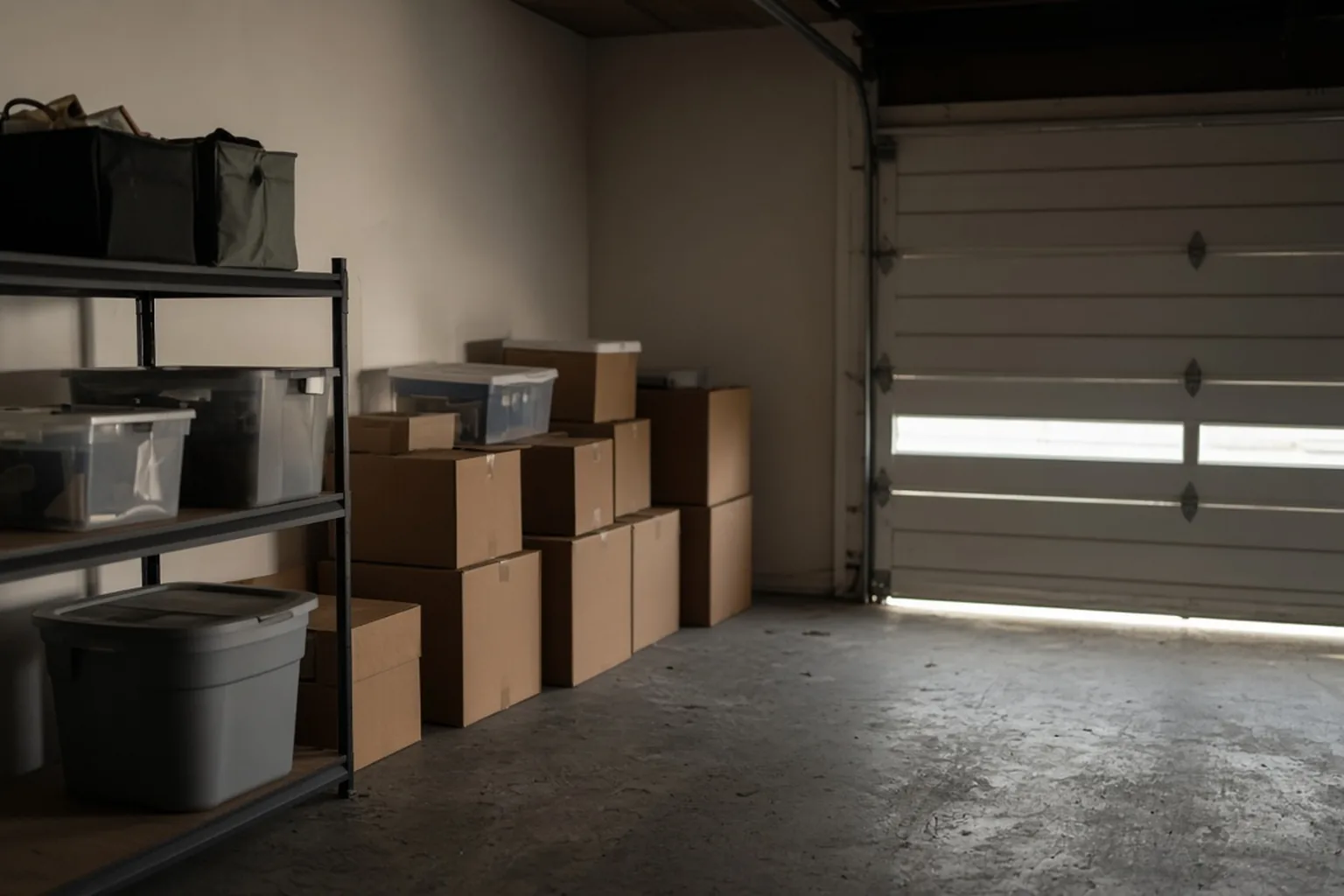 Cardboard boxes make easy nests and the gap under an overhead door makes an easy entrance. Plastic bins and a fresh door seal fix both.
How far do Hartford's rats and mice travel, and why does it matter?
That's why rat work has to cover the yard, alley, and trash area, and why bait stations belong along the property line, not just at the house corners. A Norway rat living under a neighbor's porch can easily reach your trash cans, your garage, and your foundation. For rats, distance works the other way. Cluster them along walls near the activity and you'll catch mice faster. Spread traps across the whole home and most will sit untouched. Droppings in the kitchen usually point to a nest in the kitchen wall, a ceiling void, the cabinet base, or inside an appliance. For mice, that means the nest sits close to where you're seeing signs. Connecticut DEEP's model IPM plan gives it plainly: house mice range 10 to 35 feet from the nest, while rats range 100 to 175 feet, and farther if food is scarce. The single most useful number for rodent control in Hartford is distance. A plan that treats both the same is missing something. When you talk to a provider, ask how they'll place traps for mice versus rats.
What does a Connecticut DEEP certificate mean for you?
Integrated pest management puts inspection, sanitation, and exclusion ahead of pesticides, and uses bait only when it's needed and in a controlled way. It's aimed at public buildings rather than private homes, but it makes a useful benchmark. DEEP also publishes a model IPM plan for rodent control at state agencies, written under CGS 22a-66l. It's a routine question, and a legitimate provider will answer it directly. For a Hartford homeowner or landlord, the practical point is simple: before anyone applies bait on your property, ask whether the technician is certified. Rodenticides, including the bait inside exterior stations, count as pesticides under state rules. Under Connecticut rules, every professional pesticide user needs a DEEP certificate, and rodent control is a certification category of its own. One that starts with sealing and trapping and keeps bait in locked stations is closer to the state's own approach than one that leads with poison. When you compare quotes, see whether each plan follows that logic.
 A good inspection starts outside at ground level: door thresholds, the joint between siding and foundation, and anywhere a pipe or cable enters.
Why is a mouse in a Hartford apartment a building problem?
In a city as dense as Hartford, cooperation is the cheapest fix. Coordinating trash handling helps as well, since overflowing bins in a shared area feed everyone's mice. A provider inspects every unit and common area, seals shared voids and pipe chases, and sets traps on a schedule. Landlords get the best results with a building-wide plan. Gaps in walls, floors, and pipe openings are building issues and usually fall to the owner under the lease. Tenants should report rodent activity to the landlord in writing, with dates and photos, and mention whether neighbors have seen signs too. You trap and seal your kitchen, the neighbor does nothing, and mice from their side keep finding new gaps into yours. That's why treating a single unit often fails. Connecticut DEEP's 10-to-35-foot range for house mice sounds small, but in a building with shared walls, pipe chases, and connected ceiling voids, 35 feet can easily cross into the next apartment. In dense city housing, mice don't stay in one unit.
Can mice really survive a Hartford winter in a cold garage?
Then keep checking through spring, when activity often turns up in sheds. Check the weatherstripping on the door between garage and house, a common entry point. Seal them, store food in metal cans, and set a few traps along the walls each fall. What to do: treat the garage and shed as part of the house. UConn notes they can jump about a foot straight up, so a shelf a foot off the floor isn't out of reach. They're also more athletic than most people assume. They can winter in a garage stocked with birdseed or pet food, then work their way into the house through the door to the kitchen or a gap in a shared wall. Mice don't have to be inside your heated living space to stay active. That changes how you think about winter. Hartford's winter lows average 19F, so an unheated garage, shed, or porch is perfectly livable for a mouse with a nest and food. UConn's home and garden center notes mice can survive temperatures as low as 14F. Yes, and that surprises people.
Keeping rats off a city lot: trash, yards, and alleys.
With 49 inches of rain a year keeping soil soft for digging, burrows come back fast unless food is cut off across several lots, so talk with your neighbors. Rats are a neighborhood problem. Feed pets indoors, put a tray under feeders, and keep compost in a closed bin. Pet food, birdseed, and compost come next. Trim vegetation back from the house, keep the base of fences clear, and don't stack lumber or firewood against walls. Rats burrow in soft soil near foundations, under steps, in ivy and dense shrubs, and beneath sheds. Then look at the yard. If you share a dumpster, ask the building owner to keep the lids shut and the pad clean. Use bins with tight lids, keep them closed, and don't leave bags on the ground on collection day. Start with garbage. DEEP notes rats range 100 to 175 feet from the nest, and farther when food runs short, so a cleaner block forces them to travel more until they give up and move on. Norway rats are Hartford's main outdoor rodent, and in a city setting they live on trash.
What affects the price
- The number of units in the building, since multi-family work covers shared walls and common areas.
- How many gaps the inspection finds around pipes, utilities, and the foundation.
- Whether rats are involved, which extends the work to the yard and trash areas.
- Basement and crawl space access for sealing foundation gaps.
- Follow-up visits and monitoring included in the plan.
- Cleanup of droppings and nesting material in attics, basements, or cabinets.
📊
What's your biggest concern about rodents?
When to call for help
Fall is the right time to get ahead of it, before lows head toward 19F. When you call, ask whether the technician holds a Connecticut DEEP certificate, which state rules require for professional pesticide use. Call a provider when droppings show up in more than one room, when two weeks of trapping hasn't slowed things, or when you see burrows or rats outside. In a Hartford multi-family building, call as soon as more than one unit reports activity, because mice move through shared walls. Rats near a foundation or dumpster call for property-wide work that's hard to do alone.
What you can do yourself
A good compromise: trap and seal inside your own unit, and push the landlord or association for a building-wide inspection if the problem keeps coming back. A provider can also inspect the whole building in one visit. Rats ranging 100 to 175 feet need outdoor trapping or bait stations, and in Connecticut, professional pesticide users need a DEEP certificate. In a multi-family house, the colony may live in a neighbor's wall. It gets harder when the building is shared, when rats are involved, or when you can't find the entry. Pair that with steel wool and sealant in the gaps under sinks and around pipes. Because house mice stay close to their nests, a few snap traps placed right where you see droppings, set against the wall with the bait end touching it, often finish the job. DIY is realistic for a mouse or two in a single-family home.
Rodents in Hartford
Humidity averages 67 percent and the city sits just 59 feet above sea level, so with that much rain, soil near foundations stays moist enough for Norway rat burrows. With a median home value near $190,000, sealing gaps is one of the most affordable repairs a Hartford owner can make. The insurance capital understands risk management, and rodent exclusion is exactly that. Hartford was founded in 1635, making it one of the oldest cities in the country, and today it's an urban center of about 121,000 people and the state capital. Dense housing, shared walls, and closely spaced buildings let rodents move easily between properties, so neighbors and landlords often need to act together. The climate is humid continental, with summer highs near 84F, winter lows near 19F, and about 49 inches of precipitation a year.
Local research
Rodents in Hartford, CT: what the public record shows
Before you compare quotes, it helps to know which rodents actually live in Connecticut, when they are busiest around Hartford, and what the state figures look like. Everything below links to the agency or university page it came from.
Rodent species recorded in Connecticut
- House mouse (Mus musculus) — Enters at 1/4 inch; 5-10 litters per year; eats about 200 small meals a night.
- Norway rat (Rattus norvegicus) — Burrowing rat of basements, sewers and ground floors; tail shorter than head plus body.
- Roof rat (Rattus rattus) — Climber of attics and trees in warm and coastal regions; tail longer than head plus body.
- Deer mouse (Peromyscus maniculatus) — Primary U.S. hantavirus carrier; lives throughout Washington and the interior West.
When rodents are busiest around Hartford
Mice often invade homes or sheds in the fall.
DEEP's rodent certificate and model IPM plan name the Norway rat, roof rat, house mouse, deer mouse and white-footed mouse as the commensal rodents controlled in Connecticut.
Rules that apply in Connecticut
For context, nationally
- 1/4 inch (the width of a pencil) — Smallest gap a mouse can enter. CDC
- 890; 35% fatal; 94% west of the Mississippi — Hantavirus cases reported since 1993 (through 2023). CDC
Sources: Connecticut Department of Public Health; Connecticut Department of Energy and Environmental Protection, Pesticide Management Program; CDC; Pest Notes: House Mouse; Pest Notes: Rats; Hantavirus. Figures are quoted as the source prints them. How we check our sources
Simple ways to keep rodents away
- Seal gaps around pipes under sinks and behind appliances with steel wool and sealant.
- Store dry food in glass, metal, or hard plastic containers.
- Keep trash in lidded bins and take it out often, especially in shared buildings.
- Install door sweeps on basement and exterior doors before October.
- Trim shrubs and ivy back from the foundation to remove rat cover.
- Clean under and behind the stove and refrigerator, where crumbs collect near mouse nests.
- Patch foundation cracks and gaps where utility lines enter.
- Keep birdseed and pet food in sealed metal containers.
 Shared basements and utility rooms are where rodent problems in rentals usually start. Landlords should walk them each fall and after every tenant turnover.
Did you know?
Connecticut DEEP lists the native white-footed mouse alongside the house mouse, deer mouse, Norway rat, and roof rat as rodents controlled in the state.
Connecticut's single reported hantavirus case stands against 890 counted nationwide by the CDC from 1993 through 2023.
A house mouse can leap roughly a foot straight up, UConn notes, so a low shelf won't keep food safe.
Questions people ask
Is hantavirus a concern in Connecticut?
Connecticut has reported only one hantavirus case, in 2014, since the disease became nationally notifiable in 1995, according to the state health department. Deer mice and white-footed mice do live here, so around Hartford, still air out sheds and garages before cleaning and wet down droppings instead of sweeping. The risk is low.
How far do house mice travel from their nest?
In a Hartford apartment, that means the nest is likely in the same room or the next one over from where you see droppings. Set traps close to the activity, not across the whole home. Connecticut DEEP says house mice usually stay within 10 to 35 feet of their nest.
Does a Hartford rodent company need a license?
Ask any Hartford provider whether the technician servicing your home is certified before bait goes out. A legitimate company will answer without hesitation. Yes. Connecticut DEEP requires all professional pesticide users to hold a DEEP certificate, and rodent control has its own certification.
Why do mice come back every fall in Hartford?
Around Hartford, with winter lows near 19F, a mouse that gets in stays in. Sealing gaps before October is what stops the yearly return. Because the yard population peaks by late summer and then looks for shelter as temperatures fall. UConn notes mice often invade homes and sheds in fall.
How small a gap can a mouse fit through?
Check where pipes enter the walls, along baseboards, and around doors. Seal with steel wool or copper mesh plus sealant, since mice chew through foam and caulk alone. Slightly larger than 1/4 inch, according to UConn's home and garden center, or about the width of a pencil.
How fast do mice and rats breed?
Connecticut DEEP says rodents can reproduce 4 to 8 times a year, with litters averaging 4 to 12 young, and breeding speeds up when conditions are good. A warm Hartford apartment with easy food is about as good as it gets, so a small problem can grow quickly over one winter. Fast.
Do mice need water to live in my walls?
Fixing drips won't drive them out by itself. Sealing entry points and trapping near nests does. Not daily. Connecticut DEEP notes house mice get by without a daily water source, which is why they can thrive in a kitchen wall with no leak nearby.
Nearby cities
Related guides
Sources (6)
The facts in this article come from the public sources listed above. Every home is different, so ask the company you talk to about pricing and what’s included. Published by Rodent Exterminator · Updated October 11, 2026 · How we write these guides