The short version
Rodent control in Roswell, GA starts with knowing which of Georgia's three house rodents you have: the roof rat, the Norway rat or the house mouse. Activity runs year-round with a fall surge. UGA Extension recommends sealing openings with 1/4-inch hardware cloth and setting about a dozen traps per house for rats, perpendicular to the walls where they travel.
- Georgia has all three structural rodents: house mouse, Norway rat and roof rat.
- Rodents can enter through an opening about the size of a dime.
- UGA says mice keep within 5 to 10 feet of walls, so set traps along baseboards.
- UGA suggests roughly a dozen rat traps per house, not two or three.
- Roswell's mild winters keep rodents active outdoors through most of the year.
Roswell homeowners hearing noise in the attic or walls, renters finding droppings in a cabinet, landlords responding to a tenant's complaint, and small business owners who spotted a rat near the trash enclosure. It is also useful if you own one of the older homes in or near the historic district and want to know where rodents tend to get in.
What to look for
University of Georgia Extension states that all three commensal rodents live in Georgia: the house mouse, the Norway rat and the roof rat. Identification matters because each one uses a house differently. Roof rats climb. They follow tree limbs, vines, fences and utility lines to the roofline and nest in attics and upper walls. Norway rats dig, building burrows under slabs, decks, sheds and dense shrubs, then entering from ground level. House mice settle in kitchens, cabinets and wall voids, rarely straying more than 5 to 10 feet from a wall. Roswell's climate keeps all three going. About 54 inches of rain a year and 70% average humidity produce thick vegetation, fruiting plants and plenty of insects, which feed rodents outdoors through spring and summer. Summer highs reach 89F, and winter lows average only about 32F, so cold snaps are short. Rodents in subtropical Georgia stay active year-round, but many households notice a surge in fall, when cooler nights and shrinking food supplies send rats and mice toward attics, crawl spaces and garages.
- 1Running or scratching overhead at night, a strong hint that roof rats are using the attic.
- 2Burrows with fresh soil next to a slab, deck or shed, which points to Norway rats.
- 3Droppings in a kitchen drawer or under the sink, often from house mice.
- 4Chewed fruit left hanging on trees or fallen fruit with hollowed-out centers.
- 5Gnawed holes in soffits, vent screens or the corners of garage doors.
- 6Dark rub marks along beams, pipes or the top of a wall where rats travel.
- 7A musky smell in the attic or a closet that gets stronger in warm weather.
Why it’s worth acting soon
- UGA Extension notes mice start breeding at two months and can produce litters every 30 days.
- Roof rats chew attic wiring, and damaged wires can short out and spark.
- The CDC lists leptospirosis and salmonellosis among diseases rodents spread directly to people.
- Nests and droppings in attic insulation ruin it, adding replacement costs to the job.
- A small fall problem in a mild winter rarely slows down on its own.
Treatment options and typical costs
Exclusion with hardware cloth and metal
Quoted after inspection
Sealing entry points with hardware cloth that has 1/4-inch squares, sheet metal and sealant, following UGA Extension's guidance. Work covers soffit and roof vents, gable vents, gaps where lines enter the house, crawl space openings and garage door corners. Remember that rodents can enter through an opening about the size of a dime.
- Time
- Depends on roof access and how many openings are found
- Best for
- Any home with recurring rodents
Attic trapping for roof rats
Quoted after inspection
Snap traps set along rafters, top plates and the paths roof rats use in the attic, with about a dozen traps per house as UGA Circular 970 recommends. Traps should be checked on a schedule and moved as activity shifts. Trimming branches back from the roof goes hand in hand with this step.
- Time
- Until catches stop; ask how many checks are included
- Best for
- Noise and droppings in the attic
Exterior Norway rat control
Quoted after inspection
Because a Norway rat may spend its life within a circle 100 to 150 feet across, traps or locked stations have to cover the burrow area outside, not just the house. A provider should also collapse or fill burrows and reduce cover along the foundation.
- Time
- Until burrows stay closed; ask for the follow-up schedule
- Best for
- Burrows near slabs, decks and sheds
Indoor mouse trapping
Quoted after inspection
Traps placed perpendicular to baseboards, trigger end toward the wall, within the 5 to 10 feet that house mice travel from walls. Several traps in each active room work better than one in the middle of the floor. This is often the quickest part of the job.
- Time
- Until fresh droppings stop appearing
- Best for
- Mice in kitchens, pantries and cabinets
Prices are typical published ranges. Ask what’s included before you compare quotes.
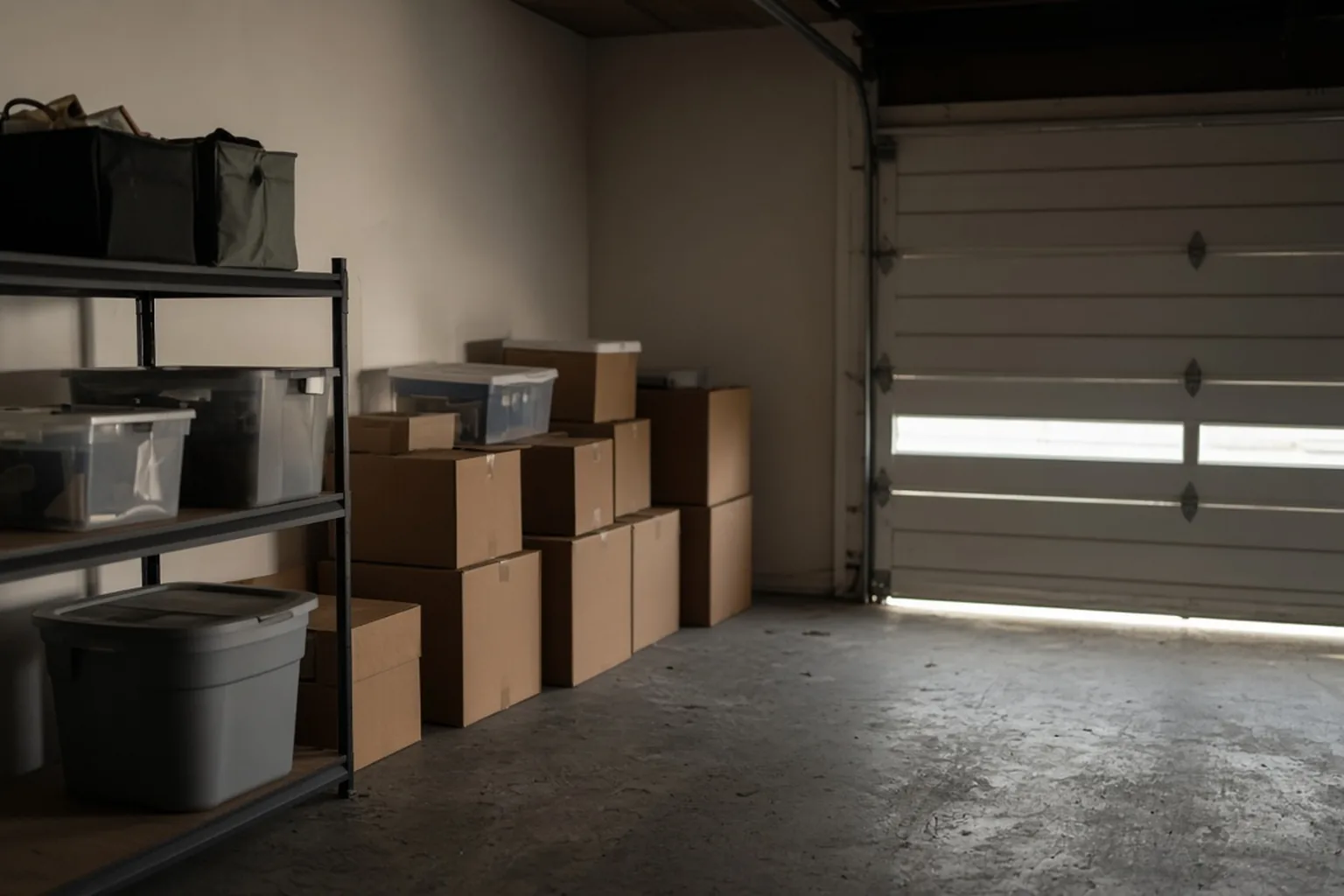 Cardboard boxes make easy nests and the gap under an overhead door makes an easy entrance. Plastic bins and a fresh door seal fix both.
Roof rat, Norway rat or house mouse: which one is in your Roswell home?
If the activity is low, with burrows beside a slab, deck or shed and gnawing at the base of a garage door, think Norway rat. These heavier rats live in the ground and come into crawl spaces and garages from below. UGA notes a Norway rat may live its whole life within a circle 100 to 150 feet across. If you see small droppings in a kitchen drawer or behind the stove and nothing in the attic, house mice are the likely answer. They hug walls and rarely wander more than 5 to 10 feet from one. Start with where the evidence is, because that usually tells you which rodent you have. UGA Extension points out that Georgia has all three commensal species, and identification drives where traps belong. If you hear running overhead at night and find droppings in the attic or on top of cabinets, think roof rat. Roof rats are slender, agile climbers that reach Roswell rooftops along tree limbs, vines and utility lines. Hollowed-out fruit in the yard is another clue.
Why does UGA recommend about a dozen traps for rats?
For roof rats in a Roswell attic, that means traps along top plates, rafters and the edges of the insulation where droppings collect. For Norway rats, it means traps or covered boxes along foundation walls, fences and burrow entrances, spread across the 100 to 150 foot circle the colony uses. Mice follow similar logic on a smaller scale. Because they stay within 5 to 10 feet of a wall, traps placed in open floor space are mostly wasted. Line them up along baseboards near droppings and check them daily. Because a few traps lose the race against breeding. UGA Extension's Circular 970, revised in November 2025, recommends roughly a dozen traps per house when rats are present, set perpendicular to the walls along the routes they use. Rats are cautious around new objects, and they travel set paths. A single trap in the wrong spot may never be touched, while a line of traps across a known runway gives several chances each night. Setting them perpendicular to the wall, trigger end toward it, catches rats traveling in either direction.
 A metal vent cover with a working flap keeps mice out all winter. Plastic flaps crack in the cold and get chewed open.
What does a rodent year look like in Roswell?
Fall is the surge. Cooler nights and declining food push rodents toward warm, sheltered spaces, and many households first hear noise in the attic or find droppings in the kitchen between September and November. Sealing vents and trimming branches before then pays off. Through winter, rodents already inside keep breeding. UGA Extension notes mice can start producing litters at two months and repeat about every 30 days, so a fall arrival can become several generations by spring if entry points stay open. In Roswell there is no true off-season, only busier and quieter stretches. Winter lows average about 32F, and cold snaps pass quickly, so outdoor rodents keep feeding through most months. From spring into summer, about 54 inches of annual rain and 70% humidity drive heavy plant growth, fruit and insect populations. Roof rats nest in trees and attics, Norway rats breed in burrows, and mice live in yards and outbuildings. Summer highs near 89F can make attics hot, but roof rats often stay anyway if the food is close.
How should a house be sealed against rodents?
Branches and vines touching the house need to come back first, or sealing just redirects rats to the next gap. At ground level, check crawl space vents and doors, gaps under the garage door, utility penetrations through the foundation and any cracks in slabs. Norway rats will chew at weak materials, so foam or caulk alone tends to fail. If your home is one of the older buildings in or near the historic district, expect more places to check: settling foundations, original trim and old chimney flues can all hide openings that a quick walkaround misses. Seal to the standard UGA Extension sets: hardware cloth with 1/4-inch squares, backed by sheet metal or sealant where needed. Rodents can push through an opening about the size of a dime, so anything larger than that is a doorway. On a Roswell house, the roofline deserves special attention because roof rats arrive from above. Look at gable vents, soffit vents, ridge vents, gaps where the roof meets a chimney or dormer, and the spots where cables and AC lines enter the siding.
When does a rodent problem become urgent?
Wiring damage is the other emergency. Roof rats nest in attics, and attics carry wiring. If you find chewed cable sheathing, turn off that circuit if you can do so safely and have an electrician check it. In Roswell's warm months, a dead rodent in a wall or attic also becomes urgent quickly because of the smell and the flies it draws. If any of these apply, ask a provider how soon they can inspect, and ask whether cleanup and insulation replacement are part of their plan or a separate job. Treat it as urgent when rodents are in living spaces, when you see chewed wiring, or when droppings are showing up on food prep surfaces. Those three situations carry fire risk or disease risk, and they rarely improve on their own. The CDC lists leptospirosis, salmonellosis, rat-bite fever and several other diseases among those rodents spread directly to people, through droppings, urine, bites or contaminated food. Anyone with a weak immune system, a newborn in the house, or a pet that has been catching rodents raises the stakes.
What affects the price
- Which species you have, since roof rats mean attic work and Norway rats mean yard work.
- Roof pitch and attic access, which affect how long sealing and trapping take.
- The number of vents and openings that need hardware cloth or metal.
- Trees and vines touching the house that need trimming before sealing works.
- How many follow-up visits are included in a climate where activity never fully stops.
- Insulation removal and attic cleanup after a long-running infestation.
📊
What's your biggest concern about rodents?
When to call for help
Bring in a professional when you hear rodents in the attic, see a rat during the day, or keep finding new droppings after a couple of weeks of your own trapping. Attic work for roof rats means ladders, rooflines and crawling over insulation, and sealing has to reach every vent and gap or the rats simply move to the next one. For Roswell homes, where rodents stay active through most of the year, a missed opening keeps paying them rent. Ask the provider to identify the species first and to show you the entry points they found. If their plan has no sealing, ask why.
What you can do yourself
House mice in a kitchen are a realistic DIY project. Set several snap traps flush against the baseboards near droppings, trigger end facing the wall, and seal the gap where the pipes come through under the sink with steel wool or hardware cloth. Mice rarely travel far from walls, so placement does most of the work. Rats are harder. UGA Extension suggests about a dozen traps for a house with rats, which is more hardware, bait and checking than most people expect. Roof rats add attic access and roofline sealing; Norway rats add burrows and a yard-sized range. A professional's biggest contribution is the inspection: finding the dime-sized gaps around vents, soffits and utility lines that you would not see from the ground. Whatever you choose, avoid loose poison indoors. Rats that die in an attic or wall leave a smell that lingers for weeks in Georgia's heat.
Rodents in Roswell
With median home values near $545,000, the cost of chewed wiring, stained ceilings and replaced attic insulation adds up fast, so closing gaps with hardware cloth before a problem grows is usually the cheaper path. At about 1,086 feet of elevation, winters stay mild, with lows averaging 32F, which lets rodents feed outdoors most of the year and keeps the fall push into homes steady rather than sudden. Where a suburban lot has trees and shrubs close to the house, roof rats get a path to the roof and Norway rats get cover for burrows. Some of the oldest buildings in town sit in or near the historic district, and older construction can hide gaps in foundations, chimneys and rooflines, so a careful inspection there should cover every elevation. Each detail touches rodent work. Roswell is a suburban city of about 93,000 people, founded in 1854 and known for its historic district and its tech companies.
Local research
Rodents in Roswell, GA: what the public record shows
Before you compare quotes, it helps to know which rodents actually live in Georgia, when they are busiest around Roswell, and what the state figures look like. Everything below links to the agency or university page it came from.
Commensal rodent species established in Georgia
UGA Extension states all three live in Georgia, so identification drives where you place traps.
University of Georgia ExtensionNorway rat home range
A Norway rat may spend its whole life in that circle, so control has to cover the burrow area, not just the house.
University of Georgia ExtensionRodent species recorded in Georgia
- House mouse (Mus musculus) — Enters at 1/4 inch; 5-10 litters per year; eats about 200 small meals a night.
- Norway rat (Rattus norvegicus) — Burrowing rat of basements, sewers and ground floors; tail shorter than head plus body.
- Roof rat (Rattus rattus) — Climber of attics and trees in warm and coastal regions; tail longer than head plus body.
When rodents are busiest around Roswell
Year-round, fall surge. Roof rats dominate Florida, Texas and Gulf Coast attics.
Based on Roswell’s humid subtropical climate profile.
UGA Circular 970 (revised November 2025) recommends about a dozen traps per house for rats, set perpendicular to walls.
For context, nationally
- 1/4 inch (the width of a pencil) — Smallest gap a mouse can enter. CDC
- 890; 35% fatal; 94% west of the Mississippi — Hantavirus cases reported since 1993 (through 2023). CDC
Sources: University of Georgia Extension; CDC; Pest Notes: House Mouse; Pest Notes: Rats. Figures are quoted as the source prints them. How we check our sources
Simple ways to keep rodents away
- Trim tree branches and shrubs so nothing touches the roof or siding.
- Cut back vines growing on walls, fences and utility poles near the house.
- Cover vents with hardware cloth that has 1/4-inch squares.
- Pick up fallen fruit and nuts and keep pet food indoors overnight.
- Keep trash and compost bins lidded and away from the foundation.
- Clear dense ground cover along the foundation so burrows stay visible.
- Seal openings around pipes, cables and AC lines with metal or mesh, not foam alone.
- Store bird seed and grass seed in metal cans in the garage.
 A good rodent quote lists the inspection, the number of trapping visits, each opening to be sealed and the material for it, and any cleanup.
Did you know?
A Norway rat may spend its entire life inside a circle only 100 to 150 feet across.
Some diseases linked to rodents, including plague, Lyme disease and murine typhus, reach people indirectly through fleas or ticks that fed on them.
About 94% of the 890 U.S. hantavirus cases reported from 1993 through 2023 occurred west of the Mississippi River.
Questions people ask
Are rodents active year-round in Roswell?
Prevention works best as an ongoing habit rather than a single season's chore. Activity does rise in fall, when cooler nights and fewer food sources push rats and mice toward attics, crawl spaces and garages. Roswell's winter lows average about 32F, so cold spells are brief and rodents keep feeding outdoors through most of the year. Yes.
How can I tell a roof rat from a Norway rat?
UGA Extension notes both live in Georgia, and identification decides where traps should go. Norway rats burrow and live low, under slabs, decks and sheds. Roof rats climb and nest high, so noise in the attic or upper walls usually means roof rats. Where you find it is the quickest clue.
How many traps do I need for rats?
For mice, place traps close to baseboards near droppings. A few traps scattered around rarely catch enough to keep up with breeding. UGA Extension's Circular 970, revised in November 2025, recommends about a dozen traps per house for rats, set perpendicular to walls along the routes they travel.
What size hole can rodents get through?
Window screen or chicken wire will not hold. That is why UGA recommends hardware cloth with 1/4-inch squares over vents and openings. UGA Extension says rodents can squeeze through an opening about the size of a dime, and the CDC puts a mouse's limit at roughly 1/4 inch.
Why do roof rats show up in Roswell attics?
Trimming branches back is one of the most effective fixes. Roswell's 54 inches of yearly rain and 70% humidity grow thick vegetation that gives them both food and highways to the roof. Roof rats climb trees, vines and utility lines to reach the roofline, then slip through gaps at vents, soffits and eaves.
How fast do mice multiply?
Trapping out the mice you see without closing the entry points just makes room for the next generation, so sealing has to come with any trapping plan. UGA Extension reports house mice start having litters at about two months old and can produce a new litter roughly every 30 days. Quickly.
What is the safest way to clean up rat droppings in a Roswell attic?
The CDC says never sweep or vacuum dry droppings, even in a hot Roswell attic. Wipe up with paper towels while wearing gloves. Spray droppings and nest material with a bleach solution of about 1.5 cups per gallon of water and let it soak 5 minutes. Open the attic and let it air out for 30 minutes first.
Nearby cities
Related guides
Sources (6)
The facts in this article come from the public sources listed above. Every home is different, so ask the company you talk to about pricing and what’s included. Published by Rodent Exterminator · Updated October 11, 2026 · How we write these guides