The short version
Rodent control in Johns Creek means identifying which of Georgia's three structural rodents you have, then sealing and trapping to match. Roof rats nest in attics, Norway rats stay within a home range about 100 to 150 feet across, and house mice keep within 5 to 10 feet of walls. UGA Extension recommends hardware cloth with 1/4-inch squares and about a dozen traps for rats.
- Georgia has all three structural rodents: house mice, Norway rats, and roof rats.
- Activity runs all year in Johns Creek, with a surge in fall.
- UGA says mice stay within 5 to 10 feet of walls, so set traps along baseboards.
- Mice can have litters every 30 days, so sealing has to come with trapping.
- Use tamper-resistant boxes for traps and bait wherever kids and pets play.
This page is for Johns Creek homeowners hearing noises in the attic or finding droppings in the garage, families who want to deal with rodents without putting children or pets at risk, and landlords or HOA boards fielding complaints. It also helps anyone comparing two provider quotes who wants to know what UGA Extension considers a sound approach.
What to look for
Johns Creek has the full Georgia set of roof rats, Norway rats, and house mice, and each one lives in a different part of the house. Roof rats climb. They run fences, tree limbs, and utility lines and enter at the roofline, so they show up as noise in attics and upper walls. Norway rats dig. UGA Extension puts their home range at 100 to 150 feet across, and a rat may spend its whole life in that circle, so a burrow near your foundation is the center of the problem. House mice stay close to cover, traveling only 5 to 10 feet from a wall, and they breed fast; UGA notes females can start at two months old and produce litters every 30 days. The climate keeps everything moving. Summer highs near 89F and 54 inches of rain support thick vegetation and plenty of food, while winter lows near 32F are not cold enough to stop breeding. Fall brings a surge indoors as nights cool, but activity in Johns Creek never fully stops.
- 1Scurrying or gnawing in the attic or ceiling at night, usually roof rats.
- 2Droppings along baseboards within a few feet of the wall, the house mouse's travel lane.
- 3Burrow holes under shrubs, along the foundation, or beneath a deck.
- 4Gnawed holes in garage storage bins, pet food bags, or bags of grass seed.
- 5Dark grease marks where rodents squeeze through gaps in the siding or around pipes.
- 6Partly eaten fruit or nuts under trees or in garden beds.
- 7A strong musky smell in a closet, attic, or crawlspace.
Why it’s worth acting soon
- Mice that breed every 30 days can turn a few into dozens over a single season.
- Roof rats chewing attic wiring can start fires and damage HVAC ducts.
- Rodent droppings and urine spread salmonellosis and leptospirosis, according to the CDC.
- Norway rat burrows under patios and walkways can lead to settling and cracks.
- Insulation soaked with urine loses its value and usually has to be replaced.
Treatment options and typical costs
Identification and inspection
Quoted after inspection
A walk-through of the attic, garage, crawlspace, and yard to confirm which rodent is present. UGA Extension stresses that identification drives trap placement, since roof rats need traps up high, Norway rats near burrows, and mice along walls. The visit should end with a list of entry points and a map of activity.
- Time
- One visit
- Best for
- Any Johns Creek home with unidentified rodent activity
Trapping by species
Quoted after inspection
Snap traps set perpendicular to walls, trigger toward the baseboard, along the routes each species uses. For rats, UGA recommends about a dozen traps per house. For mice, traps go within the 5 to 10 feet of wall where they travel. Boxed traps keep children and pets safe.
- Time
- Several weeks with regular checks
- Best for
- Rats and mice inside the structure
Exclusion with hardware cloth
Quoted after inspection
Sealing vents, eaves, crawlspace openings, and pipe gaps with hardware cloth that has 1/4-inch squares, the mesh UGA says stops rodents, plus metal flashing where needed. Exclusion is what keeps a fast-breeding mouse population from rebuilding after trapping ends.
- Time
- One or two visits
- Best for
- Homes with recurring activity
Exterior stations for Norway rats
Quoted after inspection
Locked bait stations placed within the burrow area, since a Norway rat's home range is about 100 to 150 feet across. Stations should be anchored and tamper-resistant. In a family neighborhood, ask exactly where each station goes and how it is secured.
- Time
- Ongoing until burrows go quiet
- Best for
- Norway rats in yards and under decks
Prices are typical published ranges. Ask what’s included before you compare quotes.
 Crawl spaces are where rats and mice get comfortable. Vent screens, the sill plate and any gap around pipes are worth a careful look.
Which of Georgia's three rodents is in my Johns Creek house?
Across Johns Creek, the clues are mostly about location. Noises in the attic, ceiling, or upper walls at night point to roof rats. They are agile climbers with long tails, and they reach the roofline by fences, trees, and utility lines. Burrows along the foundation, under a deck, or beneath shrubs point to Norway rats. These heavier rats dig, and UGA says a Norway rat's home range is about 100 to 150 feet across, so the burrow is probably close to where you see damage. Small droppings along kitchen baseboards, in drawers, or in garage corners point to house mice. They stay within 5 to 10 feet of walls, so their droppings and rub marks line up along edges. A single house can host more than one species at once, such as roof rats in the attic and mice in the kitchen, and each needs its own placement plan. If you are unsure, start with an inspection rather than a cart full of supplies. UGA Extension makes a point that matters: all three structural rodents live in Georgia, and identification decides where your traps go.
Why UGA recommends about a dozen traps, and where they go.
UGA Extension's Circular 970, revised in November 2025, recommends about a dozen traps per house for rats, set perpendicular to walls. The reason is behavior. Rats and mice run along walls and edges rather than across open floors, so a trap set at right angles to the baseboard, trigger end toward the wall, catches them as they pass. More traps along more routes means more chances. Placement depends on species. For roof rats, set traps on rafters, top plates, and beams in the attic, and along the routes where droppings collect. For Norway rats, put them near burrow openings, in the garage, and along ground-level walls in crawlspaces. For mice, keep traps within the 5 to 10 feet of wall where they travel. Check traps daily, wear gloves, and reset them in the same spots unless a location produces nothing for several days. In Johns Creek homes with kids or pets, put traps in enclosed boxes or in places children and animals cannot reach, such as behind appliances or up in the attic. One or two traps rarely solve a rat problem.
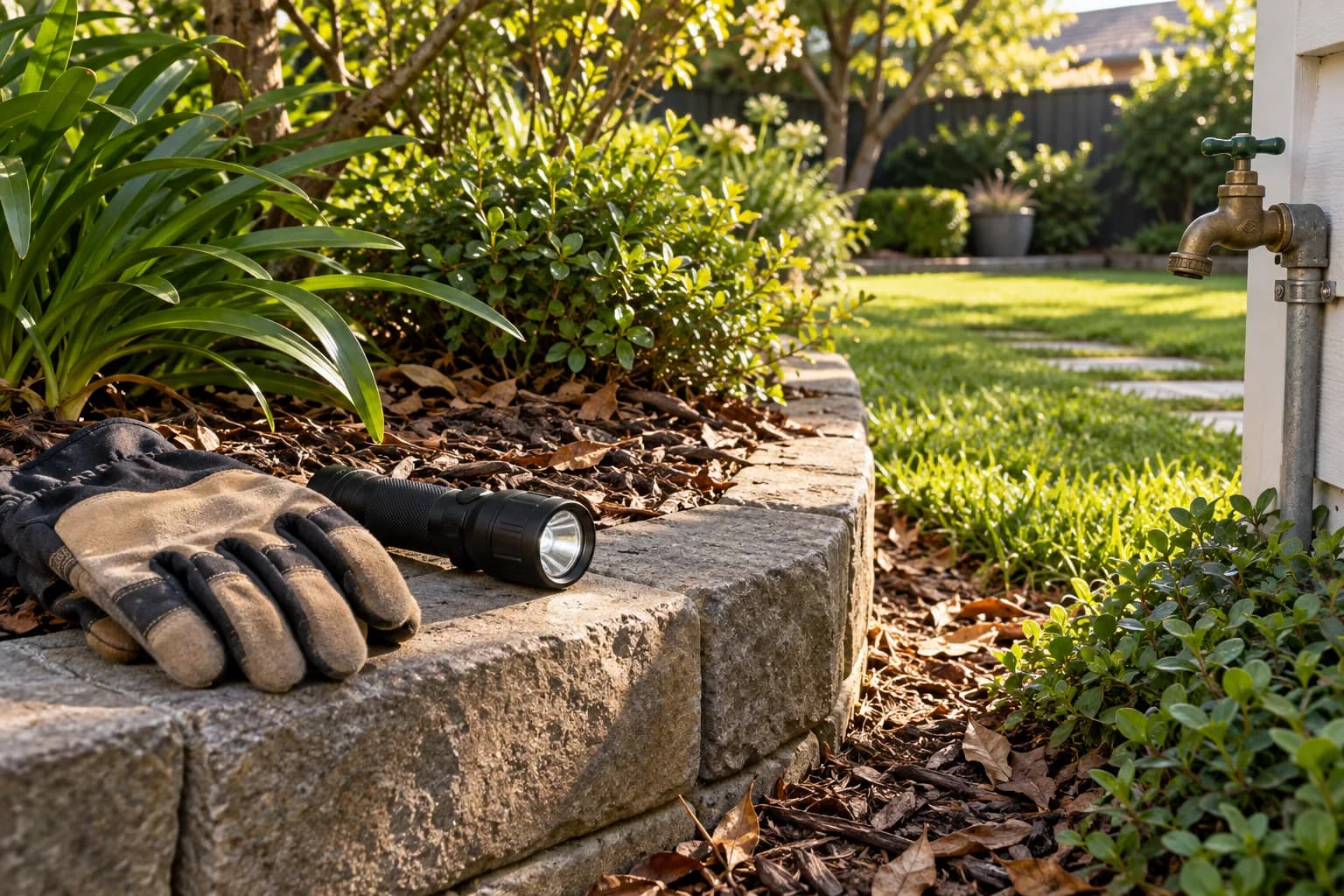 Dense shrubs against the house and a dripping hose bib give rodents cover and water. Trimming back and fixing drips makes the yard less inviting.
Rats, kids, and pets: safer choices for family homes.
The answer is mostly about placement and containers. Indoors, traps beat bait. A poisoned rodent can die inside a wall where nobody can reach it, and loose bait can be found by a curious toddler or dog. Snap traps in enclosed plastic boxes protect fingers and paws while still catching mice and rats. Outdoors, if bait is used for Norway rats, it belongs in locked, tamper-resistant stations anchored to the ground or a structure. Ask the provider where each station will sit and which product it holds, and keep that information handy in case a pet gets into something. Sealing is the safest tool of all. Hardware cloth with 1/4-inch squares over vents, crawlspace openings, and gaps keeps rodents out without chemicals. Cleanup matters too. When you clean droppings, ventilate first, wet them down with a 1:9 bleach mix, and keep children out of the area until you finish. Johns Creek is known for its top schools, and if your household includes children or pets, the big question is how to handle rodents without putting them at risk.
How fast can mice multiply in a warm Georgia house?
UGA Extension notes that house mice can start having litters at two months old and then produce a new litter at roughly 30-day intervals. A pair that gets in during an October cold snap can have grandchildren in your walls before spring. The climate helps them. Winter lows in Johns Creek average around 32F, cold enough to push mice inside in fall but not cold enough to crash outdoor populations. Indoors, with heat and food, breeding continues through the winter. That breeding rate shapes the plan. Trapping alone catches the current mice while new ones keep arriving and the ones you missed keep reproducing. UGA's point is that populations rebound fast if exclusion is not fixed. So pair traps with sealing. Find the entry points, close them with hardware cloth or steel wool and sealant, then trap the mice still inside. Catches should fall week by week. If they do not, there is still an open gap, often around plumbing, AC lines, or the garage door. Faster than most people expect.
Questions to ask before signing a rodent plan in Johns Creek.
Which species did you find, and how do you know? The answer should mention droppings, burrows, rub marks, or noise patterns, and it should reflect UGA's point that identification drives trap placement. Where are the entry points? Ask for a list or photos. A vague promise of general sealing is a red flag. What materials will you use? Hardware cloth with 1/4-inch squares and metal flashing hold up, while foam by itself does not. How many traps or stations, and where? For rats, UGA suggests about a dozen traps per house. Ask how traps and bait will be kept away from children and pets. How often will you check them, and how many visits are included? Rats can be wary of new traps, so the plan should include several checks. What happens if activity continues? Get the follow-up policy in writing. Is attic cleanup included? If your Johns Creek attic is large, removing droppings and insulation can be a major part of the job, so find out whether it is in the quote. A good provider welcomes questions, and a few of them separate a careful plan from a quick one.
What affects the price
- Square footage and attic size, since larger homes need more traps and inspection time.
- The number of rooflines, vents, and eaves to seal with hardware cloth.
- Which species are present, since roof rats and Norway rats together mean more work.
- Crawlspace access and condition.
- The number of follow-up visits needed to clear traps and confirm results.
- Whether soiled attic insulation needs removal.
📊
What's your biggest concern about rodents?
When to call for help
Call a provider if you hear rodents in the attic, see a rat in daylight, or find burrows near the foundation or under a deck. Attic and roofline work needs ladders, care, and knowledge of where roof rats get in. Call about mice if traps keep catching after a couple of weeks, since UGA notes litters can come every 30 days and a lingering population usually means a missed entry point. In Johns Creek homes with young children or pets, a provider can also set traps and stations in tamper-resistant boxes and explain the placement, which takes some of the risk out of the job.
What you can do yourself
UGA recommends about a dozen traps per house for rats, placed by species, and roof rats mean working in the attic and at the roofline. Norway rat burrows need finding and monitoring. If you have kids or pets, enclosed trap boxes and locked bait stations are worth the cost, and a provider will know where to put them. Many families handle mice themselves and hire out anything involving rats or the attic. Mice along a kitchen wall are a manageable DIY project. Set snap traps perpendicular to the baseboard with the trigger end facing the wall, put them where droppings show the mice travel, and check them daily. Seal gaps with hardware cloth or steel wool, since UGA says rodents can squeeze through an opening as small as a dime. Rats are a bigger commitment.
Rodents in Johns Creek
Johns Creek is a suburban city of about 83,000 people, founded in 2006 and known as an affluent suburb with top schools. That profile shapes rodent work in practical ways. With a median home value of around $550,000, chewed attic wiring and ductwork are costly to put right, and if your house is a large one, more attic and roofline means more places for roof rats to get in. If your household includes young children or pets, safe trap and bait placement becomes a priority. The climate is humid subtropical, with summer highs around 89F, winter lows near 32F, 70% average humidity, and about 54 inches of rain a year. That rain and warmth support thick landscaping and a steady food supply for rodents. At 1,096 feet of elevation, Johns Creek still sits in the subtropical South zone, where rodent activity runs all year and surges in fall.
Local research
Rodents in Johns Creek, GA: what the public record shows
Before you compare quotes, it helps to know which rodents actually live in Georgia, when they are busiest around Johns Creek, and what the state figures look like. Everything below links to the agency or university page it came from.
Commensal rodent species established in Georgia
UGA Extension states all three live in Georgia, so identification drives where you place traps.
University of Georgia ExtensionNorway rat home range
A Norway rat may spend its whole life in that circle, so control has to cover the burrow area, not just the house.
University of Georgia ExtensionRodent species recorded in Georgia
- House mouse (Mus musculus) — Enters at 1/4 inch; 5-10 litters per year; eats about 200 small meals a night.
- Norway rat (Rattus norvegicus) — Burrowing rat of basements, sewers and ground floors; tail shorter than head plus body.
- Roof rat (Rattus rattus) — Climber of attics and trees in warm and coastal regions; tail longer than head plus body.
When rodents are busiest around Johns Creek
Year-round, fall surge. Roof rats dominate Florida, Texas and Gulf Coast attics.
Based on Johns Creek’s humid subtropical climate profile.
UGA Circular 970 (revised November 2025) recommends about a dozen traps per house for rats, set perpendicular to walls.
For context, nationally
- 1/4 inch (the width of a pencil) — Smallest gap a mouse can enter. CDC
- 890; 35% fatal; 94% west of the Mississippi — Hantavirus cases reported since 1993 (through 2023). CDC
Sources: University of Georgia Extension; CDC; Pest Notes: House Mouse; Pest Notes: Rats. Figures are quoted as the source prints them. How we check our sources
Simple ways to keep rodents away
- Cover vents and crawlspace openings with hardware cloth that has 1/4-inch squares.
- Trim branches back from the roof so roof rats cannot drop onto shingles.
- Pick up fallen fruit, nuts, and spilled birdseed before dark.
- Store dog and cat food in sealed bins, and bring bowls inside overnight.
- Keep firewood and landscaping timbers off the ground and away from walls.
- Close gaps around pipes and AC lines with steel wool and sealant.
- Fit garage doors with tight bottom seals and keep them closed in the evening.
- Keep mulch beds thin near the foundation so rats have less cover to dig in.
 A good rodent quote lists the inspection, the number of trapping visits, each opening to be sealed and the material for it, and any cleanup.
Did you know?
UGA Extension notes that rodents can squeeze through an opening as small as a dime.
A female house mouse can start breeding at about two months old and have a new litter roughly every 30 days.
Roughly a third of U.S. hantavirus patients die: the CDC counts a 35% fatality rate across 890 cases since 1993.
Questions people ask
Are there roof rats in Johns Creek?
Yes. UGA Extension confirms that roof rats, Norway rats, and house mice are all established in Georgia, and the warm, wet climate in Johns Creek suits roof rats well. They usually live in attics and trees and travel along fences and power lines, so noises overhead at night are the most common sign.
Where should I put mouse traps?
Along the walls. UGA Extension notes mice usually travel only 5 to 10 feet from a wall, so traps belong against baseboards, set perpendicular with the trigger facing the wall. Put them where you see droppings, behind appliances, and in garage corners. In a Johns Creek home with kids or pets, use enclosed trap boxes.
How many traps do I need for rats?
More than most people think. UGA Extension recommends about a dozen traps per house for rats, set perpendicular to walls along the routes rats use. Place them by species: in the attic and on rafters for roof rats, and near burrows and ground-level entry points for Norway rats. Check them every day.
How fast do mice reproduce?
Very fast. According to UGA Extension, female house mice can start having litters at two months old and continue at 30-day intervals. Across Johns Creek, where winter lows only reach about 32F, breeding indoors can continue through the year. That is why trapping without sealing usually leads to a rebound.
Is rat bait safe around kids and pets?
Only in locked, tamper-resistant stations that are anchored and placed out of reach, and even then placement matters. Loose pellets can be eaten by pets or wildlife or carried off by rodents. Many Johns Creek families prefer boxed traps indoors and stations only outside. Ask any provider exactly where bait will go and which product is used.
Do rats really stay near one yard?
Norway rats often do. UGA Extension says a Norway rat's home range is about 100 to 150 feet across, and it may spend its whole life within that area. The burrow is likely close to where you see activity, so control has to cover the burrow area, not only the house. On a larger Johns Creek lot, that circle may sit entirely inside your own yard.
What should a rodent control plan in Johns Creek include?
Species identification, a list of entry points, sealing with hardware cloth that has 1/4-inch squares, a trap and station placement plan, and a follow-up schedule. Ask how long the provider expects trapping to take, how they will protect children and pets, and whether attic cleanup is included or quoted separately.
Nearby cities
Related guides
Sources (6)
The facts in this article come from the public sources listed above. Every home is different, so ask the company you talk to about pricing and what’s included. Published by Rodent Exterminator · Updated October 11, 2026 · How we write these guides