The short version
Rodent control in Winston-Salem, North Carolina, starts with sealing to the quarter-inch standard, since NC State says young rats fit through quarter-inch gaps and adults through half-inch ones. Then trap along established runways and be patient, because rats can take up to a week to approach new traps. Expect a fall surge as winter lows drop to around 30F.
- NC State says one rat leaves 30 to 50 droppings a day, so piles add up fast.
- Juvenile rats need only a quarter-inch gap; adults need half an inch.
- Rats may avoid new traps for up to a week, so check them daily and wait.
- Ventilate at least 30 minutes and coat droppings in 10 percent bleach before cleanup.
- Winter lows near 30F drive a strong fall move indoors.
This is for Winston-Salem homeowners finding droppings in the kitchen, garage or basement, renters near Wake Forest or elsewhere in town who need an owner to seal gaps, and restaurant and shop owners in older commercial buildings. It also helps anyone who has set traps and caught nothing, and wonders whether they are doing something wrong.
What to look for
NC State's guide to structure-invading rats covers the two rats that matter in Winston-Salem, the Norway rat and the roof rat, and house mice round out the list. Norway rats burrow along foundations and come in at ground level through basements, crawlspaces and garages. Roof rats climb trees, fences and utility lines and settle into attics. House mice nest in walls, cabinets and storage. The numbers explain why problems escalate. NC State says a single rat leaves 30 to 50 droppings a day, and juvenile rats can get through a gap only a quarter inch wide, while adults need about half an inch. Winston-Salem's weather keeps rodents active through most of the year. Summers near 88F and humidity averaging 70 percent keep yards lush. About 44 inches of rain a year softens wood trim and soil. When winter lows head toward 30F, rats and mice push indoors in larger numbers, which is why fall is the busiest season.
- 1Droppings roughly half to three-quarters of an inch long, which NC State uses to identify rats.
- 2Smaller, pointed droppings in drawers or along baseboards, which usually mean mice.
- 3Large numbers of droppings in one spot, since one rat leaves 30 to 50 a day.
- 4Scratching in walls or ceilings once the heat comes on in fall.
- 5Dark rub marks along walls, pipes or foundation edges where rats travel.
- 6Burrows along the foundation or under decks and sheds.
- 7Gnawed holes at door bottoms, around pipes or in stored food packaging.
Why it’s worth acting soon
- Droppings build up fast, at 30 to 50 per rat per day according to NC State.
- Young rats can slip through quarter-inch gaps, so a growing colony finds more ways in.
- Chewed wiring in walls, attics and basements is a fire risk.
- The CDC lists leptospirosis, rat-bite fever and salmonellosis among diseases rodents spread.
- Contaminated insulation and stored items become harder to clean the longer rodents stay.
Treatment options and typical costs
Exclusion to the quarter-inch standard
Quoted after inspection
NC State says juvenile rats fit through quarter-inch gaps and adults through half-inch ones, so sealing should target anything a quarter inch or larger. Typical spots include pipe penetrations, vents, door bottoms, basement windows and roofline gaps. Materials should be hardware cloth, sheet metal or mortar.
- Time
- One to two days
- Best for
- Every home with ongoing activity
Runway trapping with daily checks
Quoted after inspection
Snap traps go along established runways, where droppings and rub marks show rats travel. NC State notes rats may take up to a week to approach new traps, so patience matters. Traps should be checked daily and reset until catches stop.
- Time
- Two to four weeks
- Best for
- Rats or mice already inside
Droppings cleanup
Quoted after inspection
NC State recommends ventilating at least 30 minutes, then coating droppings with a 10 percent bleach solution before removal, and never dry-sweeping or vacuuming. Heavy contamination in attics or basements may require insulation removal, often quoted separately.
- Time
- A few hours to several days
- Best for
- Areas with heavy droppings
Exterior bait stations
Quoted after inspection
Locked, tamper-resistant stations along the foundation can reduce outdoor rat pressure, especially near commercial areas or dense vegetation. They supplement sealing rather than replace it. Ask what product is used and how often stations are checked.
- Time
- Ongoing service
- Best for
- Properties with burrows or steady outdoor pressure
Prices are typical published ranges. Ask what’s included before you compare quotes.
 Clutter gives mice cover. Keeping stored fabric in lidded bins and off the floor takes away the nesting spots they like best.
Rat or mouse? Reading droppings the NC State way.
Droppings are the most reliable clue in a Winston-Salem home, and NC State gives two numbers that help. First, size. Rat droppings run roughly half to three-quarters of an inch long, capsule-shaped and dark. Mouse droppings are much smaller, about the size of a grain of rice, with pointed ends. NC State uses that size difference to separate rat activity from mouse activity. Second, volume. A single rat leaves 30 to 50 droppings a day. If you find a large pile in a basement corner or behind the water heater, it may be from one rat over a few days, or several rats. Location tells you more. Droppings along basement walls, in garages and near foundation gaps point to Norway rats. Droppings in attics and on top of insulation suggest roof rats. Droppings in kitchen drawers and cabinets usually mean mice. Whatever you find, do not sweep it up. Ventilate first, then coat with bleach solution.
Why your traps are not catching anything yet.
Traps that sit untouched for days are a frustrating part of rodent work in a Winston-Salem house. NC State explains why: rats are wary of new objects, and they may take up to a week to approach new traps in established runways. That wariness is a survival trait. Rats learn their routes and notice anything new. A trap that suddenly appears on a runway may be avoided for days. The fix is patience and placement. Put traps along walls where you see droppings and rub marks, since that is where rats travel. Check them daily, as NC State recommends, and do not move them around too quickly. Mice are less cautious, so mouse traps can work within a day or two. If you are catching nothing after a week and still hearing activity, the trap placement may be off, or the rodents may be getting food elsewhere. A provider can look at runways and adjust placement.
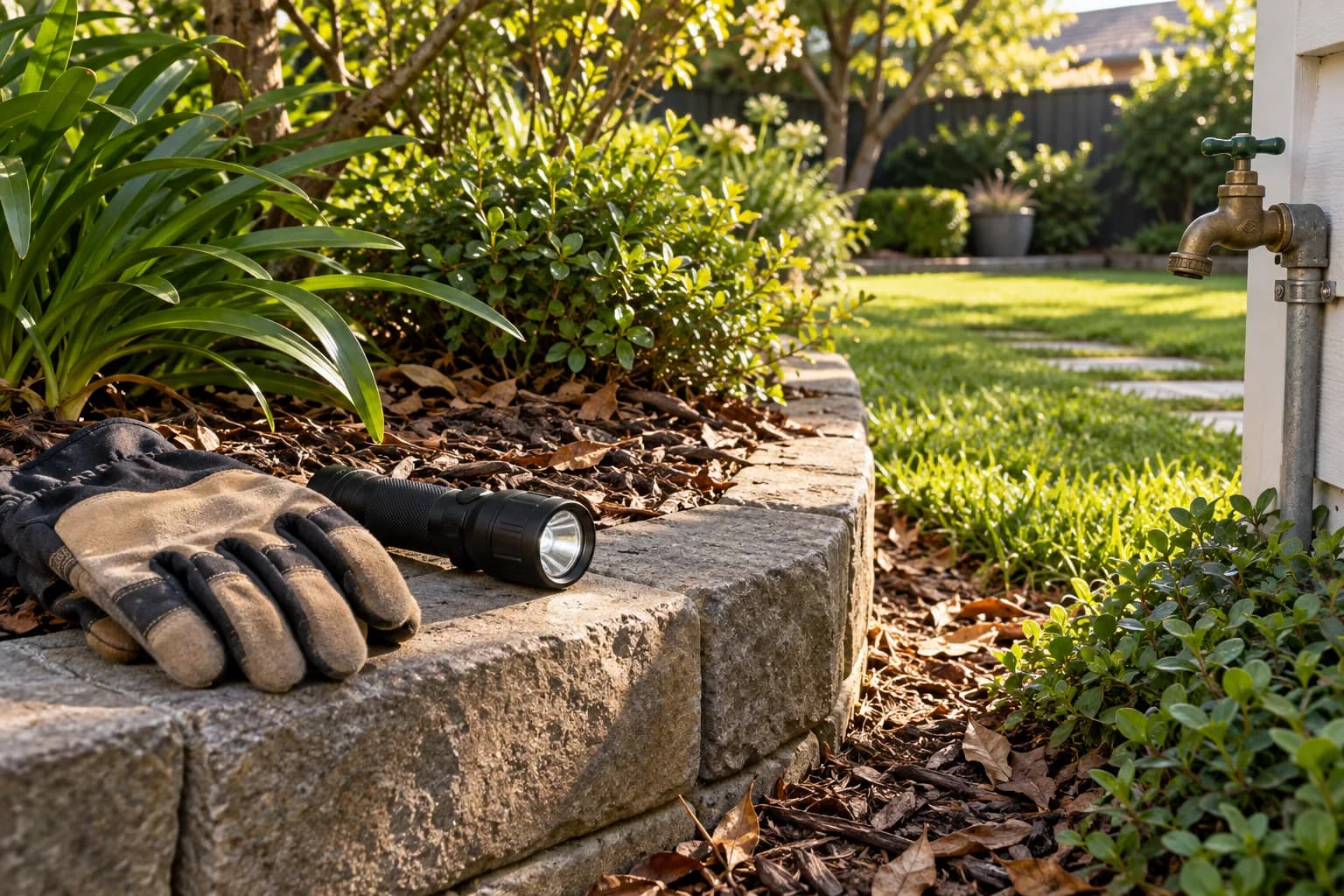 Dense shrubs against the house and a dripping hose bib give rodents cover and water. Trimming back and fixing drips makes the yard less inviting.
Sealing for young rats: the quarter-inch rule.
Many people seal gaps big enough for an adult rat and stop there. NC State points out why that is not enough: adult rats need about half an inch, but juvenile rats fit through gaps only a quarter inch wide. That means sealing to the half-inch level still leaves openings for young rats, and a growing colony produces plenty of young. The CDC uses the same quarter-inch standard for mice. In a Winston-Salem home, check around pipes and utility lines, at door bottoms, in basement and crawlspace vents, around dryer vents, and along rooflines where trees or vines give roof rats access. Use materials that resist gnawing: hardware cloth, sheet metal, mortar, or steel wool topped with sealant. Foam alone does not hold. The best time to seal is late summer, before winter lows near 30F push rodents indoors. If you had activity last fall, book an inspection by early September.
Winston-Salem's rodent year.
Rodent activity in Winston-Salem runs year-round, with a strong fall surge. Winter, December through February: lows near 30F keep rats and mice indoors in walls, basements and attics, where they keep breeding. Spring, March through May: young rats born over the winter move into new territory outside. Trim vines and branches and fix gaps noticed over winter. Summer, June through August: highs near 88F and humidity around 70 percent keep yards lush. Norway rats burrow along foundations and under decks, and roof rats move through trees. About 44 inches of rain a year keeps soil soft for burrowing. Fall, September through November: the surge. Cooling nights push rodents toward any gap they can find. This is when most new infestations start. Plan sealing for late summer, and if traps are needed, start them early so the week-long wariness period does not delay results.
Rodents in older commercial buildings and restaurants.
Winston-Salem is known for its tobacco history, and if your restaurant or shop sits in an older commercial building, expect more gaps than in new construction. Food businesses also offer plenty for rodents to eat. If you run a restaurant or shop, start with the basics NC State emphasizes. Seal gaps to the quarter-inch standard, since juvenile rats fit through openings that small. Check around pipes, utility lines, doors and loading areas. Trapping in a commercial space takes patience. Rats may avoid new traps for up to a week, so traps should be checked daily and left in place along runways. Cleanup in food areas needs care. Ventilate at least 30 minutes, coat droppings with 10 percent bleach solution, and never dry-sweep or vacuum. When hiring a provider, ask about inspection frequency, trap placement, record keeping and how they handle sealing in older construction.
What affects the price
- The number of gaps a quarter inch or larger that need sealing.
- Basements and crawlspaces with many pipe and vent openings.
- Attic access and roofline gaps for roof rats.
- How much cleanup is needed, including insulation removal.
- The number of follow-up trap checks, given rats' wariness of new traps.
- Commercial properties that need more frequent service.
📊
What's your biggest concern about rodents?
When to call for help
Call a professional if you find large piles of droppings, see signs of rats rather than mice, or have set traps for over a week with no results while activity continues. In Winston-Salem, fall is the peak, so calling in late summer gives time to seal before the surge. Restaurants and food businesses should call at the first sign. Also call if droppings are spread across an attic, basement or crawlspace, since cleanup needs careful wet methods.
What you can do yourself
Some rodent work in Winston-Salem is homeowner-friendly. For a few mice, snap traps along walls and steel wool packed into pipe gaps often do the job. Check traps daily and be patient. Rats are harder for two reasons NC State points out. First, young rats fit through quarter-inch gaps, so sealing has to be very thorough, including at the roofline and around every pipe. Second, rats may avoid new traps for up to a week, which frustrates many homeowners who give up too soon. A provider has the experience to find small gaps and the routine to check traps daily over a few weeks. For heavy droppings, a provider can also handle cleanup safely.
Rodents in Winston-Salem
With a median home value around $235,000, sealing gaps is an affordable way to protect wiring and insulation. Urban density puts homes, restaurants and trash areas close together. If you rent near Wake Forest University, check cabinets and closets for droppings on move-in day. Tobacco history is part of the city's identity, and if your home or shop is in an older building, expect more gaps to seal. The city sits at about 970 feet, and any wooded lot or creek near your yard gives rodents cover. Summer highs near 88F, humidity around 70 percent and about 44 inches of rain a year keep vegetation thick and wood trim damp. Winter lows average around 30F, so the fall move indoors is a real event. Several local details shape the rodent picture. Winston-Salem is a city of about 251,000 people, founded in 1766 and known for its tobacco history and Wake Forest University.
Local research
Rodents in Winston-Salem, NC: what the public record shows
Before you compare quotes, it helps to know which rodents actually live in North Carolina, when they are busiest around Winston-Salem, and what the state figures look like. Everything below links to the agency or university page it came from.
Droppings a rat leaves per day
Pellets run roughly 1/2 to 3/4 inch, which is how NC State separates rat activity from mouse activity.
NC State ExtensionGap size that admits rats
Seal to the quarter-inch standard or young rats still get in.
NC State ExtensionTime before rats start hitting new traps
Check traps daily; rats are wary of new objects in established runways.
NC State ExtensionRodent species recorded in North Carolina
- House mouse (Mus musculus) — Enters at 1/4 inch; 5-10 litters per year; eats about 200 small meals a night.
- Norway rat (Rattus norvegicus) — Burrowing rat of basements, sewers and ground floors; tail shorter than head plus body.
- Roof rat (Rattus rattus) — Climber of attics and trees in warm and coastal regions; tail longer than head plus body.
When rodents are busiest around Winston-Salem
Year-round, fall surge. Roof rats dominate Florida, Texas and Gulf Coast attics.
Based on Winston-Salem’s humid subtropical climate profile.
NC State's structure-invading rat guide covers both the Norway rat and the roof rat.
For context, nationally
- 1/4 inch (the width of a pencil) — Smallest gap a mouse can enter. CDC
- 890; 35% fatal; 94% west of the Mississippi — Hantavirus cases reported since 1993 (through 2023). CDC
Sources: NC State Extension; CDC; Pest Notes: House Mouse; Pest Notes: Rats. Figures are quoted as the source prints them. How we check our sources
Simple ways to keep rodents away
- Seal every gap a quarter inch or larger, since young rats fit through that size.
- Add sweeps to exterior doors and replace worn garage door seals.
- Screen basement and crawlspace vents with quarter-inch hardware cloth.
- Trim tree branches and vines away from the roof.
- Store pet food and birdseed in metal containers with tight lids.
- Keep garbage in bins with lids and away from the house wall.
- Seal gaps in late summer before the fall surge.
- Check basements and garages for droppings every few weeks.
 After sealing, a few monitors or unset traps left along the walls tell you whether anything is still getting in before you hear it again.
Did you know?
NC State notes rats are wary of new objects in their runways, which is why fresh traps can go untouched for days.
UC IPM counts four to six litters a year for a Norway rat female, adding up to 20 or more weaned young.
Rats are a key urban reservoir for leptospirosis, which sickened 21 residents of U.S. states in the first 13 weeks of 2026.
Questions people ask
How do I know if droppings are from rats or mice?
A single rat leaves 30 to 50 droppings a day, so large piles in one Winston-Salem basement or garage usually point to rats. NC State says rat droppings run roughly half to three-quarters of an inch long, while mouse droppings are much smaller and pointed. Size is the giveaway.
Why are my rat traps not catching anything?
Place traps along walls where you see droppings and rub marks, check them daily, and give them time before moving them. NC State says they may take up to a week to approach new traps in established runways. Rats are wary of new objects.
What size gap should I seal against rats?
Use hardware cloth, sheet metal or mortar. If you seal only to the half-inch level, young rats still get in. NC State says juvenile rats fit through quarter-inch gaps and adults through half-inch ones. A quarter inch.
When do rodents come inside in Winston-Salem?
Sealing every quarter-inch gap in late summer heads off much of the trouble, and traps should go out early, since NC State says rats can ignore new ones for up to a week. With Winston-Salem winter lows averaging around 30F, rats and mice push indoors as nights cool, and that surge lands on top of activity that runs all year in this climate. Mostly in fall.
How should I clean up rat droppings?
Wear gloves and wipe up with paper towels, then bag everything. Never dry-sweep or vacuum. NC State recommends ventilating the space at least 30 minutes, then coating droppings with a 10 percent bleach solution before removing them.
Do roof rats live in Winston-Salem?
Roof rats climb trees and utility lines into attics, while Norway rats burrow and come in at ground level. NC State's guide covers both the Norway rat and the roof rat as structure-invading species in North Carolina, and both turn up around Winston-Salem. Yes.
What diseases do rats carry?
The CDC lists leptospirosis, rat-bite fever, salmonellosis, tularemia, hantavirus and LCM among diseases rodents spread directly, and plague, Lyme disease and murine typhus among those spread indirectly. Avoid contact with droppings and clean with bleach solution.
Nearby cities
Related guides
Sources (6)
The facts in this article come from the public sources listed above. Every home is different, so ask the company you talk to about pricing and what’s included. Published by Rodent Exterminator · Updated October 11, 2026 · How we write these guides