The short version
Rodent control in Boca Raton, Florida is mostly a roof rat job, and it never really goes out of season. Roof rats live in fruit trees and attics all year, breed up to 8 times annually according to Florida health officials, and squeeze through a hole the size of a quarter. Sealing the roofline with metal and trapping inside work best together.
- Roof rats, also called fruit rats, are the main structural rodent in Boca Raton.
- There is no off-season here; winter lows near 58F let rats breed all year.
- A quarter-sized hole admits a roof rat, so seal with galvanized metal or steel mesh.
- Clear fallen fruit and keep stored items 12 inches off the ground, per Florida guidance.
- Florida officials flag leptospirosis and typhus as the rodent illnesses to watch in warm, wet towns.
This page is for Boca Raton homeowners hearing noises overhead, condo and townhome residents dealing with rats in shared roof spaces, landlords renting to Florida Atlantic University students, and restaurant or shop owners who need a clean inspection record. It also helps anyone with fruit trees who keeps finding half-eaten fruit on the lawn in the morning.
What to look for
With summer highs around 91F, winter lows near 58F and average humidity close to 74%, no cold snap ever interrupts breeding. Florida health officials say a female roof rat can produce up to 8 litters a year of 6 to 8 young each, and those young can breed at 2 to 3 months old. Leave an attic opening unsealed for one season and the colony rebuilds itself. Norway rats stay low, burrowing along foundations, drainage areas and garbage enclosures in a town that sits only 13 feet above sea level. House mice, smaller and quieter, turn up in garages, pantries and kitchens. Three rodents matter in this city, and Florida's health department tracks all of them: the house mouse, the Norway rat (often called the sewer rat) and the roof rat (often called the fruit rat). The roof rat does most of the damage to homes. It climbs trees, utility lines and fences, nests in attics and thick plantings, and feeds heavily on fruit. Climate is the reason it thrives.
- 1Half-eaten fruit, hollowed rinds, or chewed nuts under backyard trees in the morning.
- 2Light, quick footsteps over the ceiling at night, often near the eaves or the attic hatch.
- 3Spindle-shaped droppings on top of the water heater, along attic beams, or in garage rafters.
- 4Greasy smudges where rats squeeze past a soffit, a roof vent, or a gap around an AC line set.
- 5Chewed AC line insulation, irrigation tubing, or wiring on outdoor equipment.
- 6Nests of shredded insulation or leaf litter tucked into the attic or inside stored boxes.
- 7A dog or cat staring or pawing at a wall or ceiling where nothing seems to be.
Why it’s worth acting soon
- Roof rats can breed up to 8 times a year, so a small attic group becomes a large one within a season.
- Gnawed wiring and AC line insulation lead to costly repairs and real fire hazards.
- Urine and droppings in damp spots can carry leptospirosis, which Florida officials flag for warm, wet urban areas.
- Rat fleas can spread murine typhus, one of the diseases Florida health officials link to rodents.
- Contaminated attic insulation loses its value and usually has to be removed, adding to the final bill.
Treatment options and typical costs
Roofline exclusion
Quoted after inspection
Sealing roof vents, soffit gaps, AC and plumbing penetrations and garage door corners with galvanized metal, steel mesh and heavy-gauge steel wool, the materials Florida health guidance names because rats chew through foam and plastic. In Boca Raton this is the core of any roof rat job.
- Time
- Depends on how much of the roofline needs sealing
- Best for
- Roof rats getting into attics
Attic trapping
Quoted after inspection
Snap traps or electronic traps set along beams, near entry points and on travel routes, then checked often. Trapping confirms how many animals are present and avoids rats dying inside walls. Ask how often traps are checked, since a dead rat in a 91F attic becomes an odor problem fast.
- Time
- Until catches stop, overlapping with sealing
- Best for
- Rats or mice already living inside
Exterior bait stations
Quoted after inspection
Locked stations holding rodenticide, placed along the outside of the house and near garbage areas. They help with Norway rats and roof rats feeding outdoors. Ask what is inside, how the stations are anchored away from pets and wildlife, and how often someone services them.
- Time
- Ongoing, on a schedule the provider sets
- Best for
- Heavy outdoor rat activity around the property
Yard sanitation and trimming
Quoted after inspection
Cutting branches and shrubs back from the roof, removing fallen fruit and raising stored items off the ground. Some companies do this work and others hand you a list. Either way, it cuts the food supply and travel routes that keep refilling an attic.
- Time
- An initial cleanup, then regular upkeep
- Best for
- Yards with fruit trees or plantings touching the house
Prices are typical published ranges. Ask what’s included before you compare quotes.
 Crawl spaces are where rats and mice get comfortable. Vent screens, the sill plate and any gap around pipes are worth a careful look.
Why do roof rats rule Boca Raton attics?
It eats fruit, nuts, seeds and pet food, and it forages after dark. For Boca Raton homes, where winter lows average around 58F, the fruit and the warm attic are as available in January as in July. Breeding is where the trouble compounds. The same officials note up to 8 litters a year of 6 to 8 young, with offspring able to reproduce by 2 to 3 months old. Trap three rats and leave a vent open, and you will likely be trapping again before long, because the seasons here barely change. Because everything they need is close at hand. Roof rats are built for climbing, and a suburban yard with fruit trees, dense hedges and overhead lines gives them an aerial route straight to the eaves. Once they find a gap about the size of a quarter, which Florida health officials say is enough, the attic becomes a dry, warm nest site with insulation for bedding. The state health department calls this animal the fruit rat for good reason.
How rodent pressure shifts through a South Florida year.
As fruit ripens on backyard trees, roof rats shift their feeding there, and you may spot gnawed fruit before you ever see droppings. That is a good moment to check the roofline, because a well-fed colony is a growing one. In the cooler, drier months, lows near 58F barely slow breeding, but people open attics and garages for storage and find nests. Use that time to inspect seals, look over vents and set traps along beams. The practical lesson for Boca Raton: plan at least one roofline inspection every year, whatever the month. Rodent activity in a tropical town never shuts off, but it does shift. Here is a rough guide to what changes through the year. During the hottest months, with highs near 91F, rats spend more time sheltering from heat and downpours. Attics, garages and wall voids see more use, and standing water around drains raises leptospirosis concerns wherever rats and people share space. Any droppings found during this stretch should be wetted down before cleanup, never swept.
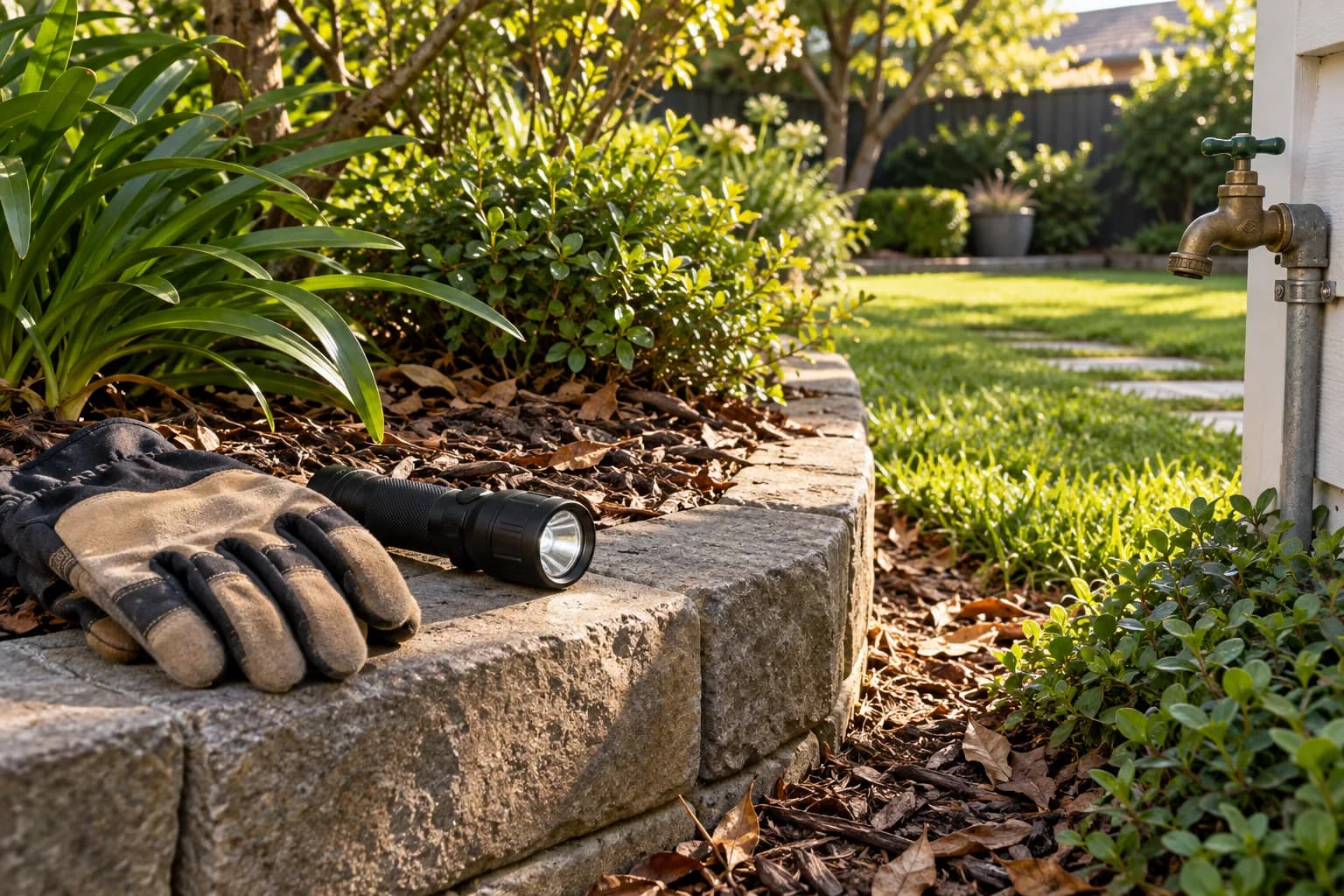 Dense shrubs against the house and a dripping hose bib give rodents cover and water. Trimming back and fixing drips makes the yard less inviting.
What affects the price of rodent work in Boca Raton homes?
Proper cleanup follows CDC guidance: ventilate for 30 minutes, wet everything with a 1:9 bleach solution, let it sit five minutes, and keep the broom away. Yard conditions matter too. Trees touching the roof need trimming before seals will hold, and exterior bait stations add a recurring service charge. The number of trap follow-up visits varies widely between companies, so ask for the count in writing. Expect a quote after the inspection rather than over the phone. The size and complexity of the roofline drives most of the price. A provider has to find and close every opening a roof rat can use, and on a two-story house with many vents, soffits and service lines, that means a lot of ladder work. With the median Boca Raton home valued near $565,000, the wiring, insulation and finishes at stake justify a careful inspection. The attic comes next. If rats have nested for months, droppings and urine-soaked insulation may need removal and replacement, often priced apart from trapping.
When does a rat problem become an emergency?
Florida health officials tie leptospirosis, salmonella and typhus to rodents, and those germs travel through urine and droppings on counters and stored food. The third is a dead rat in a wall or ceiling. In Boca Raton's heat and 74% humidity, decay odor and flies build up quickly, and the carcass has to be found and removed. A bite or scratch from a rat calls for medical advice, since the CDC lists rat-bite fever among illnesses rodents spread directly. For everything else, an inspection within a few days is reasonable. Most rodent problems are urgent rather than emergencies, but a few situations deserve a call right away. The first is chewed wiring. If you see gnawed cables in the attic or garage, or outlets and lights acting up near rat activity, treat it as a fire risk and have an electrician look as well. The second is a rat or droppings in a food area, especially in a restaurant, a daycare, or a home where someone has a weakened immune system.
What does good roof rat exclusion look like?
Mice need even less, about 1/4 inch by the CDC's measure. Sequence matters as well. Sealing while rats are still inside can trap them in the attic, so some providers trap first, or close everything except one or two openings and trap at those. Ask how the company plans to handle that order. When the work is done, you should receive photos of what was sealed and where. On a Boca Raton house that can be dozens of points, and the list lets you recheck the work after the next big storm. Good exclusion is thorough, uses the right materials, and comes with a written list. Florida health guidance names heavy-gauge steel wool, galvanized metal and steel mesh for sealing, because rats gnaw through foam, plastic and wood. Expanding foam used on its own is a warning sign. A complete job covers roof vents, ridge and soffit gaps, the points where AC lines, plumbing and cables enter, gable vents, garage door corners and gaps along the roof edge. Each one counts, since a roof rat needs only a quarter-sized hole.
What affects the price
- The number and height of roofline openings, especially where gaps hide under roof edges.
- Whether trees and dense plantings touch the house and need trimming before seals can hold.
- How long rats have lived in the attic, which decides how much insulation needs replacing.
- Exterior bait station service, which in a year-round climate often continues well past the first visit.
- Larger homes and two-story layouts that need more ladder time to inspect and seal.
- Whether cleanup of droppings and nesting material is included or priced as a separate job.
📊
What's your biggest concern about rodents?
When to call for help
Call when you hear activity in the attic more than once, find chewed fruit next to the house, or see droppings in the garage or on top of appliances. For Boca Raton homes, roof rats are rarely a one-animal problem, and with up to 8 litters possible each year, waiting a month can mean twice the work. Bring in a professional right away if wiring or AC lines are chewed, if a rat dies somewhere in the walls, or if the problem crosses into a neighbor's unit. Roofline sealing also means ladder work in serious heat, which is a fair reason on its own to hand it off.
What you can do yourself
Where DIY falls short is sealing. Roof rats use openings high on the house that most homeowners never notice, and Florida guidance calls for steel mesh, galvanized metal or heavy-gauge steel wool rather than foam. Miss one opening and the trapping never ends. A professional can also judge whether exterior bait stations make sense and place them safely. A reasonable split: trap and tidy the yard yourself, then pay for the roofline inspection and exclusion. Inside the house, trapping is a reasonable DIY step. Snap traps baited with dried fruit or peanut butter, set along attic beams and garage walls where droppings collect, will catch roof rats and mice. Pick up fallen fruit daily, keep pet food sealed, and trim branches away from the roof. Those habits alone remove a lot of food and access.
Rodents in Boca Raton
Boca Raton's tropical climate is the main reason its rodent problem never takes a break. Rain adds up to about 59 inches a year, the city sits only 13 feet above sea level, and average humidity hovers near 74%, so water and plant growth are never in short supply. For roof rats that means fruit, nesting cover and easy travel through tree canopies all twelve months. The city was founded in 1925 and is known as an affluent beach community, with a median home value around $565,000. Any tree or hedge that touches a roofline gives roof rats a route up, and the cost of ruined insulation or chewed wiring rises with the value of the house. Roughly 98,000 people live here in a suburban pattern, and Florida Atlantic University sits in the city as well. In any rental building with shared walls, rodents can move between units unless shared spaces are sealed.
Local research
Rodents in Boca Raton, FL: what the public record shows
Before you compare quotes, it helps to know which rodents actually live in Florida, when they are busiest around Boca Raton, and what the state figures look like. Everything below links to the agency or university page it came from.
Rodent species recorded in Florida
- House mouse (Mus musculus) — Enters at 1/4 inch; 5-10 litters per year; eats about 200 small meals a night.
- Norway rat (Rattus norvegicus) — Burrowing rat of basements, sewers and ground floors; tail shorter than head plus body.
- Roof rat (Rattus rattus) — Climber of attics and trees in warm and coastal regions; tail longer than head plus body.
When rodents are busiest around Boca Raton
Roof rats stay active in attics and fruit trees year-round in Florida's climate.
Florida DOH guidance: store food and feed in metal or heavy plastic containers and keep stored material at least 12 inches off the ground.
For context, nationally
- 1/4 inch (the width of a pencil) — Smallest gap a mouse can enter. CDC
- 890; 35% fatal; 94% west of the Mississippi — Hantavirus cases reported since 1993 (through 2023). CDC
Sources: Florida Department of Health in Gadsden County; CDC; Pest Notes: House Mouse; Pest Notes: Rats. Figures are quoted as the source prints them. How we check our sources
Simple ways to keep rodents away
- Pick ripe fruit promptly and clear dropped fruit every morning, since roof rats feed in trees overnight.
- Keep limbs and shrubs from touching the roof or walls so rats lose their bridge to the eaves.
- Store food, birdseed and pet food in metal or heavy plastic containers, as Florida health guidance advises.
- Raise stored boxes, lumber and outdoor gear at least 12 inches off the ground to remove hiding spots.
- Check where AC lines, cables and pipes enter the house and pack any gaps with steel mesh or metal.
- Keep tight lids on garbage and recycling bins and rinse them after hot weeks.
- Screen vents with metal mesh and replace damaged soffit panels as soon as you spot them.
 Before you call, sketch where you have seen droppings or heard noise and measure any gaps you found. It makes the first visit faster and the quotes comparable.
Did you know?
Florida health officials describe the house mouse as 3 to 4 inches long in the body, with a tail about as long again.
Murine typhus is one of the rodent-linked illnesses the CDC classes as indirect, because fleas rather than the rats themselves pass it to people.
Norway rats, the species Floridians call sewer rats, can wean 20 or more young in a single year.
Questions people ask
Why are there rats in my Boca Raton attic?
Almost always roof rats. They climb trees, fences and utility lines, then slip through roof vents, soffit gaps or openings around AC lines. Florida health officials say a roof rat needs a hole only about the size of a quarter. Boca Raton's steady warmth keeps them active in every season, so the attic is never off limits to them.
Is there a rodent season in South Florida?
Not really. Winter lows around 58F do not drive rats indoors the way frost does farther north, and roof rats stay active in attics and fruit trees all year. Activity can feel heavier when fruit ripens or after hard rain, but sealing and inspection make sense in any month.
Do roof rats carry disease?
They can. Florida health officials list leptospirosis, typhus, salmonella, rat bite fever, hantavirus and plague among illnesses tied to rodents, and they single out leptospirosis and typhus in warm, wet urban settings. Avoid touching droppings, and disinfect with a bleach solution after airing the space for 30 minutes.
Will cutting down my fruit tree get rid of rats?
Usually not, and you rarely need to. Picking fruit as it ripens, clearing what falls and trimming branches away from the roof removes most of the benefit to rats. In Boca Raton yards, sealing the house matters more, because rats will find another food source if the attic stays open.
How fast do mice breed in Florida?
Quickly. Florida health officials say a house mouse can have 4 to 7 young about once a month. A pair in the garage in spring can become a noticeable population by summer, so early trapping and sealing gaps down to a quarter inch pay off.
What should a Boca Raton rodent inspection include?
A full look at the roofline, soffits, vents and every pipe or line entering the house, plus the attic, garage and yard. The inspector should point out branches touching the roof and food sources like fruit or pet food. Ask for the findings in writing, with photos, before you agree to a plan.
Can I use poison bait in the attic?
It is risky. Rats that eat bait in an attic often die inside walls or ceilings, and in Boca Raton's heat the smell becomes intense within days. Traps let you remove the bodies. When bait is part of the plan, it usually goes outside in locked stations placed by a licensed provider.
Nearby cities
Related guides
Sources (6)
The facts in this article come from the public sources listed above. Every home is different, so ask the company you talk to about pricing and what’s included. Published by Rodent Exterminator · Updated October 11, 2026 · How we write these guides