The short version
Rodent control in Overland Park, Kansas starts with sanitation and sealing openings larger than 1/4 inch, then trapping with traps no more than 6 to 8 feet apart, as K-State Research and Extension advises. Mice stay within 10 to 30 feet of their nest, so placement matters more than trap count. Results can take up to 10 days.
- K-State says house mice stay within 10 to 30 feet of food and shelter.
- Set mouse traps no more than 6 to 8 feet apart for good coverage.
- Results can take up to 10 days, so keep traps out and checked.
- Overland Park's 22F winter lows drive mice into garages and walls each fall.
- Kansas sees zero to two hantavirus cases a year, mostly in the western half.
This guide is for Overland Park homeowners finding droppings in the garage or pantry, renters dealing with mice in an apartment or townhome, and landlords and HOA managers fielding complaints. It also helps small business owners who want to know what a provider should be doing, and anyone who has set traps for weeks without results.
What to look for
Kansas data lists two rodents that matter most in homes: the house mouse and the Norway rat. House mice are small, weighing about half an ounce according to K-State, and they squeeze through openings only slightly larger than 1/4 inch. They live within 10 to 30 feet of food and shelter, which means a mouse in your pantry is usually nesting very close by, often behind the refrigerator, in a wall, or under a cabinet. K-State's house mouse guide notes that one pair can produce more than 100,000 offspring in a year if nothing checks them, so early action matters. Norway rats are larger and burrow under decks, sheds, and along foundations. Overland Park's humid continental climate sets the timing. Summer highs near 89F and about 40 inches of rain support big outdoor populations, and winter lows around 22F push them inside. Once indoors, mice keep breeding through winter.
- 1Small dark droppings in the garage, along basement walls, or in pantry corners.
- 2Chewed holes in bags of grass seed, bird seed, or dog food stored in the garage.
- 3Light scratching in walls or ceilings at night, starting as the weather cools.
- 4Nests of shredded paper, insulation, or fabric in drawers or stored boxes.
- 5Gnaw marks on the bottom of the garage door seal or corners of wooden doors.
- 6Burrows along the foundation or under the deck, which suggest Norway rats.
Why it’s worth acting soon
- K-State estimates one pair of house mice can produce more than 100,000 offspring in a year.
- Mice chew wiring in walls, garages, and vehicles, which can cause failures or fires.
- Droppings and urine contaminate food and food-prep surfaces.
- Nests in insulation and stored belongings ruin them through urine and droppings.
- Norway rat burrows can undermine patios, steps, and slab edges.
Treatment options and typical costs
Sanitation and sealing
Quoted after inspection
Removing food sources, then sealing openings larger than 1/4 inch around doors, utility lines, garage door seals, and the foundation. K-State lists sanitation and sealing as where control starts. Ask for a written list of every opening the provider closes and the materials used.
- Time
- One visit plus a recheck
- Best for
- Homes that see mice each fall
Tight trap grid
Quoted after inspection
Snap traps placed no more than 6 to 8 feet apart along walls and in areas of activity, following K-State's spacing guidance. Because mice stay within 10 to 30 feet of their nest, close spacing makes sure traps sit inside their range. K-State notes results can take up to 10 days.
- Time
- About two weeks
- Best for
- Active mice inside the home
Bait in tamper-resistant stations
Quoted after inspection
Licensed providers may use registered baits in locked stations. K-State advises that single-dose baits should never be left exposed more than three or four days, and multiple-dose baits should be offered for at least two weeks. Ask which type is used, where stations go, and how pets and children are protected.
- Time
- Two weeks or more
- Best for
- Heavy activity or hard-to-reach areas
Exterior Norway rat work
Quoted after inspection
Inspecting for burrows under decks, sheds, and along the foundation, then setting traps or locked stations and closing burrows once activity stops. Rats forage over a wider area than mice, so placement should cover the yard. Ask how often stations will be checked.
- Time
- Several weeks
- Best for
- Rats burrowing outdoors
Prices are typical published ranges. Ask what’s included before you compare quotes.
 Crawl spaces are where rats and mice get comfortable. Vent screens, the sill plate and any gap around pipes are worth a careful look.
Why trap spacing matters: a mouse's 10-to-30-foot world.
The most useful detail in K-State's house mouse guide may be how small a mouse's world is. House mice usually stay within 10 to 30 feet of their food and shelter. They do not wander the house the way people imagine. That explains why many DIY trapping efforts fail. A homeowner sets two traps in the kitchen, catches nothing, and decides the mice are too smart. More often, the traps were simply outside the mice's range. K-State's answer is to space traps no more than 6 to 8 feet apart. In an Overland Park garage or basement, that might mean eight or ten traps along the walls rather than two. Place them perpendicular to the wall with the trigger facing the wall, where droppings are freshest. Patience matters too. K-State notes results can take up to 10 days. Check traps daily, move any that stay empty, and keep going until captures stop for several days. Once captures stop, keep a few traps in place as monitors, especially through fall and winter.
Single-dose or multiple-dose bait: what K-State says.
Bait is often the first thing people reach for, but K-State's guidance shows why it needs care. Kansas had 118 products registered for house mouse control when K-State published its guide. They fall into two broad groups. Single-dose baits can kill after one feeding, and K-State says they should never be left exposed more than three or four days. Multiple-dose baits require several feedings, and K-State says they should be offered for at least two weeks. Mixing those up causes problems. Single-dose bait left out too long increases the risk to pets and non-target animals. Multiple-dose bait pulled too early leaves mice that fed but did not get a lethal amount. There are other downsides. Mice that eat bait can die inside walls, causing odors in finished Overland Park basements and walls. Loose bait is dangerous for dogs, cats, and children. For most homes, traps plus sealing are simpler. If bait is used, it should be in locked, tamper-resistant stations placed by a licensed provider who can explain which type it is and how long it will stay out.
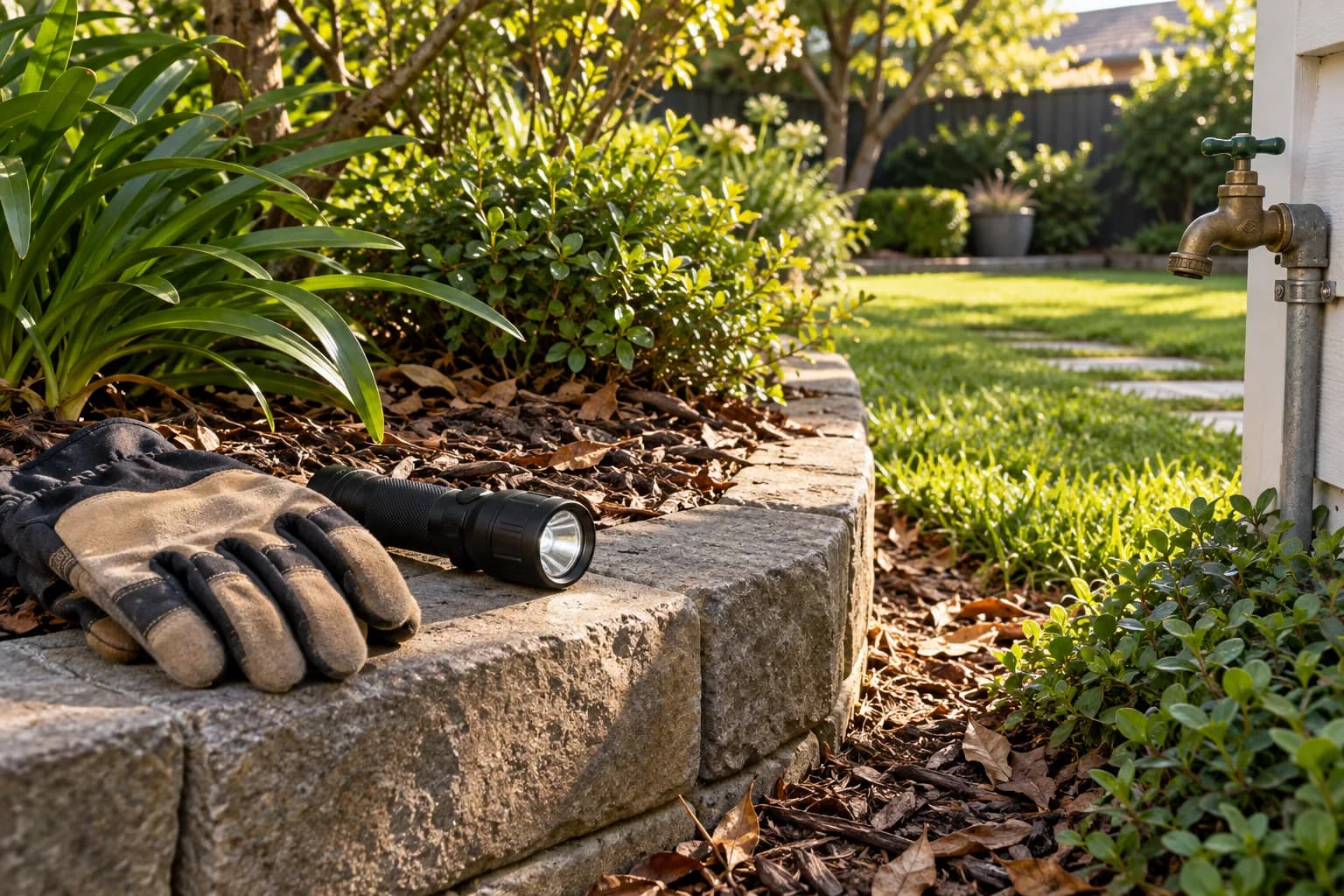 Dense shrubs against the house and a dripping hose bib give rodents cover and water. Trimming back and fixing drips makes the yard less inviting.
Fall entry in an Overland Park home: where mice get in.
Overland Park homes face a strong fall entry season. With summer highs near 89F and winter lows around 22F, mice spend summer outdoors and push indoors as the weather cools. Even newer homes have gaps. Garage doors are a frequent entry, since worn bottom seals leave openings at the corners. Garages also store bird seed, grass seed, and pet food, which draw mice in. Utility penetrations are next. Look where gas, water, cable, AC lines, and sprinkler lines pass through the walls. K-State notes mice can squeeze through openings slightly larger than 1/4 inch, so small gaps matter. The sill plate, where the house frame meets the foundation, and gaps around basement windows are also common. Dryer vents without proper covers are another route. Walk the outside of your home in late summer with a flashlight. Seal anything larger than 1/4 inch with steel wool or copper mesh plus sealant, or hardware cloth for larger openings. Replace garage door seals if you can see daylight at the corners. That work is far easier before mice move in.
Hantavirus in Kansas: what the eastern suburbs should know.
Hantavirus gets a lot of attention, and Kansas residents have reason to know about it. KDHE says Sin Nombre virus is endemic in Kansas, with zero to two cases a year and exposure mostly in the western half of the state. For Overland Park households, that means the risk is low, since KDHE ties most exposure to the western half of the state. Still, KDHE notes infections occur year-round and peak in spring and summer, when people have more contact with rodents. The practical step is safe cleanup, which also protects against other rodent-borne illnesses. The CDC recommends airing a space out for 30 minutes before cleaning, wearing gloves, soaking droppings with a bleach solution of 1.5 cups per gallon of water for five minutes, and wiping up with paper towels. Never sweep or vacuum dry droppings. If you clean a cabin, barn, or shed elsewhere in Kansas, take extra care, especially in closed spaces with heavy droppings.
Checking a Kansas pest control business license.
Kansas regulates pest control businesses under K.S.A. 2-2440, and a quick check before hiring can save trouble. The law requires a pesticide business license, with a fee of $140 per category. A business must have certified commercial applicators in each category it is licensed for, so a company licensed for structural pest work should have a certified applicator in that category. The license fee drops to $112 on and after July 1, 2028. For an Overland Park homeowner, that boils down to two questions: is your business licensed for this type of work, and who is the certified applicator on my job? A legitimate company will answer both easily. A license covers the legal side, so also ask about the plan. Will they seal openings larger than 1/4 inch, as K-State recommends? How far apart will traps be spaced? If they use bait, is it single-dose or multiple-dose, and how long will it stay out? How many follow-up visits are included? Get the plan in writing. It makes comparing quotes easier and gives you something to refer back to if mice return.
What affects the price
- Number of openings over 1/4 inch that need sealing.
- Size of the home and the number of traps needed for 6 to 8 foot spacing.
- Whether the problem includes Norway rats outside as well as mice inside.
- Number of follow-up visits needed, given results can take up to 10 days.
- Cleanup of droppings and nesting in basements, garages, or attics.
- Whether bait stations are part of the plan and how often they are serviced.
📊
What's your biggest concern about rodents?
When to call for help
Bring in help as well for droppings spread through a basement or attic, chewed wiring, or a smell of dead rodents you cannot locate. If you manage a rental, townhome community, or business, a provider's written records and building-wide approach are worth the cost. Call a provider when you have been trapping for two weeks with traps spaced 6 to 8 feet apart and you are still catching mice, since that means an entry point is still open. Signs of Norway rats, like burrows along the foundation or large droppings in the garage, are another reason.
What you can do yourself
Overland Park homeowners can handle a lot of mouse work themselves, especially with K-State's guidance. Set snap traps no more than 6 to 8 feet apart along walls where you see droppings, bait them with a little peanut butter, and check them daily. Give it about 10 days before judging results. Seal openings larger than 1/4 inch around pipes and wires with steel wool and caulk, replace worn garage door seals, and store bird seed and pet food in sealed bins. A provider makes more sense when the problem keeps returning, when you cannot find the entry point, or when Norway rats are involved. Bait is the other area where professional help pays off. K-State notes Kansas had 118 registered products for house mice at publication, and they differ in how they must be used. Single-dose baits should not stay out more than three or four days, and multiple-dose baits need at least two weeks.
Rodents in Overland Park
With a median home value around $385,000, protecting finished basements, insulation, and wiring is worth the effort of sealing before the cold arrives. K-State Research and Extension's mouse guide is the state reference to lean on, covering trap spacing, bait rules, and sealing. At about 1,086 feet of elevation in the humid continental Midwest, with average humidity near 68 percent, the city gets hot summers and cold winters, which creates a strong fall entry season. Even a newer house has gaps around garage doors, utility lines, and foundation joints that mice can use. Overland Park is an urban suburb of Kansas City with about 197,000 people, incorporated in 1960 and known for the Sprint campus.
Local research
Rodents in Overland Park, KS: what the public record shows
Before you compare quotes, it helps to know which rodents actually live in Kansas, when they are busiest around Overland Park, and what the state figures look like. Everything below links to the agency or university page it came from.
Rodent species recorded in Kansas
- House mouse (Mus musculus) — Enters at 1/4 inch; 5-10 litters per year; eats about 200 small meals a night.
- Norway rat (Rattus norvegicus) — Burrowing rat of basements, sewers and ground floors; tail shorter than head plus body.
When rodents are busiest around Overland Park
Hantavirus infections occur year-round but peak spring–summer with increased rodent exposure.
K-State's house mouse guide: one pair can produce more than 100,000 offspring in a year; control starts with sanitation and sealing openings larger than 1/4 inch.
Rules that apply in Kansas
For context, nationally
- 1/4 inch (the width of a pencil) — Smallest gap a mouse can enter. CDC
- 890; 35% fatal; 94% west of the Mississippi — Hantavirus cases reported since 1993 (through 2023). CDC
Sources: Kansas Department of Health and Environment; K-State Research and Extension; CDC; Pest Notes: House Mouse; Pest Notes: Rats. Figures are quoted as the source prints them. How we check our sources
Simple ways to keep rodents away
- Seal every opening larger than 1/4 inch with steel wool, copper mesh, or hardware cloth.
- Replace worn garage door bottom seals and check the corners for gaps.
- Store grass seed, bird seed, and pet food in sealed metal or hard plastic bins.
- Keep garage doors closed, especially in the evening during fall.
- Move firewood and stored items away from walls and off the floor.
- Trim shrubs and ground cover back from the foundation.
- Check where sprinkler lines, cable, and AC lines enter the house for gaps.
 A good rodent quote lists the inspection, the number of trapping visits, each opening to be sealed and the material for it, and any cleanup.
Did you know?
An adult house mouse weighs only about half an ounce.
The Kansas pesticide business license fee is set to drop from $140 to $112 per category on and after July 1, 2028.
About 35 percent of hantavirus cases reported in the United States since 1993 have been fatal.
Questions people ask
When do mice move into Overland Park homes?
Sealing openings in late summer and early fall keeps most of them out. Once inside, mice stay and breed through the winter. Overland Park homeowners often notice mice in garages first, then in pantries and walls. Mostly in fall, as nights cool toward the average winter low of 22F.
How far apart should I set mouse traps?
Set them along walls where droppings are fresh. House mice usually stay within 10 to 30 feet of their food and shelter, so traps spread too far apart may never be in a mouse's path. K-State recommends spacing traps no more than 6 to 8 feet apart.
How long does it take to get rid of mice?
If you are still catching mice after two weeks in your Overland Park home, look for an open entry point. Keep traps out, check them daily, and move any that stay empty. K-State notes it can take up to 10 days to see results from trapping or baiting.
Is hantavirus a risk in Overland Park?
In Overland Park, use CDC cleanup steps whenever you find droppings: ventilate, soak with bleach solution, and never sweep. Infections peak in spring and summer. Kansas averages zero to two cases a year, and KDHE places most exposure in the western half of the state, far from the Kansas City suburbs. The risk is low but not zero.
How small a hole can a mouse fit through?
Seal anything that size with steel wool, copper mesh, or hardware cloth. They weigh only about half an ounce, so gaps around pipes, wires, and garage door corners are easy entry points. K-State says house mice can squeeze through openings slightly larger than 1/4 inch.
Are there Norway rats in Overland Park?
Large blunt droppings, burrows with packed dirt, and gnawing near the ground are the usual signs, so start your search under the deck and beside the garage slab. Norway rats are on Kansas's list of structural rodents alongside the house mouse, and they burrow under decks, sheds, and along foundations. Yes.
What license should a Kansas pest control company have?
Kansas statute 2-2440 requires a pesticide business license, with a fee of $140 per category, and the business must have certified commercial applicators in each category it is licensed for. Ask any Overland Park company for its license and the name of its certified applicator.
Nearby cities
Related guides
Sources (6)
The facts in this article come from the public sources listed above. Every home is different, so ask the company you talk to about pricing and what’s included. Published by Rodent Exterminator · Updated October 11, 2026 · How we write these guides