The short version
Rodent control in Lawrence, Kansas mostly means house mice, with Norway rats in some yards. K-State's guidance is to seal openings slightly larger than 1/4 inch, keep food sealed, and set traps no more than 6 to 8 feet apart where mice travel. Expect up to 10 days before trapping shows results, and the heaviest pressure as fall cools toward 20F winter lows.
- House mice are the main indoor rodent in Lawrence, with Norway rats outdoors.
- Mice stay within 10 to 30 feet of food and shelter, so traps go close together.
- K-State says trapping can take up to 10 days to show results.
- Hantavirus is endemic in Kansas but mostly in the western half; Lawrence sits in the east.
- A Kansas pesticide business needs a certified applicator for every category it holds.
This page is for Lawrence homeowners who just found droppings in a drawer, University of Kansas students and renters dealing with mice in shared houses, landlords who handle repairs, and anyone with a garage, shed or basement that rodents seem to love. If you are deciding between doing it yourself and calling a professional, there is a fair comparison below.
What to look for
They also breed quickly, which is why a few mice in October can turn into dozens by spring. The climate sets the timing. Summers are warm and fairly humid, with 67% average humidity and about 39 inches of rain a year, which keeps outdoor food plentiful. When fall brings cold nights and winter lows near 20F, mice move indoors and settle in, and in many local homes the problem runs straight through winter inside walls, basements and garages. Norway rats follow a similar calendar but mostly stay in burrows outside, slipping into garages and basements when gaps allow. In this city, the house mouse is the rodent you are most likely to see indoors, and the Norway rat is the one most likely to dig under your shed or deck. Those are the two species Kansas sources highlight. House mice squeeze through openings only slightly larger than 1/4 inch, and they rarely travel far. K-State Research and Extension puts their home range at 10 to 30 feet, so a mouse in your pantry usually lives in the wall or cabinet right beside it.
- 1Droppings about the size of a grain of rice along kitchen baseboards or in the silverware drawer.
- 2Small chewed holes in cereal boxes, bread bags or pet food bags.
- 3Scratching in walls or ceilings at night, often starting with the first cold snap.
- 4Burrows with fresh dirt under decks, sheds or along the foundation, a sign of Norway rats.
- 5Nests of shredded paper, insulation or fabric in drawers, boxes or the back of a closet.
- 6A musty odor in cabinets or closets where mice have been nesting.
- 7A pet suddenly fixated on one spot under the stove or behind the fridge.
Why it’s worth acting soon
- Mice breed fast, so a few in October can become a much larger group by spring.
- Chewed wiring in walls, attics and appliances can cause damage or start a fire.
- Droppings and urine contaminate food and surfaces, especially in kitchens and pantries.
- Norway rat burrows can undermine slabs, steps and garden beds over time.
- Delay lets mice spread to more rooms or units, which makes control slower and costlier.
Treatment options and typical costs
Sanitation and sealing
Quoted after inspection
K-State's house mouse guide starts here: remove food sources and seal openings larger than 1/4 inch with steel wool, hardware cloth, sheet metal or sealant. Without this step, new mice keep replacing the ones you catch, especially in fall when Lawrence nights turn cold.
- Time
- Depends on how many openings the inspection finds
- Best for
- Every home with fall or winter mouse activity
Snap trapping
Quoted after inspection
Traps set no more than 6 to 8 feet apart along walls and runways, since mice seldom venture far from food and shelter. K-State notes it can take up to 10 days to see results, so a provider checks, rebaits and moves traps over several visits.
- Time
- Up to 10 days to show results, per K-State
- Best for
- Mice already inside the house
Bait in tamper-resistant stations
Quoted after inspection
Kansas had 118 products registered for house mouse control when K-State published its guide. Single-dose baits should never sit exposed more than 3 to 4 days, while multiple-dose baits are offered for at least 2 weeks. A licensed applicator should handle placement and safety.
- Time
- At least two weeks for multiple-dose baits, per K-State
- Best for
- Heavier infestations, outbuildings and exterior use
Exterior work for Norway rats
Quoted after inspection
Burrow treatment, exterior bait stations and sealing along foundations, sheds and decks. Rats are larger and warier than mice, so this work usually takes several visits and has to be coordinated with sealing any gaps into the garage or basement.
- Time
- Several weeks
- Best for
- Burrows in yards, under decks and along foundations
Prices are typical published ranges. Ask what’s included before you compare quotes.
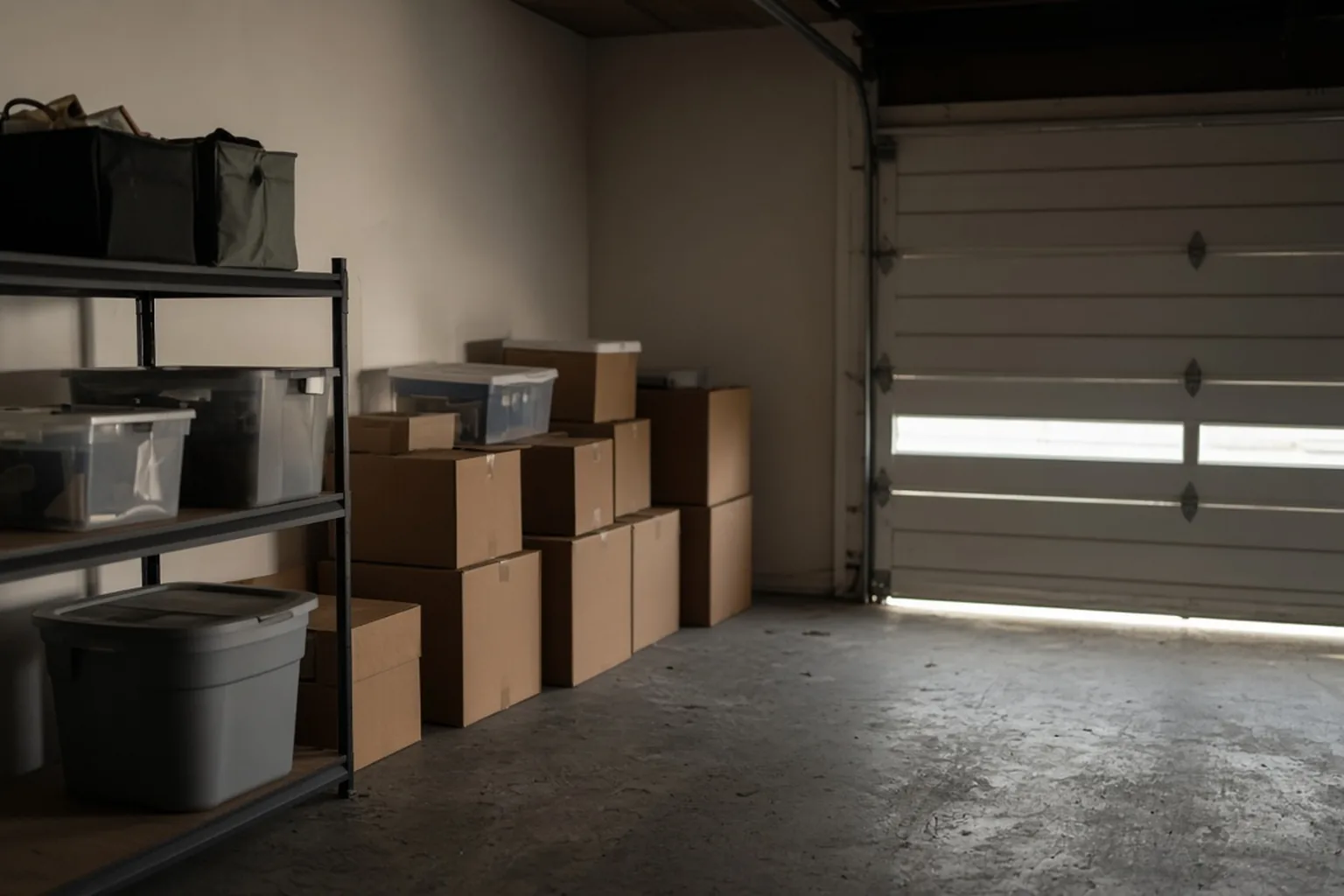 Cardboard boxes make easy nests and the gap under an overhead door makes an easy entrance. Plastic bins and a fresh door seal fix both.
Is hantavirus a real concern in Lawrence?
The Kansas Department of Health and Environment describes Sin Nombre hantavirus as endemic in Kansas, with 0 to 2 cases a year and exposure mainly in the western half of the state. Lawrence, in the east, is outside the main exposure area. KDHE also notes that infections can happen year-round but peak in spring and summer, when people have more contact with rodents. That is often when garages, sheds and cabins get opened and cleaned. The virus travels in rodent droppings, urine and nesting material, and it spreads when those are stirred into the air. So the practical advice for a Lawrence household is to clean carefully, especially in spaces that have been closed up. Ventilate for 30 minutes before you start. Wet droppings and nests with a solution of 1.5 cups of bleach per gallon of water and let it sit five minutes. Wipe up with paper towels while wearing gloves, and never sweep or vacuum dry droppings. It costs little and removes most of the risk. Mostly no, but it is worth understanding.
Mouse traps not working? Check the spacing and give it 10 days.
K-State Research and Extension recommends traps no more than 6 to 8 feet apart, because house mice live within a home range of only 10 to 30 feet and rarely wander from food and shelter. Two traps in a large kitchen leave too much ground uncovered. Set traps along walls, behind the stove and fridge, under sinks, at the back of cabinets and anywhere you see droppings. Point the trigger toward the wall so a mouse running along the baseboard hits it. Use a small amount of bait, such as peanut butter or oats. Then wait. K-State notes it can take up to 10 days to see results. Mice are curious, but they also notice sudden changes, so a trap moved every day never gets a chance to work. Check traps daily for catches, but leave them in place unless they sit empty for most of that period. If catches keep coming after 10 days in a Lawrence home, new mice are arriving, and the answer is sealing, not more traps. Most failed trapping comes down to placement or patience.
 A good inspection starts outside at ground level: door thresholds, the joint between siding and foundation, and anywhere a pipe or cable enters.
Bait or traps in a Kansas home: what K-State's guide says.
More choice does not make bait the right first step, though. K-State separates baits into two kinds. Single-dose baits can kill after one feeding, and the guide says they should never be left exposed for more than 3 to 4 days. Multiple-dose baits need repeated feeding, so they are offered for at least 2 weeks. Either way, the label rules and the risk to pets and children are real, and a mouse that eats bait indoors may die in a wall where it smells for days. For most Lawrence homes, traps inside and sealing outside handle the problem with less risk. Bait makes more sense for heavier infestations, outbuildings or Norway rats around the yard, and it belongs in tamper-resistant stations. If a company proposes bait, ask which product, whether it is single-dose or multiple-dose, where the stations will go and how often someone checks them. Rodenticide baits are easy to buy, and K-State's house mouse guide counted 118 products registered in Kansas for mouse control at the time it was published.
Norway rats in Lawrence yards: what to look for.
Instead of nesting in walls, they dig burrows under sheds, decks, slabs, compost piles and thick ground cover, then travel to food at night. The signs are mostly outdoors: holes with fresh dirt, smooth trails through grass, and larger capsule-shaped droppings near garbage or pet food. Lawrence's warm summers, with highs near 89F, and about 39 inches of rain a year keep gardens and yards productive, and rats take advantage of fallen fruit, birdseed, pet food and unsecured trash. When fall arrives, some move into garages and basements through gaps along the foundation. Rat control usually combines several pieces: removing food, sealing foundation gaps with heavy material, trapping along runways, and sometimes exterior bait stations. Rats are cautious around new objects, so expect slower results than with mice. A provider should check the whole yard, not just the house, and explain how they will handle burrows near decks and sheds. Ask how many visits that will take and what signs will tell you the colony is gone. Norway rats live differently from mice.
How a Lawrence rodent year unfolds, season by season.
Scratching at night, droppings in drawers and chewed food packaging are the usual clues. Lows near 20F keep mice indoors, nesting in walls, attics and garages until spring. Winter is when the problem shows itself. Seal before October if you can. Students moving into rentals and homeowners propping garage doors open during yard work give them extra chances. As nights cool, mice look for warmth and push through any opening slightly larger than 1/4 inch. Fall is entry season. This is the best time to clear clutter, trim plants back from the foundation and look for gaps. With highs around 89F, mice and rats live in yards, garden beds and under sheds, feeding on seeds, produce and spilled pet food. Summer is the outdoor season. Clean them wet, not dry. Garages, sheds and basements get opened and sorted, and people find nests and droppings left over from winter. Spring is cleanup season, and it is when KDHE says hantavirus exposures peak. Keep traps set and checked until catches stop for several weeks.
What affects the price
- How many openings larger than 1/4 inch need sealing, and how hard they are to reach.
- Whether Norway rats are present, which adds exterior work around decks, sheds and foundations.
- The number of traps and visits needed, given that results can take up to 10 days.
- Whether bait stations are used and how often they have to be checked.
- Cleanup of droppings and nesting material, especially in attics and basements.
- Multi-unit or shared houses where several units need inspecting at once.
📊
What's your biggest concern about rodents?
When to call for help
Bring in a professional if trapping has not reduced activity after about 10 days, if you see signs in several rooms, or if you find rat burrows along the foundation. Across Lawrence, where mice tend to settle into walls and garages for the whole winter, one missed opening means a long season of scratching. Call promptly if droppings turn up in food areas, if wiring is damaged, or if you rent and the problem crosses into other units. Before anyone applies bait, ask whether the business holds a Kansas pesticide business license and a certified applicator for that category.
What you can do yourself
If the problem is bigger than one room or involves rats, book an inspection. A licensed provider can also find openings at the roofline or foundation that are easy to miss. Getting that right around kids and pets takes care, and Norway rats are wary enough that baiting and trapping them is slow work. K-State warns that single-dose baits should not stay exposed more than 3 to 4 days, while multiple-dose baits need to be offered for at least 2 weeks. DIY gets harder with bait and rats. That approach handles a lot of fall mouse problems. Give it up to 10 days before judging results. Clean up food sources, seal openings larger than 1/4 inch with steel wool and caulk or hardware cloth, and set snap traps no more than 6 to 8 feet apart along walls where you see droppings. A mild mouse problem is a fair DIY job if you follow K-State's playbook.
Rodents in Lawrence
With a median home value around $285,000, protecting insulation, wiring and stored belongings from chewing is a practical priority for most households. When the weather turns, those well-fed mice move inside. Rain totals about 39 inches a year, keeping yards and gardens productive for rodents through the warm months. At 866 feet with a humid continental climate, Lawrence swings from summer highs around 89F to winter lows near 20F. The city's urban density means a mouse problem in one house can quickly become a neighbor's problem too. Houses of every age offer mice entry points, from worn door sweeps to utility gaps in walls. Lawrence was founded in 1854 and today has about 96,000 residents, with the University of Kansas in town.
Local research
Rodents in Lawrence, KS: what the public record shows
Before you compare quotes, it helps to know which rodents actually live in Kansas, when they are busiest around Lawrence, and what the state figures look like. Everything below links to the agency or university page it came from.
Rodent species recorded in Kansas
- House mouse (Mus musculus) — Enters at 1/4 inch; 5-10 litters per year; eats about 200 small meals a night.
- Norway rat (Rattus norvegicus) — Burrowing rat of basements, sewers and ground floors; tail shorter than head plus body.
When rodents are busiest around Lawrence
Hantavirus infections occur year-round but peak spring–summer with increased rodent exposure.
K-State's house mouse guide: one pair can produce more than 100,000 offspring in a year; control starts with sanitation and sealing openings larger than 1/4 inch.
Rules that apply in Kansas
For context, nationally
- 1/4 inch (the width of a pencil) — Smallest gap a mouse can enter. CDC
- 890; 35% fatal; 94% west of the Mississippi — Hantavirus cases reported since 1993 (through 2023). CDC
Sources: Kansas Department of Health and Environment; K-State Research and Extension; CDC; Pest Notes: House Mouse; Pest Notes: Rats. Figures are quoted as the source prints them. How we check our sources
Simple ways to keep rodents away
- Seal every gap slightly larger than 1/4 inch before October, including around pipes and dryer vents.
- Keep cereal, grains, pet food and birdseed in glass, metal or hard plastic containers.
- Fix door sweeps on exterior and garage doors so no daylight shows underneath.
- Keep woodpiles, compost and stored lumber away from the house and off the ground.
- Clean up spilled birdseed and fallen garden produce that feed mice and rats outdoors.
- In shared student houses, agree on a kitchen cleanup routine and take trash out often.
- Check basements and garages every fall for gnaw marks, droppings and new gaps.
 After sealing, a few monitors or unset traps left along the walls tell you whether anything is still getting in before you hear it again.
Did you know?
On paper, K-State says, a single pair of house mice could yield more than 100,000 offspring in a year if every generation survived.
An adult house mouse weighs only about half an ounce, according to K-State's house mouse guide.
Kansas law sets the pesticide business license fee to drop from $140 to $112 per category on July 1, 2028.
Questions people ask
When do mice come inside in Lawrence?
Sealing gaps in late summer and setting traps at the first sign of droppings keeps a Lawrence fall problem from turning into a winter-long one. Once inside, they tend to stay in walls, basements and garages all winter. Most move in during fall, as nights cool toward a winter average low of 20F.
How far apart should mouse traps be?
Put them along walls with the trigger end facing the baseboard, and give the setup about 10 days. House mice seldom travel more than 10 to 30 feet from food and shelter, so traps need to sit right on their routes. K-State Research and Extension recommends placing traps no more than 6 to 8 feet apart.
Is hantavirus a risk in Lawrence, Kansas?
Still, when cleaning droppings in sheds or garages, air the space for 30 minutes and wet everything with bleach first. Lawrence sits in the east. KDHE calls Sin Nombre hantavirus endemic in Kansas, but the state sees only 0 to 2 cases a year, with exposure mostly in the western half. The risk is low.
Is it safe to use mouse poison at home?
Indoors, traps avoid dead mice in walls; any bait belongs in tamper-resistant stations. Single-dose baits should never sit exposed more than 3 to 4 days. K-State notes 118 products were registered in Kansas for house mouse control when its guide came out, each with strict use rules. It can be risky.
Does a pest control company in Kansas need a license?
Ask any Lawrence company for its license and confirm it covers the work being proposed. State law sets the license fee at $140 per category. 2-2440, a pesticide business must hold a Kansas license and employ certified commercial applicators in each category it works in. Under K.S.A. Yes.
Why do I keep finding mice after trapping a few?
Seal first, then trap, and keep checking until catches stop for a couple of weeks. K-State notes trapping can take up to 10 days to show results, and new mice keep arriving through any gap slightly larger than 1/4 inch. Usually because openings remain or more mice are still inside.
Are Norway rats common in Lawrence?
If you see burrows with fresh dirt or larger droppings outdoors in Lawrence, treat it as a rat issue, which usually needs exterior work and patience. They burrow under sheds, decks, compost piles and foundations rather than living in walls. Norway rats are one of the two rodents Kansas sources highlight, along with the house mouse.
Nearby cities
Related guides
Sources (6)
The facts in this article come from the public sources listed above. Every home is different, so ask the company you talk to about pricing and what’s included. Published by Rodent Exterminator · Updated October 11, 2026 · How we write these guides