The short version
Rodent control in Topeka, KS starts with sanitation and sealing any opening larger than 1/4 inch, then trapping. K-State Research and Extension advises setting mouse traps no more than 6 to 8 feet apart, because house mice rarely range beyond 10 to 30 feet, and results can take up to 10 days. Mice push indoors in fall as winter lows near 19F.
- House mice and Norway rats are the two structural rodents that matter in Kansas.
- K-State says mouse traps should sit no more than 6 to 8 feet apart.
- A house mouse weighs about half an ounce and fits through gaps just over 1/4 inch.
- Single-dose baits should never sit exposed longer than 3 to 4 days.
- Kansas requires a certified applicator in every category a pest business is licensed for.
This is for Topeka homeowners who have caught one mouse and suspect more, renters who need to describe a problem clearly to a landlord, and owners of rental houses who want a plan that keeps working each fall. It also helps anyone uneasy about using poison bait around children or pets and looking for safer choices.
What to look for
The house mouse is the rodent most Topeka households deal with. It is small, about half an ounce according to K-State, and slips through openings just slightly larger than 1/4 inch. Once inside, it nests in wall voids, behind appliances, in cabinets and in stored boxes, and it rarely travels more than 10 to 30 feet from that nest. The Norway rat is the bigger problem when it shows up: a heavy burrowing rat that digs beside foundations, sheds and slabs and comes inside through garages and basements. Topeka's climate sets the schedule. Summers average around 90F, long and warm enough for outdoor populations to build, and winter lows near 19F send those rodents looking for heated space. The push starts as fall cools, and mice that get in stay through the winter, breeding in walls and garages. K-State notes a single pair of house mice can produce more than 100,000 offspring in a year, which is why control should start with sanitation and sealing rather than a single trap.
- 1Small dark droppings in drawers, under the sink or along the back of the counter.
- 2Chewed holes in cereal boxes, pet food bags or birdseed in the garage.
- 3Nests of shredded paper, fabric or insulation in stored boxes or behind appliances.
- 4Night scratching in walls or ceilings, most often from fall through winter.
- 5Burrow holes beside the foundation, shed or patio slab, a sign of Norway rats.
- 6A musty smell in closets, cabinets or the corner of the garage.
Why it’s worth acting soon
- House mice breed fast enough that a few in October can become a large colony by spring.
- Chewed wiring in walls, attics and garages is a fire hazard and costly to fix.
- Droppings and urine contaminate food, counters and stored belongings.
- Norway rat burrows can damage slabs, steps and foundations over time.
- The longer mice nest in insulation, the more of it may need replacing.
51%Midwest homeowners with a rodent encounter at any time, NPMA/Harris Poll of 2,000+ U.S. adults, 2022NPMA and The Harris Poll Treatment options and typical costs
Sanitation and exclusion
Quoted after inspection
K-State says rodent control starts here: remove food and clutter, then seal any opening larger than 1/4 inch around pipes, vents, siding joints and garage doors. A provider should show you the gaps and close them with steel wool, hardware cloth, flashing or concrete, not foam alone.
- Time
- Depends on the gaps found
- Best for
- Every home with mice, especially before fall
Snap trapping
Quoted after inspection
Traps go along walls and behind appliances, no more than 6 to 8 feet apart, the spacing K-State recommends for house mice. Since mice stay close to their nests, more traps set closer together beat a few traps spread out. Results may take up to 10 days.
- Time
- Results may take up to 10 days
- Best for
- Mice already inside the living space
Bait in locked stations
Quoted after inspection
Bait can help with heavier activity, but it has rules. K-State says single-dose baits should never be left exposed more than 3 to 4 days, while multiple-dose baits are offered for at least 2 weeks. Ask which type a provider plans to use and how stations are secured from pets and kids.
- Time
- Several days to two weeks or more
- Best for
- Larger infestations and garage or exterior use
Exterior rat work
Quoted after inspection
For Norway rats, a provider places locked stations along the foundation, fence and garage, and plans to collapse and fill burrows once activity stops. Expect follow-up visits to service stations and to confirm the burrows are not reopened.
- Time
- Until burrows stay closed
- Best for
- Rats burrowing in the yard or under a slab
Prices are typical published ranges. Ask what’s included before you compare quotes.
 Crawl spaces are where rats and mice get comfortable. Vent screens, the sill plate and any gap around pipes are worth a careful look.
Why do Topeka mice move in each fall and stay all winter?
The temperature swing explains it. Topeka summers average about 90F, and through that long warm season house mice and Norway rats live outdoors in yards, fields, gardens and garages, building up numbers. As fall cools, the attraction of a heated house grows, and by the time winter lows average 19F, a basement or wall void is the best shelter around. Mice start testing the outside of a house as nights get cooler, slipping in through gaps just over 1/4 inch around pipes, vents and garage doors. Once inside, they do not leave in spring on their own. They nest close to food and keep breeding through the winter. That pattern points to a simple plan. Late summer is the best time to seal, before the push starts. Fall is when to set traps at the first sign of activity. Winter is when to keep checking, since mice inside the walls stay active. And spring is the time to clean up droppings and recheck the house for any gaps that opened up.
How close together should mouse traps go in a Topeka home?
K-State Research and Extension gives a specific answer: no more than 6 to 8 feet apart. The reason is the mouse's small world. K-State puts a house mouse's home range at about 10 to 30 feet, and mice seldom venture far from food and shelter. A trap set across the kitchen from where a mouse lives may never be visited. In practice, that means more traps than most people expect. In a Topeka kitchen with droppings under the sink and behind the stove, you might set several traps along those walls rather than one in the middle of the floor. Place them flush against the wall, with the trigger side facing the wall, since mice travel along edges. Patience helps too. K-State says it might take up to 10 days to see results. If you are still catching mice after two weeks, the likely problem is an entry point that has not been sealed, which lets new mice keep arriving. That is the time to look for the gap or bring in a provider.
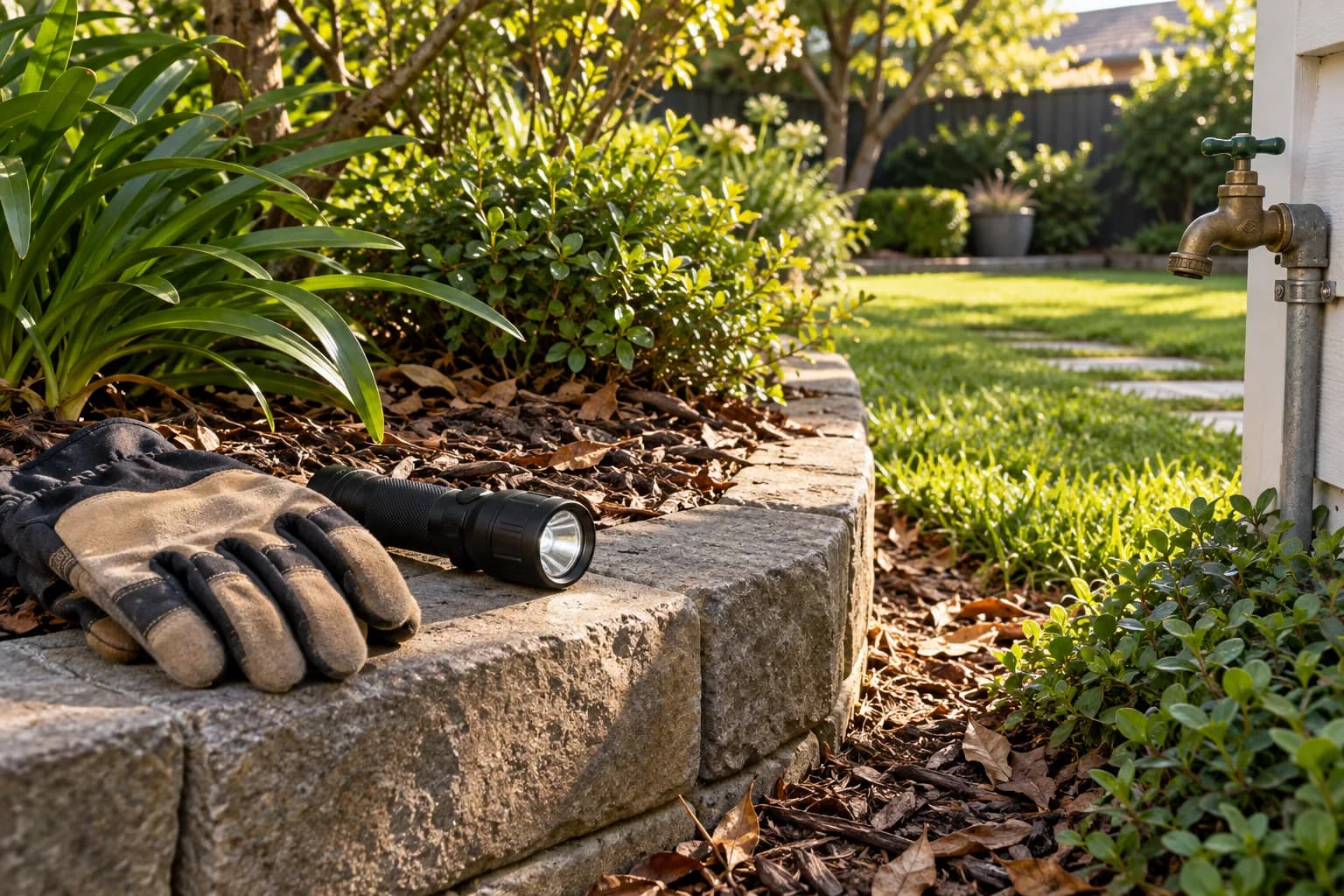 Dense shrubs against the house and a dripping hose bib give rodents cover and water. Trimming back and fixing drips makes the yard less inviting.
Single-dose or multiple-dose bait: what the difference means.
Not all rodent bait works the same way, and Kansas has plenty of options. K-State counted 118 products registered in Kansas for house mouse control at the time its guide was published. The key difference is how many feedings it takes. Single-dose baits act after one feeding, and K-State says they should never be left exposed for more than 3 to 4 days. Multiple-dose baits need several feedings and are offered for at least 2 weeks. Each type has a place, but they are not interchangeable, and leaving the wrong one out too long creates risk for pets and wildlife. For most Topeka households, bait belongs in locked, anchored stations, not loose in a drawer or garage corner. Inside the living space, traps are often better, since a mouse that eats bait may die in a wall where you cannot reach it. If a provider recommends bait, ask which type it is, where each station will go, how stations are secured, and when they will be removed.
Checking a Kansas pest control business license.
Kansas regulates pest control businesses under K.S.A. 2-2440. A business needs a pesticide business license for each category of work it does, and the fee is $140 per category, dropping to $112 on and after July 1, 2028. Just as important, the law requires a business to have certified commercial applicators in each category it is licensed for. For Topeka homeowners, that gives you a clear question to ask. Before a company places bait or stations around your house, ask for its Kansas pesticide business license and the name of the certified applicator responsible for the work. A legitimate provider will be able to answer without hesitation. It also helps to ask what products they will use and how they keep stations secure from children and pets. A provider who explains the bait type, station placement and follow-up schedule is giving you the information you need to judge the plan. Vague answers about products or licensing are a reason to get another quote.
Hantavirus in Kansas: how worried should Topeka households be?
The risk is real but low. The Kansas Department of Health and Environment says Sin Nombre hantavirus is endemic in Kansas, with 0 to 2 cases a year and exposure mainly in the western half of the state. Infections can happen any month but peak in spring and summer, when people have more contact with rodents. The virus spreads through dust from the droppings and urine of infected rodents, mainly the deer mouse. That makes cleanup method the part you control. The CDC's steps are straightforward: open the space and let it air out for 30 minutes, put on gloves, soak droppings and nests with 1.5 cups of bleach per gallon of water, wait 5 minutes, then wipe up with paper towels and bag everything. Never sweep or vacuum. For a Topeka home, the moments to be careful are opening a shed, garage, cabin or storage area that has been closed with rodents inside. For heavy contamination, hiring the cleanup is a reasonable choice.
What affects the price
- How many openings over 1/4 inch need sealing around the house and garage.
- The number of traps or stations the job calls for, given 6 to 8 foot mouse spacing.
- How many follow-up visits it takes to stop activity.
- Whether Norway rats are burrowing outside, which adds exterior stations and burrow work.
- Insulation or stored items that have to be removed after nesting.
- A one-time job versus a seasonal plan that rechecks each fall.
📊
What's your biggest concern about rodents?
When to call for help
Call a provider if you are still catching mice after two weeks, finding droppings in several rooms, or seeing burrows and rats outside. In Topeka, a Norway rat near the garage usually means a burrow nearby, and that takes exterior work beyond indoor traps. Move quickly if you find chewed wiring, smell something dead in a wall, or have small children or pets in a home where bait is being considered. Ask anyone you hire to confirm their Kansas pesticide business license and their certified applicator. For prevention, schedule sealing in late summer, before the fall push starts.
What you can do yourself
Plenty of Topeka households can handle a small mouse problem themselves. Snap traps, set no more than 6 to 8 feet apart along walls where droppings show up, often work within about 10 days, and steel wool plus caulk will close small gaps around pipes. Keep food sealed and clean droppings wet rather than sweeping. Where a provider helps most is finding and sealing every opening over 1/4 inch, especially low on the foundation, around utility lines and at garage door corners, where gaps are easy to miss. Rats are the other case for hiring out, since burrows and exterior stations need more coverage and follow-up than most people want to manage. If bait is on the table, a licensed provider can explain which of the many products registered in Kansas fits your situation and how to keep it away from pets and kids.
Rodents in Topeka
With a median home value around $145,000 in the data we compiled, rodent damage to wiring and insulation can take a noticeable share of a household's repair budget, which makes sealing early worth it. Topeka was founded in 1854, and if your house is one of the older ones in town, settled foundations, worn siding joints and old utility openings deserve a close look. Humidity around 68 percent and roughly 36 inches of precipitation a year keep yards and vegetation full enough to hide rodent runways and burrows through the warm months. It has a humid continental climate with summers around 90F and winter lows near 19F, which produces the classic pattern for rodents: a long warm season outside, then a strong fall push into heated buildings. Board of Education. Topeka is the Kansas state capital, a city of about 125,000 people best known for its role in Brown v.
Local research
Rodents in Topeka, KS: what the public record shows
Before you compare quotes, it helps to know which rodents actually live in Kansas, when they are busiest around Topeka, and what the state figures look like. Everything below links to the agency or university page it came from.
Rodent species recorded in Kansas
- House mouse (Mus musculus) — Enters at 1/4 inch; 5-10 litters per year; eats about 200 small meals a night.
- Norway rat (Rattus norvegicus) — Burrowing rat of basements, sewers and ground floors; tail shorter than head plus body.
When rodents are busiest around Topeka
Hantavirus infections occur year-round but peak spring–summer with increased rodent exposure.
K-State's house mouse guide: one pair can produce more than 100,000 offspring in a year; control starts with sanitation and sealing openings larger than 1/4 inch.
Rules that apply in Kansas
For context, nationally
- 1/4 inch (the width of a pencil) — Smallest gap a mouse can enter. CDC
- 890; 35% fatal; 94% west of the Mississippi — Hantavirus cases reported since 1993 (through 2023). CDC
Sources: Kansas Department of Health and Environment; K-State Research and Extension; CDC; Pest Notes: House Mouse; Pest Notes: Rats. Figures are quoted as the source prints them. How we check our sources
Simple ways to keep rodents away
- Seal gaps over 1/4 inch around pipes, vents and cables with steel wool and caulk.
- Replace worn garage door bottom seals and close gaps at the door corners.
- Store pet food, birdseed and grass seed in metal cans with tight lids.
- Keep boxes on shelves off the floor so droppings and nesting are easy to spot.
- Stack firewood off the ground and away from the house.
- Trim shrubs and ground cover back from the foundation.
- Check the house for new gaps every August, before mice start moving in.
 Before you call, sketch where you have seen droppings or heard noise and measure any gaps you found. It makes the first visit faster and the quotes comparable.
Did you know?
A full-grown house mouse weighs only about half an ounce, according to K-State Research and Extension.
K-State's house mouse guide says one breeding pair can produce more than 100,000 offspring in a year.
Roughly a third of U.S. hantavirus patients have died; the CDC puts the fatality rate at 35 percent across 890 cases since 1993.
Questions people ask
How long does it take to get rid of mice in Topeka?
Trapping a small problem can take up to 10 days to show results, according to K-State Research and Extension, and that assumes traps sit no more than 6 to 8 feet apart where the mice actually travel. In Topeka homes with mice already nesting in walls, sealing entry points is what keeps the problem from returning.
How small a hole can a mouse get through?
The CDC adds that rats chew small holes larger, so sealing with metal or steel wool matters. A house mouse weighs only about half an ounce and can squeeze through openings that look far too small. Only slightly larger than 1/4 inch, according to K-State, which is why any gap around a pipe or cable matters.
When are mice worst in Topeka?
That is why late summer is the best time for sealing work, before the push begins. As Topeka nights cool toward the average winter low of 19F, house mice move from yards, fields and garages into walls and basements, then stay and breed through the cold months. Fall into winter.
Are Norway rats a problem in Kansas?
If you see burrows or rats near a Topeka home, plan on exterior work, not just indoor traps. It burrows beside foundations, sheds and slabs, and it moves into garages and basements when food is around. The Norway rat is one of the two main structural rodents in Kansas, along with the house mouse. They can be.
Is rat or mouse poison safe to use at home?
Any bait should go in locked, anchored stations out of reach of pets and kids, and label directions are the law. K-State notes that single-dose baits should never be left exposed more than 3 to 4 days and multiple-dose baits are offered for at least two weeks, which shows how different products work. Only with care.
How do I clean up mouse droppings safely?
The CDC warns never to sweep or vacuum droppings, since that puts particles into the air. Bag everything and wash up afterward. Air out the space for 30 minutes, put on gloves, then soak the droppings with a bleach solution of 1.5 cups per gallon of water and wait 5 minutes before wiping up.
How much does rodent control cost in Topeka?
Ask for those items listed separately. Providers serving Topeka usually price the job after inspecting, since the cost depends on how many gaps need sealing, how many traps or stations are needed, whether Norway rats are present outside, and how many follow-up visits it takes. Prices come from the companies themselves, not from this site.
Nearby cities
Related guides
Sources (6)
The facts in this article come from the public sources listed above. Every home is different, so ask the company you talk to about pricing and what’s included. Published by Rodent Exterminator · Updated October 11, 2026 · How we write these guides