The short version
Rodent control in Rockville, Maryland comes down to Norway rats outdoors and house mice indoors, with most new problems starting between September and November. In a denser city, rats from one property can feed across several, so the plan should cover trash, compost and shared spaces as well as your own walls. Seal gaps of 1/4 inch or more, then trap what is already inside.
- Maryland's species list names Norway rats and house mice, the two rodents Rockville homes face.
- The fall entry window runs September through November.
- In attached housing, mice and rats move between units through shared walls.
- Maryland logged 2 leptospirosis cases in early 2026, up from 1 a year before.
- Sealing to 1/4 inch matters more than any trap or bait.
This page is for Rockville homeowners and renters seeing droppings or hearing activity in walls, townhouse and condo owners dealing with rodents that seem to come from next door, and property managers or HOA boards weighing a building-wide approach. It also helps small business owners near commercial areas where rats gather around trash.
What to look for
Two rodents dominate in Rockville: the Norway rat and the house mouse. Norway rats are heavy-bodied burrowers that dig along foundations, under stoops and decks, and beneath landscaping, then travel at night to food sources like trash bins, compost, bird feeders and restaurant dumpsters. They can range 100 to 500 feet from the nest, which in a dense area can span several properties. House mice live inside, in wall voids, kitchen cabinets and storage spaces, and they slip through gaps about 1/4 inch wide. The climate keeps both active most of the year. Summer highs reach about 86 degrees, rain totals about 41 inches, and average humidity sits near 65 percent, so food, water and cover are easy to find. Then fall cooling pushes rodents indoors, typically from September through November, and winter lows near 26 degrees keep them there until spring.
- 1Burrows two to four inches wide beside a foundation, stoop or patio slab.
- 2Droppings in kitchen cabinets, behind the fridge or along a shared wall.
- 3Gnawed corners on trash bins or bags torn open overnight.
- 4Scratching inside walls or the ceiling, sometimes seeming to come from next door.
- 5Grease marks along fences, walls or pipes where rats travel the same route.
- 6Rats seen at dusk near dumpsters, compost or bird feeders.
Why it’s worth acting soon
- In attached housing, a problem in one unit can spread to its neighbors.
- Rats undermine stoops, patios and walkways as burrows expand.
- Rat urine in soil and water can spread leptospirosis.
- Mice chew wiring in walls, which can create a hidden fire hazard.
- Droppings and urine contaminate stored food and kitchen surfaces.
2 vs. 1Maryland leptospirosis cases, early 2026 vs. early 2025CDC NNDSS 1/4 inchSmallest gap a mouse can enterCDC Treatment options and typical costs
Exclusion and sealing
Quoted after inspection
Closing every opening of 1/4 inch or more with steel wool and caulk, hardware cloth, sheet metal or concrete. In Rockville townhouses and condos, that includes gaps where pipes and wires pass between units, under kitchen sinks and around utility closets. Ask the provider to list each opening sealed.
- Time
- Depends on how many openings are found
- Best for
- Homes and units with recurring mice
Interior trapping
Quoted after inspection
Snap traps tucked against baseboards, under the dishwasher kick plate and inside lower cabinets wherever fresh droppings turn up. Traps are checked and reset until catches stop. In attached housing, traps work best when neighboring units are treated at the same time.
- Time
- Until catches stop
- Best for
- House mice indoors
Exterior rat program
Quoted after inspection
Tamper-resistant bait stations or traps placed near burrows and along fences, foundations and trash areas. Because rats range 100 to 500 feet, coverage should include shared spaces and trash enclosures. Ask how stations are locked and serviced, and how pets and children are kept away.
- Time
- Ongoing, on a schedule the provider sets
- Best for
- Norway rats around yards, alleys and dumpsters
Building-wide or HOA program
Quoted after inspection
Inspecting and treating an entire townhouse row, condo building or community at once, including trash enclosures, common areas and every unit with activity. This avoids the cycle of rodents moving from a treated unit to an untreated one.
- Time
- Initial service plus scheduled visits
- Best for
- Townhouse rows, condo buildings and HOAs
Prices are typical published ranges. Ask what’s included before you compare quotes.
 Under the sink is the first place to check: the hole where the pipe passes through the cabinet back is often cut much bigger than the pipe.
Why one rat problem in Rockville is often a neighborhood problem.
Trapping rats on your property helps, but if food sources nearby stay open, new rats keep coming. The most effective programs work at the scale of the problem: the townhouse row, the condo building, or a cluster of neighbors. Talk to neighbors about trash lids, compost and bird feeders. If you are in an HOA or managed building, ask whether the association has a pest control contract and whether trash areas are serviced. When you hire a provider, ask how far the inspection extends and whether they will look at shared spaces and nearby food sources. In a dense Rockville neighborhood, the rats under your stoop may be eating from a neighbor's bird feeder and sleeping under a third neighbor's deck. Norway rats commonly forage 100 to 500 feet from their nest. In a suburb with large lots, that might stay within one or two yards. In Rockville's denser areas, it can cover several homes, an alley, a shared trash enclosure and a commercial dumpster. That changes the strategy.
Mice in townhouses and condos: dealing with shared walls.
Set snap traps along walls. Then look beyond your walls. Ask neighbors whether they have seen mice. Report the problem to your HOA or property manager in writing. Building-wide treatment, with every affected unit and shared spaces inspected and sealed at the same time, is usually the only way to end it. Keep records of droppings and catches with dates. They help make the case for a broader approach. If you live in attached housing in Rockville, mice can be especially frustrating, because the source is often not in your unit. House mice travel through wall voids, pipe chases, utility closets and gaps under kitchen cabinets. In a townhouse row or condo building, those spaces connect units. You can trap every mouse in your kitchen and still find new droppings a week later. Start with your own unit. Seal gaps under sinks and around pipes, check where wires and cables enter walls, and fix door sweeps. Use steel wool and caulk for small gaps and hardware cloth or sheet metal for larger ones.
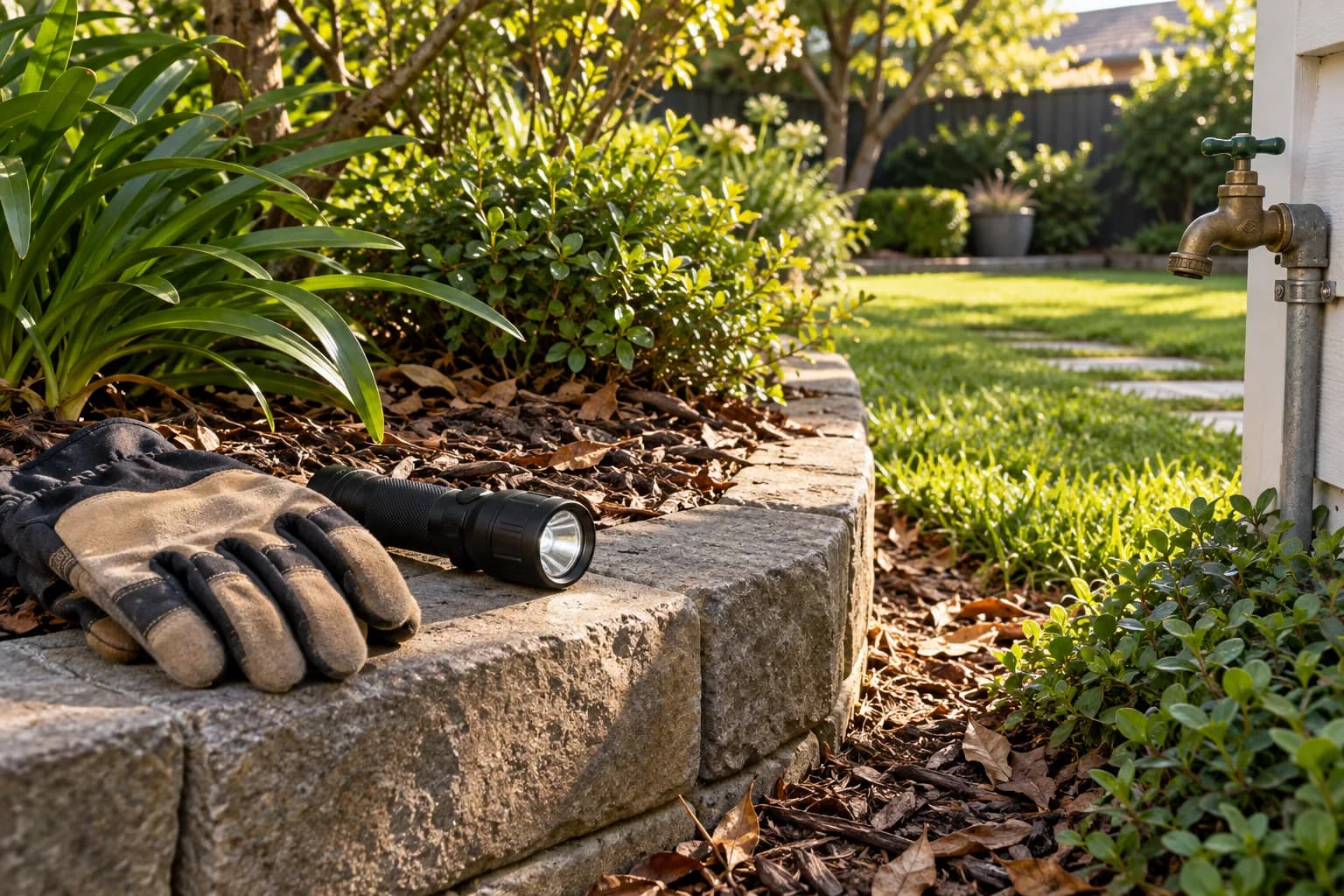 Dense shrubs against the house and a dripping hose bib give rodents cover and water. Trimming back and fixing drips makes the yard less inviting.
Leptospirosis in Maryland: small numbers, simple precautions.
For Rockville residents, a few habits lower risk. Put on gloves before you clear out a shed, garage corner or trash enclosure that rats have used. Avoid touching standing water where rats travel, and keep dogs from drinking from puddles in those areas. Wash hands after yard work near burrows. For droppings indoors, follow CDC cleanup steps: open windows and air the space out for 30 minutes, soak droppings with a bleach solution of 1.5 cups per gallon of water for 5 minutes, then wipe up with paper towels. Do not sweep or vacuum. Leptospirosis is a bacterial disease spread mainly through rat urine in water or soil. It is uncommon in Maryland, but it is one reason to handle rat cleanup carefully. The CDC counted 2 Maryland cases through early April 2026, compared with 1 at the same point in 2025. Nationally, cases among U.S. residents outside the territories were 21 versus 22 over the same weeks. The numbers are small, but rats are a key urban reservoir.
A rodent calendar for Rockville.
Rats shelter in burrows and forage around trash and compost on milder nights. March through May brings spring rain, part of Rockville's roughly 41 inches a year. Wet soil can flood burrows and push rats toward drier spots, including garages, sheds and spaces under stoops. June through August is warm, with highs near 86 degrees. Rodents forage at night and populations grow outdoors. This is the best time to seal gaps, fix door sweeps, pull mulch back from foundations, and get trash and compost under control before fall. Late August is the single most useful time to act. Rockville's rodent year follows the temperature, with a clear fall entry season and steady activity the rest of the year. September through November is the main entry period. Nights cool, and Norway rats and house mice move toward warm buildings. This is when most residents first notice droppings or hear noises in walls. December through February brings lows near 26 degrees. Mice inside stay put and keep breeding.
What a first visit should cover and how to compare quotes.
Ask how many traps will be set and where, whether exterior stations are part of the plan, and how often they are serviced. When comparing two quotes, look at scope. Does it cover the yard as well as the house? Does it include follow-up visits? Is cleanup included? Is it priced for one unit or a building? Get everything in writing, then compare what each plan actually does. A good first visit to a Rockville home is mostly inspection, and the plan that comes out of it is what you are paying for. Expect the provider to walk the outside, checking the foundation, stoops, patios, decks, trash areas and landscaping for burrows and runways. Inside, they should check kitchens, basements, utility areas and any walls shared with neighbors. In a condo or townhouse, ask whether they will look at shared spaces. The plan should name specific openings and the materials used to seal them. Steel wool and caulk, hardware cloth, sheet metal and concrete hold up. Foam alone does not.
What affects the price
- Whether you live in a single-family home or attached housing with shared walls.
- How many entry points need sealing and their location.
- Whether rats are burrowing outdoors, which adds exterior work.
- Treating one unit versus a building or community.
- Number of follow-up visits and how often stations are serviced.
- Cleanup of droppings and soiled insulation after trapping.
📊
What's your biggest concern about rodents?
When to call for help
Call a provider if you see rat burrows or rats near your home, since rats in a dense area often come from a colony that spans several properties. Call too if mice keep returning after you trap and seal, which in attached housing often means they are coming from a neighboring unit. If you are in a condo or townhouse community, talk to your HOA or property manager about a building-wide approach. Ask any company how far its inspection extends and whether shared spaces are included.
What you can do yourself
A few mice in a Rockville single-family kitchen are often a fair DIY job. Plug the small holes with steel wool, caulk over them, and keep a line of snap traps against the walls nearest the droppings, checking each morning. DIY gets harder in attached housing, where mice travel through shared walls and pipe chases you cannot reach. Rats are also harder: they burrow outdoors, avoid new objects, and range across several properties. Cutting off food is the part residents do best. Use trash bins with tight lids, keep compost closed, clean up under bird feeders, and bring pet food inside at night. Pair that with a provider for sealing in shared spaces and exterior rat work, and results usually come faster.
Rodents in Rockville
With a median home value around $585,000, homes here represent a large investment, and sealing gaps, protecting wiring and keeping insulation clean is a sensible way to protect it. Summer highs near 86 degrees and winter lows near 26 frame a clear fall entry season. At about 451 feet of elevation, Rockville gets around 41 inches of rain a year and averages 65 percent humidity, which keeps soil soft for burrowing. Where homes share walls, mice move between units, and Norway rats can forage across several properties, alleys and commercial trash areas within their 100 to 500 foot range. Its urban density shapes rodent problems. Rockville is an urban city of about 68,000 people, founded in 1801, the seat of Montgomery County and a center for biotech.
Local research
Rodents in Rockville, MD: what the public record shows
Before you compare quotes, it helps to know which rodents actually live in Maryland, when they are busiest around Rockville, and what the state figures look like. Everything below links to the agency or university page it came from.
Leptospirosis cases (YTD 2026 vs 2025, week 13)
CDC NNDSSRodent species recorded in Maryland
- House mouse (Mus musculus) — Enters at 1/4 inch; 5-10 litters per year; eats about 200 small meals a night.
- Norway rat (Rattus norvegicus) — Burrowing rat of basements, sewers and ground floors; tail shorter than head plus body.
When rodents are busiest around Rockville
Fall entry (Sept-Nov). Norway rats and house mice move indoors as temperatures drop.
Based on Rockville’s humid subtropical climate profile.
For context, nationally
- 1/4 inch (the width of a pencil) — Smallest gap a mouse can enter. CDC
- 890; 35% fatal; 94% west of the Mississippi — Hantavirus cases reported since 1993 (through 2023). CDC
Sources: CDC NNDSS; CDC; Pest Notes: House Mouse; Pest Notes: Rats. Figures are quoted as the source prints them. How we check our sources
Simple ways to keep rodents away
- Use trash and recycling bins with tight lids and keep them closed.
- Switch to a closed compost bin rather than an open pile.
- Clean up spilled bird seed or move feeders away from the house.
- Seal gaps under sinks and around pipes where they pass between units.
- Fix door sweeps on entry and patio doors.
- Keep landscaping mulch and ground cover pulled back from the foundation.
- Report rodent signs in shared spaces to your HOA or property manager promptly.
 A good rodent quote lists the inspection, the number of trapping visits, each opening to be sealed and the material for it, and any cleanup.
Did you know?
Salmonellosis is on the CDC list of diseases rodents spread directly, usually through droppings that contaminate food.
A roof rat raises three to five litters a year of up to eight young, while Norway rats manage four to six.
Only 17 provisional hantavirus cases were reported nationwide for 2025, and Maryland was not among the states listed.
Questions people ask
Why do mice keep coming back in my Rockville townhouse?
In Rockville townhouse rows and condos, a building-wide approach through your HOA or manager usually works best. Trapping and sealing your own unit helps, but if the units next door still have mice and open gaps, they will keep coming. In attached housing, mice often travel through shared walls, pipe chases and utility openings from neighboring units.
When do rodents move indoors in Rockville?
Sealing gaps in late summer is the most effective way to head off that fall push. With Rockville winter lows around 26 degrees, rodents that get in usually stay until spring. Norway rats and house mice both look for warm buildings in fall. Mostly between September and November, as temperatures drop.
Is leptospirosis a concern in Maryland?
Leptospirosis spreads through rat urine in water and soil, so wear gloves when cleaning areas rats have used and keep pets from drinking standing water where rats travel. The CDC counted 2 Maryland leptospirosis cases through early April 2026, compared with 1 at the same point in 2025. Cases are uncommon.
How far do rats travel from their nest?
That is why rat control works best when it covers food sources and shared spaces, not just one home. In a dense Rockville neighborhood, that can cover several yards, an alley and a nearby dumpster. Norway rats commonly forage 100 to 500 feet from the nest.
What size gap does a mouse need?
Expanding foam by itself is chewed through quickly. Seal with steel wool packed tight and topped with caulk, or with hardware cloth, sheet metal or concrete for bigger openings. Rats can chew small gaps larger. The CDC sets it at 1/4 inch, about the width of a pencil.
Who pays for rodent control in a condo or rental?
If you own a condo, check whether the association covers pest control in shared spaces. If you rent, report signs in writing with photos and dates. Generally, landlords and associations handle structural repairs and common areas, while residents handle food storage and reporting. It depends on your lease or HOA rules.
How much does rodent control cost in Rockville?
Ask for each part listed separately to compare quotes. Cost depends on single-family versus attached housing, how many entry points need sealing, whether rats are present, and whether the job covers one unit or a whole building. Rockville providers usually quote after an inspection, and there is no published local price.
Nearby cities
Related guides
Sources (6)
The facts in this article come from the public sources listed above. Every home is different, so ask the company you talk to about pricing and what’s included. Published by Rodent Exterminator · Updated October 11, 2026 · How we write these guides