The short version
Rodent control in Sioux City, Iowa comes down to sealing every gap a pencil fits through, then trapping whatever is already inside. Deer mice and white-footed mice move indoors in fall as outdoor food runs out, joining house mice that never leave. With winter lows near 10F, any rodent that gets in by November tends to stay until spring.
- House mice live indoors all year; deer and white-footed mice arrive in fall.
- Winter lows near 10F keep rodents in Sioux City walls and garages until spring.
- Iowa State favors paired snap traps over glue boards, first-response poison, or ultrasonic gadgets.
- Pack steel wool tight before any foam, and use metal flashing on long seams.
- Stored corn, bird seed, and pet food are the main indoor draw through an Iowa winter.
This guide fits Sioux City homeowners hearing noises in walls or finding droppings in a pantry, renters deciding what to report to a landlord, and anyone keeping bird seed, pet food, or garden seed in a garage or basement. It also helps small-business owners who spot gnawed packaging in a stockroom and want to know whether they are looking at mice or rats.
What to look for
Three mice and one rat account for nearly every rodent problem in Sioux City. The house mouse is the one that moves in for good. According to Iowa State university extension, it stays indoors year-round once inside, nesting in wall voids, behind appliances, and in stored boxes. Deer mice and white-footed mice keep a different calendar. They raise their young outdoors through spring and summer, then move into buildings as outdoor food runs out in fall. That migration lines up with the first cold snaps, and with winter lows averaging 10F, few rodents that make it inside will leave on their own before spring. The Norway rat is the heavier problem. It burrows along foundations, under slabs, and beneath woodpiles, and a female can raise four to six litters a year, according to UC IPM. Food storage is the hidden driver for all four. Iowa State notes that mice cache corn kernels and bird seed indoors to carry them through Iowa winters, so a garage full of feed bags can sustain a colony for months.
- 1Small stashes of corn kernels or sunflower seeds tucked behind stored boxes or inside a boot.
- 2Droppings the size of a rice grain along baseboards, in drawers, or under the kitchen sink.
- 3Larger, capsule-shaped droppings near the foundation or garage, which point to Norway rats.
- 4Open burrow holes in the soil along the foundation, under a deck, or beside a shed.
- 5Light scratching or running sounds in the ceiling or walls after dark, often starting in fall.
- 6Gnawed corners on feed bags, dog food, or grass seed stored in the garage.
- 7A stale, musky odor in a closet, cabinet, or basement corner that never airs out.
Why it’s worth acting soon
- House mice breed 5 to 10 times a year, so a few fall arrivals can become a winter-long population.
- Mice gnaw wiring in walls and parked vehicles, which means repair bills and a fire concern.
- Urine and droppings foul insulation and stored food, and the CDC lists salmonellosis among illnesses rodents spread.
- Norway rat burrows can loosen the soil under slabs, steps, and walkways the longer they stay active.
- Every week of delay widens the area you will eventually need to disinfect.
Treatment options and typical costs
Exclusion and sealing
Quoted after inspection
A provider walks the full exterior and closes openings 1/4 inch or larger, the threshold Iowa State uses, with steel wool packed tight under any foam and metal flashing on long seams. Because mice climb, the work should reach roof edges and attic vents, not just the foundation. In Sioux City it pays off most when done in September.
- Time
- One or two visits
- Best for
- Homes with a repeat fall mouse problem
Paired snap trapping
Quoted after inspection
Snap traps set in pairs along walls with the bait sides facing opposite directions, the method Iowa State Extension recommends. Traps get checked and moved as catches reveal travel routes. It avoids glue boards and leaves no poisoned mice decaying inside walls while the house is shut tight for winter.
- Time
- Until catches stop
- Best for
- Mice already active indoors
Norway rat program
Quoted after inspection
Rats need a wider plan because they forage well beyond the house. A provider should map burrows, place traps or locked bait stations along fences and foundations, and close gaps under doors and around utility lines. Ask how burrows near slabs will be handled and how bait is kept away from pets and children.
- Time
- Ongoing until activity ends
- Best for
- Burrows, large droppings, or gnawing outdoors
Droppings and nest cleanup
Quoted after inspection
Removing nests, droppings, and soiled insulation using the CDC wet method: air the space for 30 minutes, saturate with a 1:9 bleach solution, let it sit 5 minutes, then wipe up and bag everything. Ask whether insulation replacement is part of the price or quoted separately.
- Time
- Depends on the area affected
- Best for
- Attics, garages, and basements with heavy activity
Prices are typical published ranges. Ask what’s included before you compare quotes.
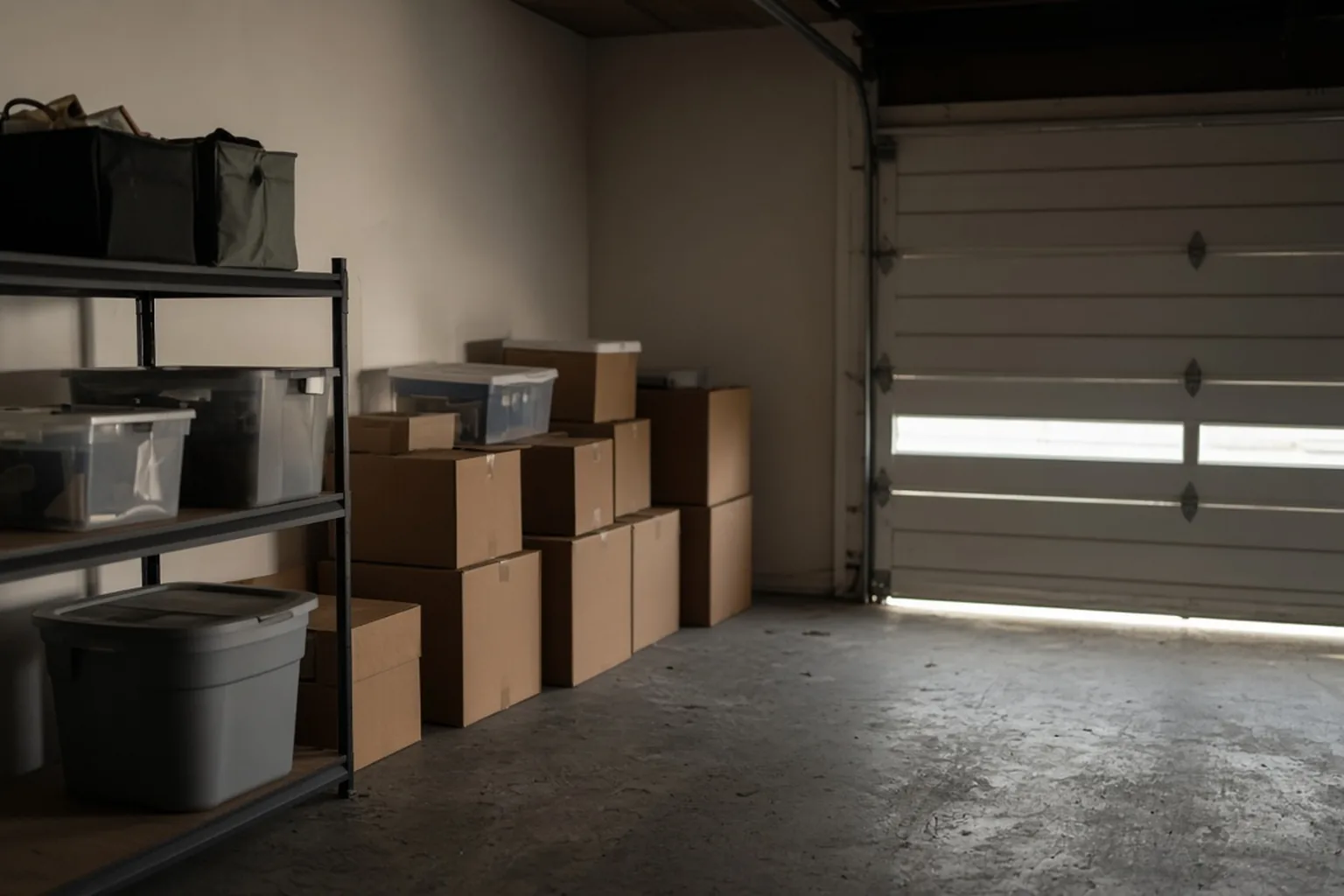 Cardboard boxes make easy nests and the gap under an overhead door makes an easy entrance. Plastic bins and a fresh door seal fix both.
Which rodents show up in Sioux City homes, and in what months?
As that food disappears in fall, they move into garages, basements, and wall voids. Both have white bellies and bigger eyes and ears than house mice, which helps you tell them apart in a trap. Winter is when the problem settles in. With lows averaging 10F, mice that got in during October tend to stay through March, living in walls and garages the whole time. Spring brings partial relief as native mice head back outside, but house mice stay put. If catches continue into April, you are dealing with a resident population rather than seasonal visitors. Expect house mice in any month and native mice from September onward. That is the short version for Sioux City. The house mouse is the year-round tenant. Iowa State university extension notes that it never leaves once inside, so a kitchen colony in July is the same colony you will have in January unless you remove it. Deer mice and white-footed mice run on a seasonal schedule. They raise their young outdoors in spring and summer, when yards, gardens, and field edges supply seeds and insects.
Why do corn kernels and bird seed keep mice in Iowa garages?
The fix is simple but strict. Move every bag of seed, feed, and pet food into metal cans with tight lids, because mice chew through paper sacks and thin plastic bins. Rake up spilled seed under feeders and around storage. Check items you rarely touch, such as camping gear and holiday boxes, since a hidden cache there means mice already have a route in. Taking the food away will not evict mice already inside, but it shortens how long they can hold out and makes a baited snap trap far more tempting. Mice in Iowa do more than eat what they find. Iowa State Extension notes that they cache corn kernels and bird seed indoors to carry themselves through winter, a bit like a squirrel filling a hollow tree. That habit explains a common Sioux City discovery: a tidy pile of seeds inside a boot, a drawer, a dryer vent, or the back of a cabinet. It also explains why the garage is so often the center of activity. A single large bag of bird seed or deer corn is a winter's supply for a family of mice.
 A good inspection starts outside at ground level: door thresholds, the joint between siding and foundation, and anywhere a pipe or cable enters.
Glue boards, poison, ultrasonic plug-ins: what Iowa State tells you to skip.
A mouse that eats bait wanders off and may die inside a wall, and in a Sioux City home shut tight against winter, the smell lingers. Bait also does nothing about the gaps that let the next mouse in. Ultrasonic plug-ins promise a lot, but mice tend to get used to the sound or simply avoid the one room the unit covers. What works is the ordinary snap trap, set in pairs along walls with the bait ends facing opposite directions, so a mouse traveling either way runs into a trigger. Place pairs where droppings appear, use a small dab of peanut butter or a few seeds, and check them daily. Combined with sealing, catches should taper off. Iowa State university extension is direct about three popular products. It advises against glue traps, against poison as a first response, and against ultrasonic devices. Each has a practical reason behind it. Glue boards catch mice slowly and often leave a live, struggling animal you then have to deal with. Dust in garages and basements also coats the surface and ruins the grip. Poison works on its own timeline.
How is a Norway rat problem different from a mouse problem?
The signs look different, too. Rats leave capsule-shaped droppings far larger than a mouse's, dig burrows in soil along foundations and under slabs, and leave greasy rub marks along walls they travel often. They are wary of anything new, so traps sometimes need to sit baited but unset for a few days before they start catching. That is why rats make a strong case for hiring help. A sound plan covers the whole lot, with traps or locked bait stations along fences and foundations, burrows dealt with, and gaps under doors and around utility lines closed. Ask how far from the house the provider plans to work. Mice live close to their food. Rats do not. Norway rats typically forage 100 to 500 feet from the nest, so a burrow behind a neighbor's shed may be the source of the gnawing in your garage. They are also prolific. UC IPM reports that a female Norway rat produces four to six litters a year and can wean 20 or more young. Iowa's list of rodents that invade homes includes the Norway rat alongside the three mice, so it belongs in any Sioux City inspection.
How do you compare two rodent control quotes for a Sioux City house?
Ask which material goes where. Trapping and follow-up. How many traps, placed where, checked how often, and what happens if activity continues after the last scheduled check? Cleanup. Is removal of droppings and soiled insulation included, and will the crew follow the CDC wet method? Keep the price in proportion. With Sioux City's median home value around $150,000, an exclusion job is a real expense, and a cheaper quote that skips the roofline can cost more over two or three falls. Ask each company for its plan in writing so you are comparing like with like. Put the quotes side by side and look past the totals. The real differences usually sit in four places. Entry points. A solid quote lists where the provider found gaps, such as garage door corners, utility penetrations, the dryer vent, and roof vents. Iowa State flags roof areas and attic vents because mice climb, so a quote that mentions only the foundation may be missing half the job. Materials. Steel wool packed tight before foam, plus metal flashing on long seams, costs more than a quick bead of foam, and it lasts.
What affects the price
- How many openings of 1/4 inch or more turn up around the foundation, siding, and utility lines.
- Whether roof edges and attic vents need sealing, which adds ladder work.
- Rats versus mice, since rats call for traps or stations spread across the whole lot.
- The volume of soiled insulation or stored goods that has to come out.
- Detached garages, sheds, or outbuildings where feed and seed are kept.
- How many follow-up trap checks the plan includes.
📊
What's your biggest concern about rodents?
When to call for help
Bring in a provider when the signs point to rats rather than mice, since rats range widely and need property-wide control. Call too if catches keep coming after two weeks of steady trapping, if you hear activity in the attic or high inside walls, or if you cannot find where mice are getting in. Mice that slip into a Sioux City home in October can breed for months behind closed-up walls, so a December call usually means a bigger job than a September one. A heavily soiled attic or crawlspace is another good reason to hand off the work, because the CDC cleanup steps are harder to follow safely in tight, dusty spaces.
What you can do yourself
Doing it yourself works well for a few house mice in an otherwise tight home. Set snap traps in pairs along walls with the bait ends facing opposite directions, as Iowa State suggests, and check them every morning. Pack steel wool into gaps around pipes, seal over it, and move bird seed and pet food into metal cans. That combination handles a lot of Sioux City kitchens. DIY falls short in a few situations. Rats are harder, because they are wary of new objects and their burrows can run under slabs you cannot reach. Gaps along the roofline and attic vents mean ladder work many people would rather skip. And if mice return every fall, the real entry points have not been found, which is the main thing a careful inspection pays for. Either way, skip the ultrasonic plug-ins and glue boards, since Iowa State advises against both.
Rodents in Sioux City
Sioux City is an urban river city of about 85,000 people on the Missouri River, founded in 1854 and long known for meatpacking. Its humid continental climate brings summer highs near 85F, winter lows around 10F, average humidity of about 70%, and roughly 28 inches of rain a year at an elevation of 1,102 feet. For rodents, the cold is what matters most. Native mice spend the warm months outdoors, and when temperatures drop and seeds run out, buildings are the nearest refuge. Humid summers and steady rainfall keep gardens and yards producing seed right up to the fall turnover, so mouse pressure tends to arrive all at once. With a median home value around $150,000, replacing chewed wiring or soiled attic insulation can be a large bill relative to the house, which makes sealing early a better deal than repairing later. Iowa State university extension is the closest expert reference, and its advice leans on exclusion and snap traps.
Local research
Rodents in Sioux City, IA: what the public record shows
Before you compare quotes, it helps to know which rodents actually live in Iowa, when they are busiest around Sioux City, and what the state figures look like. Everything below links to the agency or university page it came from.
Rodent species recorded in Iowa
- House mouse (Mus musculus) — Enters at 1/4 inch; 5-10 litters per year; eats about 200 small meals a night.
- Norway rat (Rattus norvegicus) — Burrowing rat of basements, sewers and ground floors; tail shorter than head plus body.
- Deer mouse (Peromyscus maniculatus) — Primary U.S. hantavirus carrier; lives throughout Washington and the interior West.
When rodents are busiest around Sioux City
Deer and white-footed mice move into Iowa buildings as outdoor food runs out in fall.
Mice cache corn kernels and bird seed indoors to get through Iowa winters, so stored feed and seed are the main draw.
For context, nationally
- 1/4 inch (the width of a pencil) — Smallest gap a mouse can enter. CDC
- 890; 35% fatal; 94% west of the Mississippi — Hantavirus cases reported since 1993 (through 2023). CDC
Sources: Iowa State University Extension and Outreach, Natural Resources; CDC; Pest Notes: House Mouse; Pest Notes: Rats; Hantavirus. Figures are quoted as the source prints them. How we check our sources
Simple ways to keep rodents away
- Keep corn, bird seed, grass seed, and pet food in metal cans with tight lids.
- Run a pencil test each September along the foundation, garage door, and utility lines.
- Pack steel wool into gaps first, then cover it with foam or caulk so it stays put.
- Screen attic and roof vents with hardware cloth, since mice climb siding and downspouts.
- Mow a bare or short strip along the foundation so rodents lose cover.
- Stack firewood and lumber off the ground and away from exterior walls.
- Use trash and compost bins with locking lids to cut off easy food for Norway rats.
- Fill bird feeders lightly in fall and rake up the spilled seed beneath them.
 A good rodent quote lists the inspection, the number of trapping visits, each opening to be sealed and the material for it, and any cleanup.
Did you know?
Tularemia and rat-bite fever both appear on the CDC's list of diseases rodents can pass directly to people.
Roof rats, the climbing relatives of Norway rats, have three to five litters a year of up to eight young each, according to UC IPM.
Plague still turns up in the United States, averaging about seven human cases a year, spread by fleas on wild rodents in parts of the Southwest and Far West.
Questions people ask
When do mice start coming into houses in Sioux City?
Mostly from September through November, as deer mice and white-footed mice lose their outdoor food supply. Iowa State Extension describes these native mice as seasonal movers that raise young outside and come in for winter. For Sioux City homes, sealing gaps in early fall beats trapping in December, because winter lows near 10F keep them indoors once they arrive.
Are glue traps a good idea for mice in Iowa?
No. Iowa State university extension advises against glue traps, along with ultrasonic devices and poison as a first response. Its recommended tool is the plain snap trap, set in pairs along a wall with bait sides facing opposite ways so a mouse running in either direction meets one. Snap traps also make it obvious when the problem is over.
Is hantavirus a concern in Sioux City?
The risk is low, but worth careful cleanup habits. The CDC reports that 94% of U.S. hantavirus cases since 1993 occurred west of the Mississippi, though Iowa was not among the 11 states with provisional cases in 2025. Deer mice carry the virus, so handle droppings in garages and sheds with care.
How can I tell if I have mice or rats?
Check the droppings and the damage. Mouse droppings are about the size of a rice grain, while Norway rat droppings are much larger and blunt at the ends. Rats also dig burrows beside foundations and under sheds. If you find large droppings near a Sioux City garage or open burrows in the yard, plan for property-wide rat control rather than a few mouse traps.
Why does my garage attract mice every winter?
It offers food and shelter together. Iowa State notes that mice stash corn kernels and bird seed indoors to survive Iowa winters, and a garage holding feed bags is ideal for that. The door seal is often the weakest gap. Move seed into metal cans, adjust the seal so it meets the floor, and set paired traps along the walls.
What is the safe way to clean up mouse droppings?
Wet, never dry. The CDC says to air the space out for 30 minutes, spray droppings with 1.5 cups of bleach per gallon of water, wait 5 minutes, then wipe with paper towels and bag the waste. Sweeping or vacuuming throws particles into the air. In a closed Sioux City basement in midwinter, open windows briefly before you start.
Should I put rodent poison in my house?
Usually not as a first step, and Iowa State lists poison as a first response among the approaches it advises against. A mouse that eats bait can die in a wall or attic, where it smells for weeks. In a Sioux City house sealed up against 10F nights, that odor has nowhere to go. Trap first, then seal the gaps.
Nearby cities
Related guides
Sources (6)
The facts in this article come from the public sources listed above. Every home is different, so ask the company you talk to about pricing and what’s included. Published by Rodent Exterminator · Updated October 11, 2026 · How we write these guides